

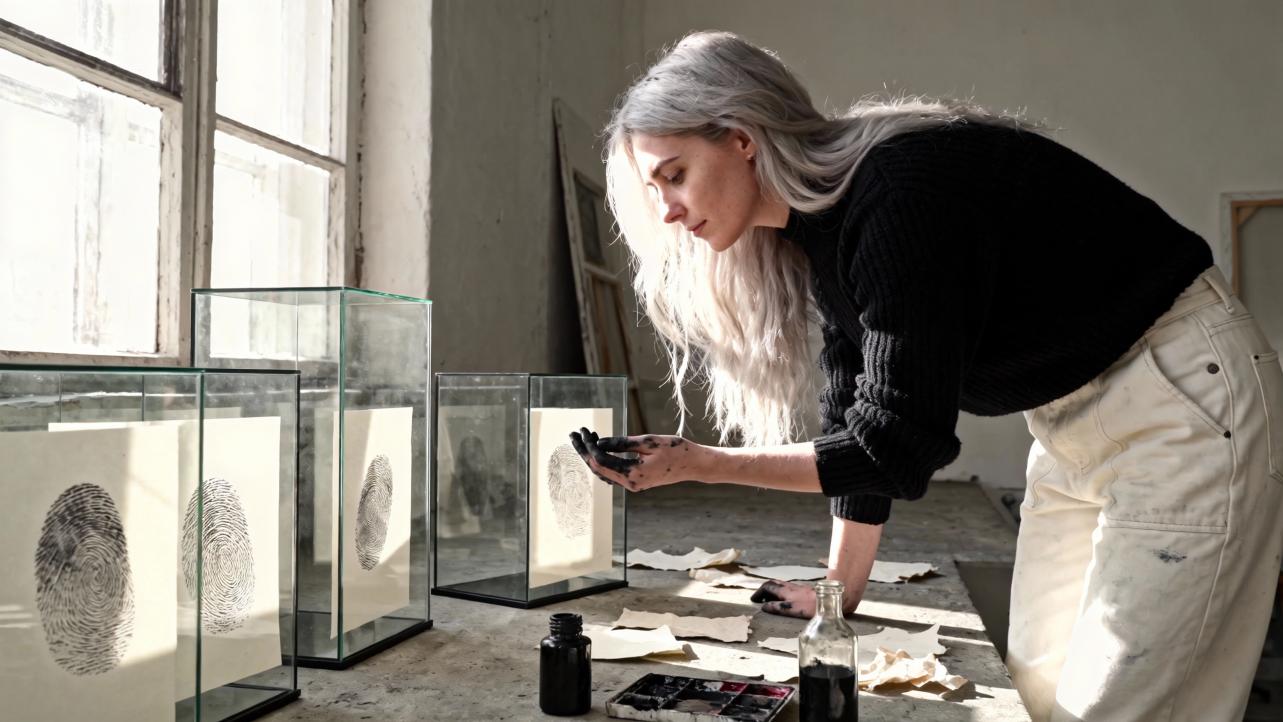
Transforming Fingerprints into Unique Artistic Expressions with AI
There is something quietly magical about a fingerprint. It is the tiny swirl you leave on a fogged window, the smudge on a favorite mug, the invisible trace of every hand-held hug. As an Artful Gifting Specialist and Sentimental Curator, I like to think of fingerprints as the poetry of our touch: small, intricate, and completely personal.
Today, thanks to artificial intelligence, those intimate patterns can be transformed into art that feels as singular as the person it celebrates. Not generic “tech art,” but keepsakes that carry both emotional weight and scientific wonder: wedding gifts built from two intertwined fingerprints, a wall canvas made from a loved one’s touch, or a memorial piece that turns biometric traces into a luminous tribute.
In this guide, we will walk through how AI can turn fingerprints into expressive artworks, what the science and ethics behind these creations really look like, and how you can commission or create these pieces in a way that is as safe as it is heartfelt.
From Forensics to Feelings: What Fingerprints Mean in the Age of AI
For more than a century, fingerprints have been associated with law enforcement and identity checks. They were framed as the ultimate proof that “no two people are alike.” Modern AI research has added nuance to that belief. Work from Columbia Engineering and collaborators shows that fingerprints from the same person share recognizable patterns and that AI can learn to spot those patterns with notable accuracy. In one study, a deep-learning system correctly guessed whether two fingerprint images came from the same person roughly three-quarters of the time and became even more reliable when it could compare several images together.
This does not mean the romantic notion of uniqueness is wrong; it means the story is more complicated and more interesting. Your fingerprints are part of a recognizable pattern family, but the chance that someone shares your full life, relationships, memories, and emotional history is essentially zero. When we use fingerprints in sentimental art, we are not just using a biometric identifier. We are using a symbol of continuity: the same fingertips that held a newborn, gripped a steering wheel on the first solo road trip, or intertwined with a partner’s hand.
AI takes that symbol and helps us see it differently. Scientists at Argonne National Laboratory, for example, use AI to generate “material fingerprints” from X‑ray scattering data, compressing complex patterns into compact signatures that help them study how materials move and change. Researchers at Case Western Reserve University create 3D maps of paint surfaces and use neural networks to identify an individual painter’s brushstroke at almost the level of a single bristle, describing those microscopic textures as “almost like a fingerprint.”
In the art market, companies like Hephaestus (now part of ArtDiscovery) build multi-dimensional “fingerprints” of artists’ styles, extracting over a million features from high‑resolution images and compressing them into about a hundred key dimensions. Their system reportedly distinguished between works by Canaletto and his apprentice Bellotto with more than 98% accuracy in one case study, helping experts authenticate paintings and detect forgeries.
Across forensics, materials science, and art history, one idea keeps resurfacing: a fingerprint is any pattern that is stable, distinctive, and deeply tied to identity or authorship. When we turn literal fingerprints into AI art, we are joining a larger cultural conversation about what it means to see a person in their patterns.

What Is AI Fingerprint Art, Really?
In the world of personalized gifts, “fingerprint art” usually means that someone’s actual fingerprint (or a fingerprint-like pattern) becomes the raw material for a visual composition. AI fingerprint art goes one step further: it uses algorithms to transform that pattern into something rich, abstract, and often impossible to produce by hand within a reasonable time.
A helpful starting point is biometric art more broadly. A personalized canvas-print maker describes biometric art as using someone’s heartbeats, fingerprints, or voice patterns to generate visual artworks. They capture the data with tools like high‑resolution fingerprint scanners, heart monitors, or microphones, convert it into digital form, and then feed it into software that turns those measurements into shapes, colors, and textures. The result might be a canvas for a living room, a piece in a bedroom, or an office focal point that quietly encodes a person’s identity.
This focus on extreme personalization is what makes biometric art so powerful as a gift. The same provider notes that each piece is one‑of‑a‑kind because it is literally generated from the individual’s own traits, and that these artworks become instant conversation starters. Guests want to know what the swirling lines stand for; the owner gets to tell the story.
AI simply gives artists more ways to translate those lines into visual language. A gallery of AI‑generated fingerprint art on NightCafe, for instance, showcases images built from organic, fingerprint-like patterns that feel both digital and deeply human. The collection emphasizes that no two designs are exactly alike and presents it as “AI-enhanced individuality,” where algorithms amplify personal expression rather than flatten it.
Other biometric artworks push beyond fingerprints to irises and brain waves. In the piece “Eyes,” an artist uses iris recognition and image-processing techniques to convert the unique pattern of a person’s iris into sound and 3D animated visuals, even 3D‑printing physical sculptures of those patterns. The DATA‑ART‑SKILLS project transforms EEG brainwave data from festival-goers tasting a new beer into playful visualizations, complete with personalized classifications and QR codes guests can take home.
Seen together, these projects show a consistent pattern: capture something intimate and invisible, translate it into visual or sonic form, and give it back to the person as a mirror of who they are. Fingerprint AI art is one especially accessible, gift-friendly branch of this broader movement.
How AI Turns Fingerprints into Art
While every studio has its own process, many fingerprint‑to‑art journeys follow a similar arc: capture, translate, and refine.
First comes capture. Some artists work with high‑resolution fingerprint scanners, just as the biometric print maker describes, while others accept a clear ink impression that you photograph and send. The core requirement is enough detail in the ridges and swirls to give the AI something to work with.
Next comes translation. The raw fingerprint is digitized and cleaned so that smudges and dust do not confuse the algorithm. Then it is fed into software that may combine several AI techniques. Research on AI-generated anime and Ghibli-style art, for example, highlights how deep-learning models such as generative adversarial networks and variational autoencoders can transfer a distinct visual style onto a photo. Similar families of models can take the line structure of a fingerprint and reimagine it in different aesthetics: minimal black‑and‑white linework, flowing watercolor-like gradients, or luminous, otherworldly textures.
On platforms like NightCafe, you see the product of these techniques: spiraling fingerprint forms rendered as glowing galaxies, intricate labyrinths, or delicate botanical shapes that still echo the original ridges. Each time the AI runs, it explores variations, which is why the gallery emphasizes that no two designs are identical.
Finally comes refinement. Human creators still matter here. Studies of public perception show that people tend to rate an artwork higher when they believe it was made by a human rather than AI, even when the images are identical. Audience research in museum-like settings finds that visitors enjoy interactive AI-driven experiences but often feel they lack the emotional depth and personal narrative of traditional art unless the artist’s story is clearly communicated.
In thoughtful fingerprint art, the human guiding the AI acts as storyteller and curator. They choose color palettes that suit the occasion, make composition decisions that prioritize legibility or abstraction, and weave your narrative into the piece. AI does the heavy lifting of pattern transformation; the artist ensures the result feels like you.

Gift Ideas: Where Fingerprints and Feelings Meet
Fingerprints are naturally suited to marking milestones and relationships, because they come from touch. When you wrap an occasion in that symbolism, you give the recipient more than a pretty picture; you give them a story they can tell every time someone asks about the artwork.
Here are a few emotionally rich directions fingerprint‑based AI art can take.
You can commission a couple’s piece that blends two fingerprints into one composition to celebrate an engagement, wedding, or anniversary. The ridges might intertwine, echoing the way two lives weave together, while AI adds color washes that mirror the couple’s aesthetic: soft neutrals for a calm, grounded relationship, or jewel tones for something more vivid and dynamic.
For new parents, a tiny fingerprint from a baby, transformed into large‑scale art, captures that fleeting sense of “they were so small once.” Biometric canvas providers already highlight how such pieces work beautifully as nursery focal points or bedroom art that feels deeply personal.
For families spread across cities or countries, you might create a multi‑panel work that uses fingerprints from different family members, each panel rendered in a style that suits their personality, then hung together as a unified set. The result becomes a kind of visual family tree, built from the lines that literally tie you together.
There is also powerful potential in memorial pieces. A fingerprint taken from a cherished object or paperwork can be transformed using AI into a soft, contemplative artwork that keeps a loved one’s presence visible without being overtly literal. Because each biometric print is one‑of‑a‑kind, it can become a deeply comforting heirloom.
To spark your imagination, you can think of the options in terms of biometrics, formats, and occasions.
Biometric Pattern |
AI Art Format |
Occasion or Use |
Emotional Flavor |
Fingerprint lines |
Canvas or metal wall art |
Weddings, anniversaries, family gifts |
Tangible touch, togetherness |
Fingerprints plus text (names, vows, lyrics) |
Framed print or album cover |
Vows, first dance song, personal mottos |
Storytelling and shared memory |
Fingerprint-based abstract pattern |
Office or studio art |
Career milestones, new home |
Identity and confidence |
Iris or heartbeat data alongside fingerprints |
Mixed-media or digital frame |
Births, healing journeys, personal growth |
Inner life made visible |
These ideas are just starting points. The heart of a meaningful fingerprint artwork is not the technology; it is the story you want it to hold.

The Emotional Power of Biometric Gifts
Why do people respond so strongly to biometric art? Part of the answer is cognitive, and part is emotional.
On the cognitive side, biometric art is novel. A personalized canvas-print company notes that guests often find these works captivating because they invite questions: whose heartbeat is that, whose fingerprint, whose voice pattern? That curiosity opens a doorway for the recipient to share stories and memories, turning the artwork into a narrative device rather than static decor.
On the emotional side, biometric art reinforces identity and connection. When your own fingerprint becomes an artwork, you see yourself as worthy of being “on the wall,” not just as a face in a photo but as a pattern that belongs uniquely to you. For couples and families, sharing biometric patterns can feel like saying, “Here is how deeply our lives are entwined,” in a visual language that transcends words.
In immersive performances, researchers have found that sharing biometric data like heart rate between performers and audiences can deepen engagement and a sense of shared vulnerability. Projects documented in the human–computer interaction literature use heartbeats, breath, or muscle activity to drive music and visuals in real time, giving participants a visceral sense that their body is part of the artwork. Your fingerprint art does something similar, on a quieter scale: it tells the recipient, “You are woven into this piece.”

Ethics, Privacy, and Trust When Art Uses Your Fingerprint
Turning fingerprints into art is not just a creative act; it is a biometric act. That carries real responsibilities, both for artists and for gift-givers.
Scholars studying AI-generated art warn that using sensitive data such as facial images, biometrics, health records, or genetic information in training sets can create serious privacy risks. If platforms are insecure or poorly governed, data breaches could expose identities and enable misuse, from identity theft to deepfake production. Research on biometric art and facial recognition politics points to the way “datafied” faces can be repurposed far beyond their original context, as surveillance tools rather than creative materials.
Even outside art, AI “fingerprints” raise ethical stakes. Work at Binghamton University shows how AI can detect deepfake images and audio-video recordings by exploiting telltale fingerprints in frequency patterns or electrical network noise, with tools like GANIA and DeFakePro. Brookings researchers describe watermarking and other detection techniques as “AI fingerprints” that help label machine-generated content and combat misinformation, but also stress that no detection method is foolproof, especially against motivated adversaries.
This broader picture matters because it shows two truths at once. First, biometric and AI fingerprints can be used to protect authenticity, as in art authentication platforms like Peggy, which creates AI-based “digital fingerprints” of physical artworks from brushstrokes and canvas texture to verify provenance and track royalties. Second, the same kinds of technologies can be turned toward surveillance, tracking, or deception if deployed irresponsibly.
When fingerprints become art, you are putting a piece of sensitive data into an ecosystem where its future depends on human choices. A thoughtful biometric art provider recognizes this and emphasizes strong safeguards: encrypting stored data, restricting access, being transparent about how data is used and how long it is kept, and treating consent as central and revocable.
Artists and commissioners can take cues from these recommendations. Before sharing a fingerprint, it is wise to ask a few straightforward questions. How will the file be stored and protected? Will it be reused to train any AI models beyond your artwork? Who can see it, and for how long? Can you request that the raw data be deleted after the final piece is delivered?
Projects like “Eyes” and DATA‑ART‑SKILLS also highlight the importance of storytelling and context. They explicitly address concerns about privacy and biometric misuse, inviting viewers to reflect on how their bodies are encoded and what happens when those encodings circulate. Including a short printed note with your gift that explains how the fingerprint was processed and how the data is (or is not) retained can transform anxiety into informed trust.
Pros and Cons of AI Fingerprint Art for Gifts
As with any emerging creative medium, AI fingerprint art comes with both bright possibilities and real trade-offs. Thinking through them helps you choose the right approach for the right moment.
Aspect |
What You Gain |
What To Watch |
Personalization |
Each piece is generated from one person’s biometric data, making it deeply individual and emotionally resonant. |
Over-promising absolute “uniqueness” can be misleading; AI can produce similar styles across different inputs, and scientific work shows that even fingerprints have patterns in common. |
Storytelling |
The art becomes a built-in conversation starter, inviting stories about relationships, milestones, and memories. |
Some recipients may be uneasy about biometrics or AI; explaining the process and intentions helps avoid discomfort. |
Creative range |
AI opens up styles that would be extremely time-consuming by hand, from intricate patterning to subtle color morphs. |
Public perception research finds a bias against AI-labeled art; pairing AI with visible human craftsmanship can mitigate this. |
Longevity |
High-quality prints, especially on canvas or metal, can become heirloom pieces that travel with a family over years. |
Technology and tastes change; choosing designs that feel timeless rather than overly “techy” can keep the piece meaningful longer. |
Ethical alignment |
Working with vendors who follow strong privacy practices can align your gift with your values around consent and data protection. |
Weak governance of biometric data could expose fingerprints to misuse; carefully vetting providers is essential. |
The goal is not to eliminate every risk—that is impossible in any domain—but to match the intimacy of the data with equal care in how it is handled.
Practical Advice: Commissioning or Creating Fingerprint AI Art
If you feel drawn to this kind of gift, here are practical ways to make the experience smooth, safe, and emotionally rich.
Start by clarifying the story you want the piece to tell. Is this about two lives joining, a family’s shared home, a friend’s resilience, or a loved one’s memory? The clearer your emotional intention, the easier it becomes to guide stylistic choices: bold vs. subtle, monochrome vs. colorful, literal vs. abstract.
When capturing the fingerprint, follow the artist’s instructions carefully. A biometric canvas-print studio notes that they use specialized scanners for high‑resolution fingerprints, but many independent artists can work from a simple ink impression photographed in good light. If you are privacy-conscious, you might choose to send only part of the fingerprint or a stylized version, while keeping the full original private.
Discuss the role AI will play. Some creators use AI primarily as a style-transfer tool, similar to the systems that transfer a Ghibli-like aesthetic to photographs, while others build more generative systems that synthesize entirely new patterns based on your fingerprint lines. The AI art perception research reminds us that viewers respond best when they understand the human artist’s journey. Ask the maker how they collaborate with AI, what decisions they make by hand, and whether they can share a short process note to accompany the gift.
Talk openly about data handling. Ground your questions in the ethical guidance offered in discussions of biometric art and AI governance: seek transparency, accountability, and the ability to opt out. Ethical recommendations from AI-art scholars include building robust governance frameworks, fair data management, and unbiased algorithms. In the context of your gift, that translates into simple things like written assurances that your fingerprint file will not be used to train unrelated models, that it will not be shared with third parties, and that it will be deleted on request.
If you are experimenting at home with consumer AI tools, remember that some platforms may keep uploaded images and use them to refine their models. Check the terms of service, consider masking parts of the fingerprint or adding noise before uploading, and avoid reusing the same exact file for sensitive purposes like official documents or device unlocking.
Finally, think about presentation. A small fingerprint-based artwork might belong in a quiet corner of a bedroom, while a bold, colorful piece could sit proudly in an entryway or office. Including a handwritten note that explains what the pattern represents often becomes as treasured as the art itself.
Frequently Asked Questions
Is it safe to share my fingerprint for an artwork?
Biometric data is inherently sensitive. Research on AI and biometrics highlights risks if such data is mishandled, including identity theft and the creation of convincing deepfakes. That does not mean you must avoid biometric art altogether, but it does mean you should choose partners carefully. Look for creators who explain how they secure files, who can delete your data on request, and who commit not to reuse your fingerprint beyond your artwork. If you remain worried, consider commissioning a piece that stylizes the fingerprint heavily or uses only a partial pattern.
Will an AI-made fingerprint artwork feel “less real” than traditional art?
Audience studies show that people often rate identical artworks lower when told they are AI-made, even if they enjoyed them beforehand. At the same time, visitors in interactive art settings report strong enjoyment of AI-driven experiences when there is a clear human narrative behind them. The most emotionally satisfying fingerprint pieces tend to be collaborations: AI handles complex pattern generation, while a human artist shapes the story, composition, and finishing touches. If you or your recipient are skeptical of AI, look for makers who foreground their own craftsmanship and share their process openly.
Could someone misuse the fingerprint image from my artwork?
A high-resolution, unaltered fingerprint image could, in theory, be misused if exposed in the wrong context. However, many biometric art practitioners deliberately transform, abstract, or partially obscure the pattern, reducing its direct utility for authentication while preserving its symbolic value. You can also ask your artist to avoid publishing the original fingerprint or the unprocessed artwork online. Approaching the project with the same care you would apply to sharing sensitive photos is a good rule of thumb.
In the end, transforming fingerprints into unique artistic expressions with AI is about honoring the traces we leave on each other’s lives. When done thoughtfully, with respect for privacy and a clear creative vision, these pieces become more than prints. They become tactile stories of touch, presence, and connection, crafted at the intersection of human feeling and intelligent tools. As you plan your next deeply personal gift, you might find that the most meaningful canvas is the one you have been carrying on your fingertips all along.
References
- https://www.anl.gov/article/scientists-develop-new-artificial-intelligence-method-to-create-material-fingerprints
- https://case.edu/news/different-strokes-using-artificial-intelligence-tell-art-apart
- https://www.brookings.edu/articles/detecting-ai-fingerprints-a-guide-to-watermarking-and-beyond/
- https://www.engineering.columbia.edu/about/news/ai-discovers-not-every-fingerprint-unique
- https://artsengine.engin.umich.edu/feast/aura/
- https://www.binghamton.edu/news/story/5109/new-tools-use-ai-fingerprints-to-detect-altered-photos-videos
- https://cavrn.org/the-body-as-data-immersive-technology-and-biometric-artistic-performance/
- https://dl.acm.org/doi/10.1145/3613904.3642309
- https://escholarship.org/content/qt3t71k2jk/qt3t71k2jk_noSplash_6d83f32e583f4e938d3e0b74fca4be7f.pdf
- https://networkcultures.org/longform/2020/06/22/on-the-basis-of-face-biometric-art-as-critical-practice-its-history-and-politics/
