

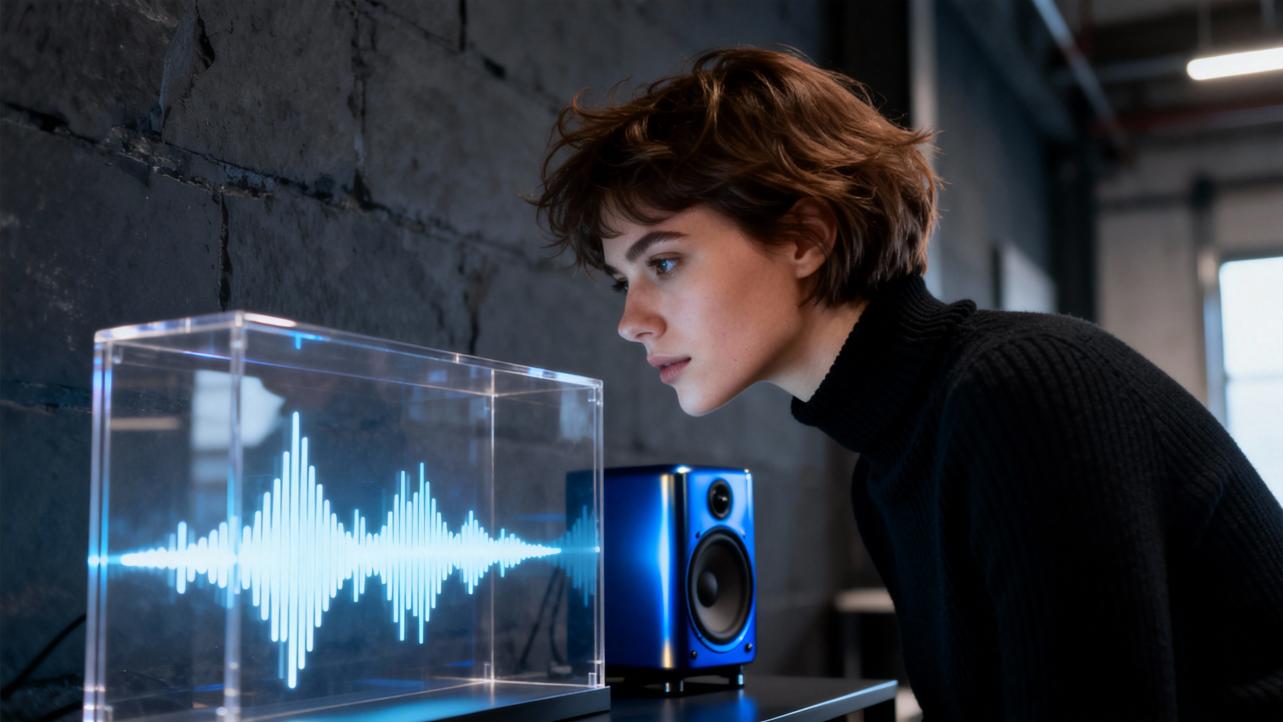
Turning Sound into Sight: Transforming Audio Spectra into Visual Gifts with AI
When you love someone’s voice, you do not just hear it; you feel it. The laugh that fills a kitchen, the vows whispered at an altar, the song that held you together during a hard year. Audio spectrum art lets you bottle that feeling, then pour it onto canvas, wood, or screen. With modern AI, those once-ephemeral sounds can become deeply personal, museum-worthy keepsakes.
In my studio, I have turned everything from baby heartbeats to grandparents’ stories into visual gifts. Under the surface, these sentimental pieces are powered by the same AI techniques used in speech recognition, medical sound analysis, and even research that generates street images from audio. In this guide, I will walk you through how that works and how you can harness it for your own handcrafted, one-of-a-kind gifts.
From Sound Waves to Spectra: A Gentle Primer
Before you can create art from sound, it helps to know what you are actually painting with.
Sound is a wave of vibrations traveling through air or water. As audio engineers and AI researchers describe it, each sound can be broken down into three key ingredients: how long it lasts (time period), how loud it is (amplitude, measured in decibels), and how high or low it feels (frequency, measured in Hertz). Human hearing typically spans from about 20 Hz up to roughly 20,000 Hz, as outlined in technical overviews from firms like Apiko and AltexSoft.
When a microphone records a voice or a song, it samples that wave tens of thousands of times each second. A common format captures about 44,100 samples every second at a fixed precision, turning the wave into long lists of numbers. That dense list of numbers is what you see as a waveform: a line zigzagging above and below zero over time.
For visual gifts, a waveform is only the beginning.
Waveforms, Spectra, and Spectrograms
Authors in audio deep learning tutorials, such as the work published on Towards Data Science and in the “Audio Deep Learning Made Simple” series, describe three visualizations that matter most:
A waveform plots loudness over time. Imagine tracing the rise and fall of a loved one’s laugh as a gently undulating line. This is beautiful in its simplicity and works well for minimalist gifts, but it does not show which pitches are present.
A spectrum freezes time and asks a different question: at this instant, which frequencies are present and how strong are they? On this graph, the horizontal axis is frequency and the vertical axis is amplitude. Audio education resources like Audio-Intro explain that the lowest frequency is called the fundamental, and multiples of it are harmonics. While spectra are essential for engineering, they are snapshots rather than full stories.
A spectrogram is where the magic for artists truly begins. It spreads time across one axis and frequency across the other, then uses color or brightness to represent loudness at each time–frequency point. Audio scientists refer to this as a time–frequency representation. Articles from AltexSoft and Tensorway describe spectrograms as compact “fingerprints” of an audio clip. Each voice, each song, even each bird species traced in a research blog from Towards Data Science, leaves a uniquely patterned spectrogram.
There is also a human-hearing-aware cousin called the mel spectrogram. In the mel scale, frequencies are warped so that equal distances feel equally different to our ears. Educational pieces from Devopedia and multiple deep learning tutorials emphasize that mel spectrograms often align better with how we perceive sound and tend to work extremely well for machine learning models.
These spectra and spectrograms are not just analytical tools any more; they are the raw visual clay for your future keepsakes.
Why AI Loves Spectrograms (And Why That Matters for Gifts)
Modern AI treats spectrograms as images. Deep learning researchers, including those contributing to Hugging Face’s blog and the Keras and PyTorch communities, routinely convert audio to spectrograms and then feed them to Convolutional Neural Networks, Vision Transformers, and other image models.
One study in an MDPI information journal applied a Vision Transformer to different image-like representations of infant cries. The authors found that certain spectral images, such as GFCC (gammatone-frequency cepstral coefficients), mel spectrograms, and standard spectrograms, supported test accuracies in the mid‑90% range for classifying healthy cries versus respiratory distress and sepsis. They also used explainable AI techniques to show that the model focuses on specific frequency bands in those images.
Why mention hospital-grade cry analysis in a gifting context? Because it quietly reassures you that the visual patterns you are turning into canvas are not random. These spectral fingerprints carry enough structure for a model to distinguish subtle medical conditions; they certainly carry the unique character of the vows you exchanged or the song that held your family together.
When you print a spectrogram as art, you are not just decorating; you are framing a scientifically robust portrait of a sound.
Why Audio Spectra Make Such Powerful Gifts
There is a reason these pieces often bring people to tears when they unwrap them.
First, audio spectra are personal yet abstract. A spectrogram of a first dance song, or of your child saying “I love you,” does not reveal the content to a stranger. To them, it looks like modern art. To you, it is the visual DNA of a memory. This balance of privacy and intimacy is rare.
Second, each sound’s spectrum is remarkably distinct. In a Kaggle bird-call identification challenge discussed on Towards Data Science, teams compared spectrograms of different bird species. Even untrained eyes could see that their frequency patterns and textures differed. In the same way, the chorus of your favorite song will not look like anyone else’s wedding vows or lullaby.
Third, spectra age gracefully. Unlike a photo that might feel dated as hairstyles or clothes change, angular streaks of turquoise and gold capturing a whispered promise can live happily beside any decor style. The story deepens over time as you remember, “That streak was the pause before I said yes.”
Finally, gifts like these resonate with a cultural moment. Analysts at Apiko and Tensorway highlight how audio recognition and voice assistants are growing rapidly, with market analyses from Statista and other sources projecting double‑digit annual growth. Turning audio into insight has become a central technological theme of this decade. By turning audio into art, you are echoing that story in a more human, handcrafted way.
Core AI Techniques Behind Audio-to-Image Art
Now let us peek behind the curtain. Several families of AI techniques can help you transform audio spectra into visual gifts, each with its own character and ideal use.
Classic Spectrograms Enhanced by Deep Learning
The most straightforward approach is to generate a beautiful spectrogram and then treat it like a photograph you can stylize.
In many practical audio deep learning guides, such as Ketan Doshi’s UrbanSound8K tutorials and articles on Hugging Face’s blog, the workflow goes like this: load a sound file, standardize its sampling rate, convert it to a mel spectrogram (often with around 128 mel bands as in LinkedIn engineering walkthroughs), and then normalize and colorize it. Libraries like Librosa or Torchaudio, mentioned in resources from Librosa’s creators and from Tensorway and AltexSoft, handle the heavy math behind the Short‑Time Fourier Transform and mel filtering.
Once you have a crisp spectrogram image, you can:
Apply artistic color maps inspired by colormaps used in scientific tools, or design your own palette that matches your recipient’s space.
Feed the image into standard image‑style neural networks to enhance edges, blur backgrounds, or blend with textures.
Combine multiple spectrograms, say both partners’ voices layered together, into a single composition.
Because AI models are trained to treat spectrograms as images for tasks like classification, denoising, and enhancement, many image filters and style techniques carry over naturally.
Generative Audio-to-Image Systems
Researchers have also explored more imaginative mappings from sound to visuals that go beyond the literal spectrogram.
Work from UT Austin, reported by their College of Liberal Arts, describes a soundscape‑to‑image model trained on paired ten‑second audio clips and corresponding street‑view frames from videos. The system learns statistical relationships between environmental sounds and visual features like sky, greenery, and building proportions. In human evaluation, participants could pick the correct generated image that matched an audio clip about 80% of the time, far above random guessing. Generated scenes captured not just layout but also ambiance, with lighting and architectural styles often aligning with the soundscape.
A technical article on LinkedIn walks through an end‑to‑end pipeline that uses mel spectrograms and a pretrained Wav2Vec 2.0 model to turn audio into high‑dimensional embeddings. Those embeddings conceptually carry the essence of the sound and are then used alongside a text prompt by a diffusion model such as Stable Diffusion to generate images guided by the mood or theme of the audio.
These systems are more experimental for everyday crafters, but they open poetic possibilities. Imagine a print where a seaside field recording becomes a misty shoreline painting, or where your child’s laughter drives the creation of a whimsical city in pastel colors. The connection is learned rather than literal, but the story you tell when gifting it can be powerful.
AI Audio Visualizers and Living Gifts
Beyond static prints, there is a growing world of AI audio visualizers that convert music into animated graphics. Articles from creative platforms and AI music visualization companies describe how these tools analyze frequency and amplitude in real time, then map them to shapes, colors, and motion. Some modern systems, such as those highlighted by neural frames and similar services, even generate full AI‑animated music videos from audio and text prompts.
These visualizers are the basis for gifts like:
A looping video artwork that dances to your wedding song on a digital frame.
An AI‑generated lyric video for a loved one’s original composition.
A VR or AR experience where a friend can “step inside” the visual heartbeat of a favorite track.
All three families of techniques—classic spectrograms, generative audio‑to‑image models, and live visualizers—can be turned into artisanal gifts once you bring a maker’s eye and heart into the process.
Here is a compact comparison to help you choose your path.
Approach |
What you work with |
Strengths for gifts |
Things to consider |
Classic spectrum print |
A mel spectrogram or similar time–frequency image of the original audio |
Direct, scientifically faithful visual of the exact sound; easy to print on canvas, wood, or paper |
Requires some audio processing steps; aesthetic impact depends on good color and layout choices |
AI‑stylized spectrum image |
Spectrogram plus image‑style neural filters or artistic post‑processing |
Keeps a tight link to the sound while feeling more painterly or abstract |
Extra AI processing can introduce artifacts; balancing legibility and artistry takes experimentation |
Generative scene from audio |
Embeddings from models like Wav2Vec 2.0, used to guide a diffusion image generator |
Creates evocative scenes that reflect the mood or environment of the audio rather than literal shapes |
Mapping is probabilistic, not exact; generated images may surprise you in both delightful and odd ways |
Designing Your Own Audio Spectrum Gift
You do not need a research lab to turn a beloved sound into art. What you do need is a clear story, a bit of care in preparing the audio, and an openness to collaborating with AI.
Choosing the Sound and the Story
Begin by asking what moment you want to honor.
For love stories, it might be the exact line from your vows where everything changed, or the chorus of the song you walked in to. For new parents, it could be the whoosh of a fetal heartbeat recorded during a checkup or the first babbled word. For memorial gifts, I have often worked with short voicemails that capture the cadence of a lost loved one.
Short clips of a few seconds often work beautifully because they distill a feeling rather than trying to fit an entire track into one frame. Tutorials based on datasets like UrbanSound8K and ESC‑50, referenced by authors on Towards Data Science and in academic surveys, frequently work with clips around four to five seconds long, which turns out to be a sweet spot for both analysis and aesthetics.
Preparing the Audio with Care
AI practitioners who build sound recognition systems emphasize that models are only as good as the data they receive. Articles from Apiko, AltexSoft, and Tensorway all recommend using uncompressed formats like WAV or AIFF when preparing audio for analysis, because they retain all the subtle details that compression might discard.
In a gifting context, that translates to a few practical habits.
If possible, start from the highest‑quality version of the sound you can access, ideally an original recording rather than a screen‑recorded snippet from social media.
Trim long silences at the beginning and end so that the visual density reflects the emotional heart of the moment.
Avoid heavy noise reduction filters that might smear the sound; gentle cleanup is helpful, but over‑processing can make the spectrogram look lifeless.
Common audio tools mentioned in practitioner blogs—such as Audacity for simple editing, and Librosa, Torchaudio, or MathWorks Audio Toolbox for more technical transformations—can handle trimming, resampling, and basic enhancement without requiring you to reinvent the wheel.
Creating the Spectrogram
Once your audio is groomed, it is time to turn it into an image.
Libraries like Librosa, used in multiple tutorials and in the LinkedIn audio‑to‑image pipeline, make it possible to load an audio file and compute a mel spectrogram in a few lines of code. You specify parameters such as the number of mel bands (128 is a common and visually pleasing choice), then convert power values to decibels and plot them with a color map.
If you are more craftsperson than coder, do not worry. Many visual audio tools and plugins hide this code behind sliders and export buttons. What matters artistically is that you:
Choose a time window that shows the most interesting part of the sound.
Pick a color palette that reflects the emotion. Soft blush and gold for wedding vows; deep blues and violet for a lullaby; bold neons for a favorite dance track.
Consider the orientation. A tall print can emphasize rising pitch or intensity; a wide one can feel more like a landscape of sound.
The research community has validated that these images are rich and informative. Papers on sound classification, whether in bird‑song challenges or medical infant‑cry analysis, consistently lean on mel spectrograms and related representations as their primary input. You are tapping into the same visual language, but for art.
Adding AI Magic
If you want to go beyond a straightforward spectrogram, AI offers playful tools.
One path is to treat the spectrogram as a base layer and apply image‑style techniques. Vision Transformers and CNNs used in classification can double as feature extractors for style transfer, helping you blend your spectrogram with watercolor textures or geometric patterns. Explainable AI techniques like Layer‑Wise Relevance Propagation and attention maps, as shown in the MDPI infant‑cry study, can even guide you toward the frequency regions most central to the sound’s identity, which you might choose to highlight with different colors.
Another path is to explore the generative pipelines described in engineering writeups on LinkedIn. In those examples, a Wav2Vec 2.0 model turns raw audio into embeddings, and a diffusion model such as Stable Diffusion uses those embeddings alongside a text prompt to create a scene “inspired by” the audio. While the published code focuses on experimentation rather than polished products, the concept is clear: your sound becomes a seed for visual imagination.
Whichever route you take, treat AI as a collaborator, not a dictator. Generate several candidates, notice which ones feel like the person or memory you have in mind, and then refine color, crop, and composition by hand.
Color, Composition, and Personalization
This is where your identity as an artful gifter shines most.
Think about the recipient’s space: warm, earthy tones in a cozy living room call for a different palette than a monochrome loft. Decide whether you want the piece to whisper or shout. A mostly dark canvas with a single luminous band can feel like a quiet promise; a dense field of bright streaks can capture shared laughter.
You can overlay handwritten text—a date, a lyric, a phrase from a poem—or hide those in the matting or backing for a more private message. Some makers layer multiple sounds together, for example both partners’ voices, using color to differentiate them. Others create series: a triptych of three milestones from a relationship, or a grid of each grandchild’s “I love you.”
AI helps you generate the bones and textures. Your eye and heart decide what stays.

From Pixels to Keepsake: Materials and Formats
Once you have an image you love, the next question is how to bring it into the physical or digital world.
Fine art paper and canvas prints are classic choices. The texture of cotton paper can give spectrograms a painterly softness, while canvas can make them feel like contemporary abstracts. Metal and acrylic prints emphasize the luminous, data‑driven side of the piece, especially when you lean into high‑contrast palettes.
Wood can be wonderful for warm, organic gifts. The grain peeking through the darker regions of a spectrogram of a lullaby or a grandparent’s story adds a tactile layer of inheritance.
Do pay attention to resolution. Academic examples often work with mel spectrograms at specific sizes for model efficiency, but for printing you typically want higher resolutions so lines remain crisp. Upscaling tools, including AI‑based super‑resolution trained on images, can help, but starting with a reasonably large output from your spectrogram generator gives you more breathing room.
Digital and hybrid formats are equally special. You might load a looping AI visualizer of a favorite song onto a dedicated display, or embed a QR code on the back of a framed print that links to an animated version. Educational and creative articles about audio visualizers note how streaming creators and VR experiences now use these tools to create immersive, reactive environments; you can borrow those ideas for your own family or studio.
Practical Pros and Cons for Audio Spectrum Gifts
As with any creative medium, it helps to know both the delights and the constraints.
On the plus side, these gifts are uniquely personal. Two people can own the same photograph of a skyline, but only you can own the spectrum of your father’s last voicemail or your own heartbeat. They also age well, as abstract images that continue to spark questions and stories long after the specific fashion of a given year fades.
They also ride on a mature technical foundation. Industry surveys from Apiko, Tensorway, and SpringerLink reviews of spatial and audio machine learning underscore that spectrograms, mel scales, and related representations have been stress‑tested in everything from speech recognition markets projected into the billions of dollars to complex spatial audio reconstruction. You are building art on top of tools that audio engineers and scientists trust daily.
On the challenging side, there is a learning curve. If you are comfortable in creative software but new to audio, the vocabulary—FFT, STFT, mel bands—can feel intimidating. Fortunately, open‑source libraries and graphical tools encapsulate most of that for you. Another challenge is that generative audio‑to‑image models, especially those using large language models and diffusion, can be unpredictable; they are better at evoking moods than at encoding precise, verifiable details.
There are also ethical and legal considerations. When using commercial music or someone else’s voice, think about rights and consent. While the research on soundscape‑to‑image generation from UT Austin highlights beautiful possibilities for cities and accessibility, it also reminds us that sounds carry a lot of information about place and activity. For personal gifts, staying within your own recordings or content you are allowed to use is both kinder and safer.
FAQ: Turning Sound into Keepsakes
How long should the audio clip be for a good spectrum print? Short segments of a few seconds usually work best. Research datasets like UrbanSound8K and ESC‑50, referenced by authors in the audio deep learning community, commonly use clips of around four to five seconds. That length is long enough to show interesting structure, yet short enough that the spectrogram remains legible and aesthetically balanced.
Do I need to know how to code to make these gifts? Not necessarily. Many of the underlying methods—mel spectrograms, Fourier transforms, even Wav2Vec embeddings—are available through friendly tools. Articles from AltexSoft and Tensorway point to libraries like Librosa and Torchaudio for developers, but if you prefer no‑code approaches you can look for audio editors and visualization apps that export spectrogram images or video. Coding simply gives you more control and customizability.
Which AI models should I explore if I want to go beyond simple spectrum prints? Educational and engineering blogs point to a few families that are particularly relevant: convolutional neural networks and Vision Transformers trained on spectrograms for enhancement or style, pretrained audio models like Wav2Vec 2.0 for turning sound into embeddings, and diffusion‑based image generators such as Stable Diffusion that can translate text and, conceptually, audio‑derived embeddings into images. Starting with spectrograms and simple visualizers is plenty for many gifts; you can gradually experiment with these more advanced tools as your curiosity grows.
When you transform audio spectra into visual gifts, you are not just playing with pretty patterns. You are honoring the shape of a moment in time: the way a laugh arcs upward, the quiet weight of a whispered promise, the bustling complexity of a city street. With a little help from AI and a lot of heart, you can turn those invisible vibrations into heirlooms that hang on walls, glow on screens, and keep singing long after the room has fallen silent.

References
- https://liberalarts.utexas.edu/news/researchers-use-ai-to-turn-sound-recordings-into-accurate-street-images
- https://iopscience.iop.org/article/10.1088/1742-6596/1098/1/012003/pdf
- https://www.researchgate.net/publication/360489695_Application_of_Spectrum_Analysis_Technology_in_Music_Audio_Analysis
- https://www.audiotease.com/blog-post/audio-waveform-visualization-explained
- https://ketanhdoshi.github.io/Audio-Intro/
- https://www.linkedin.com/pulse/audio-image-llms-bridging-gap-between-sound-vision-ganesh-jagadeesan-f83sc
- https://www.microflown.com/blogs/sound-visualization-tools-history
- https://www.neuralframes.com/post/audio-visualizers-the-magic-behind-musics-visual-pulse
- https://www.tensorway.com/post/audio-analysis-with-machine-learning
- https://towardsdatascience.com/audio-deep-learning-made-simple-sound-classification-step-by-step-cebc936bbe5/
