

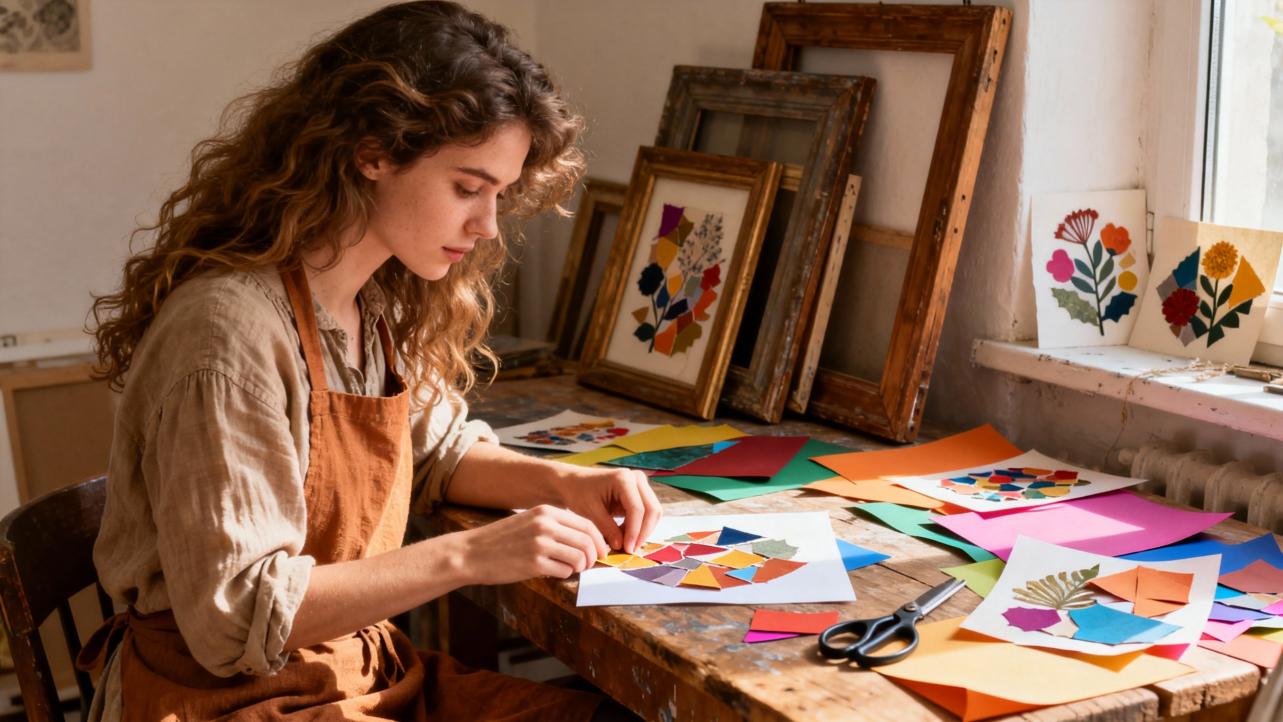
The Harmony Of AI‑Generated Collages And Handmade Creations
Collage has always been an art of gathering. You take the ticket stub from your first concert together, the photo where everyone is laughing a little too hard, the dried petal from a bouquet that meant more than words. You nestle them side by side and suddenly a simple arrangement becomes a love letter in paper form.
Today, artificial intelligence is slipping into this tender space, offering tools that can assemble and polish collages in seconds. For anyone who cares deeply about handmade gifts and personalized presents, that can feel both exciting and a little unsettling. Does an AI collage have the same emotional weight as something you cut, glue, and layer by hand? Or is there a way for the two to sing in harmony?
In this guide, I will walk you through what AI collage tools actually do, how they compare with traditional mixed‑media collage, and how to use both thoughtfully when you are crafting sentimental, one‑of‑a‑kind gifts.
What A Collage Really Is In The First Place
Before we compare AI and handmade, it helps to remember that collage itself is already a story of mixing mediums and technologies.
A detailed guide from ArtHelper traces one pivotal moment back to 1912, when Pablo Picasso created “Still Life with Chair Caning.” He pulled together oil paint, oilcloth, paper, and even rope, coining, together with Georges Braque, the term “papier collé” for pasted paper. That work did not abandon painting; it expanded it, layering materials into a new kind of visual conversation.
ArtHelper also reminds us that the instinct to join different materials goes much deeper than modern art history. Artists in China began incorporating paper into artworks around 200 BC, Japanese calligraphers in the 10th century adhered paper to surfaces to deepen texture, and medieval European artisans pressed thin gold leaf onto panels for cathedral interiors. Each of these practices took separate elements and bound them into a single visual statement.
Modern mixed‑media collage simply continues that impulse. ArtHelper’s technical guidance describes the practice as building depth through layers, mixing acrylics, watercolors, inks, textured papers, found objects, and carefully composed color and composition. Artists choose sturdy substrates like heavy paper or wood, acid‑free adhesives, and protective varnishes so the piece will age gracefully. They wrestle with warping, drying times, and compatibility between materials, solving problems layer by layer.
From a gifting perspective, that means a handmade collage is not just a picture. It is a record of attention: which photo you chose to place at the center, how you softened a harsh color, where you tucked a small fabric scrap only the recipient will recognize. Those decisions are the heart of its sentimental value.

What An AI Collage Maker Actually Does
When we talk about “AI‑generated collages,” we are really talking about a family of tools that automate parts of that process.
A definition from Simplified describes an AI collage maker as a tool that uses neural networks and pattern recognition to automatically arrange photos into visually balanced layouts. Instead of you dragging every image into place, the system analyzes color, composition, and subject matter, then proposes layouts that tend to feel polished even for beginners.
Several sources give us glimpses of what this looks like in practice.
Simplified explains a typical workflow as uploading photos, optionally choosing a template, letting the AI suggest layouts, and then customizing with text, filters, and design elements before exporting. The benefits they highlight include time savings, access to more layout ideas than a human might try manually, and surprisingly professional‑looking results for non‑designers.
Andromo’s AI Collage Maker is positioned as a versatile tool that adapts to both personal and professional use, from personal photo collections to social media posts and marketing assets. It turns the collage into a flexible, everyday design building block, not just a gallery‑style artwork.
ReelMind paints a more advanced picture. Their overview describes AI models that not only place images, but also generate new visuals to fill gaps, keep characters and styles consistent across a set of assets, and accept natural language prompts such as “vintage travel collage with Paris landmarks and classic cars.” They combine multi‑image fusion with orchestration agents that manage the workflow, particularly for brands and content creators.
Deep Image shows another layer: you can roughly assemble a collage in an editor, then run it through an AI engine that “binds” the composition into one seamless photograph. Their recommended settings use very strict edge preservation so the AI respects your placements while harmonizing lighting, shadows, and texture. In other words, you still decide what goes where; the model tidies the seams.
Apple Education, writing about classroom projects, encourages students to generate AI imagery as collage elements in apps like Keynote and Procreate. Their focus is on originality and ease of use. Instead of grabbing random internet images, learners generate unique visuals to match specific moods or fantasy concepts, then cut, layer, and draw over them. Even in a school setting, AI is framed as a way to create more personal, less generic starting material.
Across these examples, AI collage tools are less a single “robot artist” and more a toolkit. They help choose, arrange, blend, and sometimes even create source images. The key question for heartfelt gifting is how much of your decision‑making and story stays visible inside that toolkit.
Process Versus Automation: Where Creativity Lives
A thoughtful essay from Amplify Partners contrasts the way artists and AI toolmakers tend to think. Artists describe creativity as an iterative dialogue with their medium: they push paint around, remove pieces of paper, refine a single area of a collage, live with it for a day, and then come back to nudge a color or shift a focal point. Control and process are central.
Many AI systems, by contrast, emphasize automation and generation. Type a prompt, press a button, and receive a finished output. That can feel magical, especially the first few times. Over time, though, creators in Amplify Partners’ research reported a kind of disenchantment when the primary interaction became typing variations of the same prompt and waiting. The work began to feel closer to consumption than to creation.
Technically, they note that today’s diffusion models struggle with fine‑grained control. Because they are trained mostly on whole images rather than clearly separated objects, it is still surprisingly difficult to change one small element—a single chair in a room—without the rest of the composition drifting. Many tools also lack truly iterative workflows; they are optimized for one‑shot generations rather than targeted adjustments to a specific portion of the image.
This is exactly where mixed‑media collage, as ArtHelper describes it, shines. A collage artist can scrape away one textured area, add a new layer of tissue paper, or reposition a tiny button without disturbing the rest. The process is literally in their hands.
User feedback synthesized by Amplify Partners emphasizes that many creators actually value this friction. They want tools that let them “work the dough” rather than only ordering a ready‑made pizza. In gifting terms, friction is often where meaning accumulates: the extra fifteen minutes you spend deciding if that handwritten note belongs in the top corner or tucked into a flap is part of what makes the piece feel like a keepsake rather than a template.

Handmade Collage As A Sentimental Medium
The ArtHelper guide reads almost like a gentle masterclass for anyone who wants to make a collage that will outlive trends. It emphasizes strong foundations: heavy paper, canvas boards, or wood panels that can absorb many layers; acid‑free glues so the piece will not yellow; sealants and varnishes to protect against dust and fading.
It then walks through how to build depth, treating the collage like a landscape, with background, middle ground, and foreground. Colors are chosen using classic color theory. Analogous hues create unity; complementary pairs introduce lively contrast. Composition methods such as the rule of thirds help you place a focal point so the eye naturally lands where you want the story to begin.
Texture emerges through a combination of media—acrylics, watercolors, inks, charcoal—and through found materials: fabric, buttons, leaves, corrugated cardboard, sandpaper. Everyday objects become carriers of memory. A scrap from a favorite shirt, a page from a book you read aloud together, a piece of wrapping paper from a long‑ago birthday; each of these can be layered in.
The practical advice is also deeply emotional advice. Let each layer dry so the work does not warp or smear. Test materials on scrap so you do not damage your main piece. Choose archival adhesives so the gift can remain on someone’s wall for years. These small acts of care are an echo of the care you feel for the person receiving the collage.
From the perspective of sentimental gifting, handmade collage is particularly powerful because it can weave in physical artifacts from shared experiences. No AI tool can generate the actual napkin from your engagement dinner or the original boarding pass from your once‑in‑a‑lifetime trip. At most, it can simulate their look. When presence of the object itself matters, hands and glue still have the last word.
How AI Collages Can Carry Feeling Too
None of this means AI‑generated collage has to be cold or generic.
Education resources from Apple show students using AI imagery to illustrate personal poems, memories, and dreams. They carefully prompt for specific moods such as “misty” or “dreamy,” choose color palettes that resonate with their themes, and then bring the images into Keynote or Procreate, where they erase edges, soften transitions, and add hand‑drawn lettering. Even in a primarily digital workflow, the personal touch returns as they trace, adjust, and annotate.
ReelMind emphasizes that AI tools can actually strengthen narrative coherence when used thoughtfully. Their systems analyze subject matter, color palettes, and emotional tone to decide where to place elements so collages feel more like visual stories than random grids. You might, for example, create a collage of family photos where AI automatically centers faces, groups related moments, and balances warm and cool colors to evoke a particular mood, all based on a simple written description of what the collage is meant to say.
In an OpenAI Community post about “AI‑Graft,” a creator describes a very ambitious project: a human‑written novel surrounded by hundreds of AI‑generated images and songs. The author treats AI as one medium among many, analogous to assembling a mosaic. They curate AI outputs, selecting and pruning so that the final mosaic still reflects their own symbolic pattern. The core idea is that AI does not originate meaning but resonates with the themes it is given. The artistic act lies in choosing which resonances to keep.
A Facebook collage artist shared a similar sentiment with their community. After experimenting with AI in analog collages, they wrote that while some people reacted negatively, the overwhelming majority of respondents saw AI as just another tool in the collage artist’s toolkit. They emphasized that they had made hundreds of decisions about composition, color, and materials, and that, as a result, the collage still felt entirely theirs.
These experiences suggest that AI collages can absolutely carry genuine feeling when you remain deeply involved in the decisions: which photos to include, how to describe the mood in your prompts, how to arrange and edit the result, and how to combine AI imagery with physical elements if you decide to print and embellish.

At A Glance: AI Versus Handmade Collages For Gifts
Here is a simple comparison, drawing on the sources above and on practical gifting experience.
Aspect |
AI‑Generated Collage |
Handmade Mixed‑Media Collage |
Time and effort |
Tools described by Simplified, Andromo, and Apple can produce a polished layout in minutes, especially when you start from templates or prompts. |
ArtHelper’s methods involve multiple layers, drying times, and testing materials; a single piece can easily take hours or days. |
Accessibility for non‑artists |
Simplified notes that AI collage makers analyze design principles for you, which helps beginners get balanced layouts quickly. Classroom workflows at Apple show students making expressive collages without prior design training. |
Traditional collage demands comfort with scissors, adhesives, and composition. ArtHelper offers clear guidance, but there is more trial and error, especially at the beginning. |
Material possibilities |
ReelMind and Deep Image show how AI can generate fantastical elements, seamless composites, or even cross‑modal translations such as music‑inspired visuals. You can ask for cyberpunk skylines or dreamlike castles that would be difficult to photograph. |
ArtHelper highlights physical richness: fabric, twigs, sandpaper, gold leaf–style metallics, and handwritten marks. The authenticity of real objects and textures is the main strength. |
AI tools can respond to prompts that encode memories and aesthetics, and can remix your own photos. Education examples and the AI‑Graft project show how much personality can emerge when you steer the process. |
Handmade pieces can embed irreplaceable physical artifacts and traces of your own handwriting, brushwork, and even fingerprints. They naturally feel intimate and one‑of‑a‑kind. |
|
Scalability |
ReelMind notes that AI systems excel at producing many variations for marketing and social content and cites industry forecasts of an AI market worth hundreds of billions of dollars, reflecting broad adoption. That scalability is ideal for series of collages or brand campaigns. |
Handmade collages do not scale well; their strength lies in singularity. For gifting, this limitation is often a virtue: a hand‑built collage is clearly not mass‑produced. |
Neither column is “better.” The artful question is which combination fits the story you want to tell and the way you want to show your care.

A Practical Guide For Choosing And Creating The Right Collage
When you are curating a deeply personal gift, start by listening for the story you want the collage to hold. Is it the arc of a friendship, a year of a child’s life, a shared creative journey, or perhaps an honoring of someone’s favorite books and films? Once that narrative feels clear, you can decide how much you want to lean into tactile craft, digital polish, or a blend of both.
If you lean toward AI first, think of yourself less as a passive prompter and more as a director, echoing the role outlined in the AI‑Graft project and in the Format magazine piece on AI collaboration. Spend time gathering meaningful source images: your own photos, scans of handwritten notes, perhaps a small sketch. Then write prompts that describe both content and feeling, such as “warm, nostalgic collage of our road trip with soft golden light and handwritten map elements.” Tools like Simplified or Adobe Express can handle much of the layout, and Deep Image‑style processes can merge elements into a cohesive photo‑like scene if that suits the recipient.
Once you have a promising AI output, resist the urge to stop at the first pass. Amplify Partners’ analysis points out that real creativity is iterative. Use whatever editing tools are available to adjust specific areas, erase or soften edges, and add text or personal doodles. If the platform allows it, regenerate only certain regions instead of the whole image. Your goal is to leave visible traces of judgment and taste.
If you are drawn to hands‑on making, ArtHelper’s roadmap is a wonderful starting place. Choose a sturdy substrate, gather acid‑free adhesives, and collect materials that mean something to the recipient: ticket stubs, fabric, photos, pressed leaves. Think about color harmony and composition, perhaps sketching a light layout before you commit to glue. Allow for pauses, as drying time can be your friend; stepping away and returning with fresh eyes often leads to more thoughtful arrangements.
Blending the two approaches can be especially charming for gifts. You might, for instance, generate AI artwork in the style of a favorite genre—Apple’s education piece suggests keywords such as “fantasy,” “cyberpunk,” or “surreal”—and then print, cut, and integrate those images into a physical collage alongside real‑world keepsakes. Deep Image’s method of binding rough collages into seamless images could work in reverse: assemble a digital collage first, print it as a base layer, and then add handmade textures and objects on top.
In all cases, the most important step is to invite your own curiosity back into the process. Ask yourself what small surprise, hidden detail, or tactile element will make the recipient pause and smile.
Ethics, Authorship, And The Soul Of The Collage
Whenever AI enters an artistic space, questions of ownership and authenticity are never far behind.
Format’s exploration of human–machine artistry suggests thinking about AI less as an originator of creativity and more as a “hive mind” of prior cultural material. It likens AI outputs to collages or dreams built from absorbed images and symbols. The difference is that human artists bring intention and the ability to think beyond learned patterns, while AI reshuffles what it has seen.
A 2023 article in Transformative Works and Cultures, summarized in an Academia brief, looks specifically at AI and fan art. It highlights how fans are using tools like Midjourney to generate new interpretations of beloved characters and worlds, treating AI as a collaborative partner that speeds up idea generation or handles tedious details. At the same time, it raises serious concerns about authorship, credit, and the way AI systems may mimic living artists’ styles without permission. Fan communities and legal frameworks, the authors argue, will need to renegotiate norms around attribution and ethical use.
Meanwhile, a Threads conversation about collage, AI art, and fan art proposes a practical ethical test rooted in Fair Use Factor 4 from copyright law. The author finds it most convincing to ask whether the new work harms the potential market for the original. In that view, both AI collages and handmade collages are on firmer ground when they do not substitute for or undercut the market for the images they reference.
In the Facebook collage group mentioned earlier, the conversation is less legalistic and more emotional. Members overwhelmingly describe AI as a tool in the kit. The emphasis falls on the hundreds of human decisions that still go into a well‑made collage, whether or not an AI was involved at some stage. The feeling of authorship comes from that web of choices.
Corporate and research projects echo the theme of partnership rather than replacement. Safran’s Harmony initiative, for example, opens an internal graphic archive to digital artists working with AI, 3D imagery, collage, and other emerging techniques through Artpoint. The artists are given creative freedom but are invited to respond to Safran’s products, sites, and values. A ResearchGate paper on “Harmony in Design” explores how generative models such as variational autoencoders can translate between senses—turning, say, a classical symphony into an impressionist‑style visual piece. In both cases, AI sits inside human‑designed frameworks that give it direction and cultural meaning.
For gift‑givers, an ethical and soulful approach could draw on all of this. Choose AI tools that respect original creators where possible. Use your own photos and texts as primary inputs. Keep your creative fingerprints visible, whether through composition, mixed media, or the way you present and frame the finished collage. And when in doubt, ask the simple question suggested by the Threads discussion: is this piece harming the market or livelihood of someone else’s work, or is it adding something new and personal?

A Short FAQ For Thoughtful Gift‑Givers
Is an AI collage “cheating” compared with a handmade one?
The evidence from artists and writers suggests that it depends entirely on how you use it. The AI‑Graft project, the Facebook collage discussion, and the Format article on collaboration all portray AI as one medium among many. If you simply accept whatever the model produces without reflection, you may feel disconnected from the result. If instead you treat AI outputs as raw material that you curate, refine, and sometimes combine with handmade elements, your authorship and care remain central.
How can I make an AI‑assisted collage feel genuinely personal?
Draw on what Apple Education recommends in the classroom and what Simplified and Deep Image describe in their workflows. Start with your own photos and words, write prompts that describe not just objects but feelings and memories, and then bring the result into an editor where you can cut, layer, and draw by hand. Even simple touches such as adding your handwriting or including a scanned ticket stub can anchor the piece in lived experience.
What if I am worried about copyright or fairness?
The Transformative Works and Cultures article and the Threads discussion both point to two helpful questions. First, whose work is being referenced or mimicked, and are they credited or consented when that matters? Second, following the Fair Use factor highlighted on Threads, does your collage meaningfully harm the potential market for the originals, or is it transformative and non‑competitive? For personal gifts that use your own photos and add significant new expression, the ethical concerns are usually smaller, but staying mindful is part of honoring both your recipient and the wider creative community.
In the end, the most moving collage gifts rarely declare themselves as “AI” or “handmade” first. They whisper, “Someone saw me, remembered me, and spent time weaving my stories together.” Whether you are pasting ticket stubs by hand or guiding an AI to paint your memories in light, the harmony you are looking for lives in that attentive, loving gaze.
References
- https://www.academia.edu/108352159/Artificial_intelligence_and_the_production_of_fan_art?uc-sb-sw=3413226
- https://digitalcommons.unomaha.edu/cgi/viewcontent.cgi?article=1260&context=university_honors_program
- https://arxiv.org/pdf/2509.07029?
- https://dl.acm.org/doi/10.1145/3706599.3719860
- https://papers.cumincad.org/data/works/att/ecaade2024_363.pdf
- https://www.researchgate.net/publication/387058180_Harmony_in_Design_Leveraging_AI_for_Synesthetic_Art_Architecture_and_Multi-Dimensional_Creativity
- https://amplifypartners.com/blog-posts/wheres-the-creativity-in-creative-ai-tools
- https://education.apple.com/story/250012536
- https://www.arthelper.ai/blog/mixed-media-collage-techniques
- https://bigwalldecor.com/what-ai-art-means-for-artists-should-artists-fear-ai-art-generators/?srsltid=AfmBOoqmZRyCWgpns-B3b9NASSIVANQjEqE1zYmFXaFk-l76uL4cePh5
