

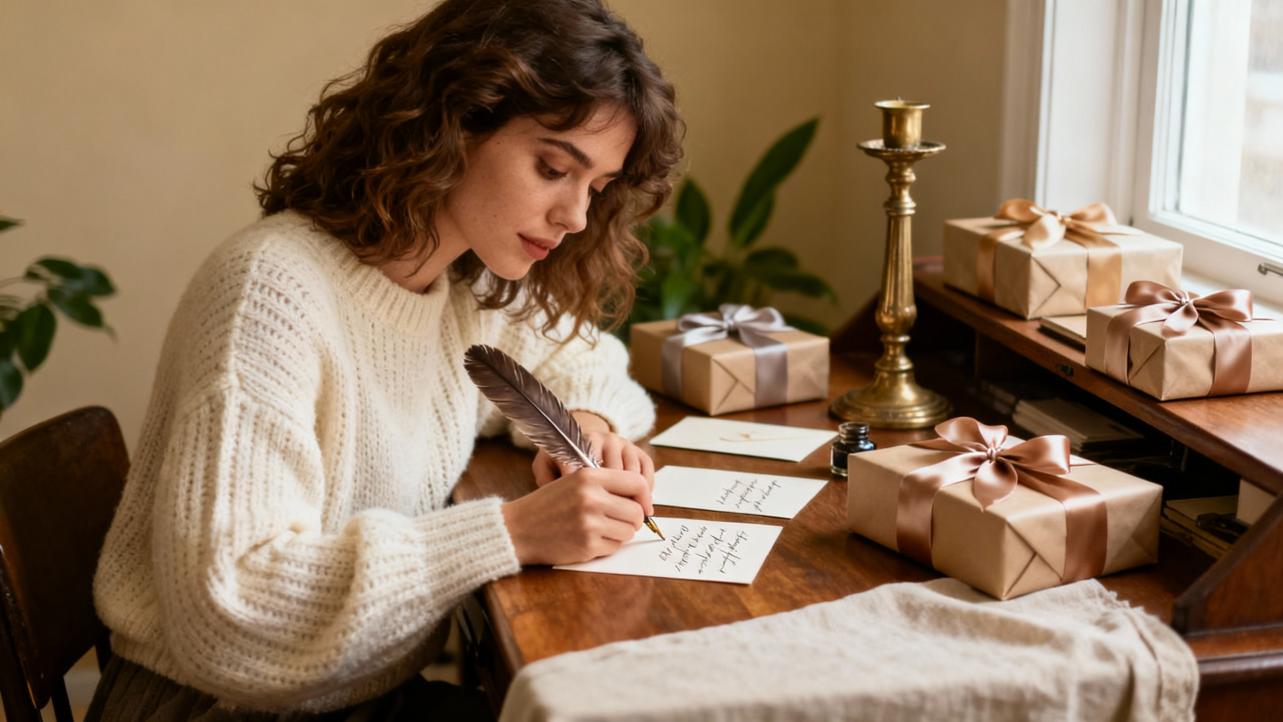
Can Neural Networks Create Gifts from Your Handwritten Font?
There is something quietly intimate about a handwritten note. The way a letter leans, the pressure of a curve, the tiny quirks in a signature all become part of your visual voice. For a long time, this kind of warmth belonged only to ink and paper. Today, neural networks are close to catching that voice and helping you turn it into endless, tangible gifts.
In this guide, I will walk you through how modern handwriting models work, what researchers have already achieved, and how you can translate that into heartfelt, handcrafted-style presents. The goal is not to replace your handwriting, but to understand how AI can help you bottle its personality and pour it into cards, art prints, storybooks, and keepsakes that still feel deeply, unmistakably you.
Handwriting, Fonts, And Neural Networks: The Basics
Before we talk about gifts, it helps to draw some gentle lines between a few key ideas: handwriting, fonts, and neural networks.
A traditional font is a collection of glyphs, one for each character. When you type a letter, your computer simply looks up the matching glyph image and places it on the page. Your handwriting, by contrast, is a sequence of strokes over time. You do not draw twenty-six independent shapes; you move your hand in one fluid rhythm. The spaces between letters, the joins in cursive, the way a word speeds up or slows down all matter.
Neural networks, especially recurrent neural networks and transformers, are good at understanding sequences and patterns. Researchers have used them to learn handwriting styles by training them on many examples of pen strokes or handwriting images. Once trained, these models can generate new samples in that style, letter by letter or even word by word.
An experiment published on Distill showed how an LSTM-based handwriting model could produce sequences of pen strokes that look like human handwriting. Even when the words were nonsense, each sample preserved a recognizable style: loopiness, slant, and spacing stayed consistent because the network remembered what it had done in earlier strokes. Other work by Alex Graves and colleagues demonstrated that similar recurrent models can generate realistic cursive writing when conditioned on a target text string.
More recent research has focused on images of handwriting rather than pen coordinates. Vision-transformer-based systems like WriteViT, introduced by a team at the University of Information Technology in Ho Chi Minh City, learn from scanned word images. They can generate high-quality handwritten text in multiple languages, including scripts with complex accents, after seeing as little as one example from a writer. Another model, PSA‑HWT, adds a multi-scale attention mechanism and has been shown in open-access evaluations to improve key realism metrics by around twenty to twenty-five percent compared with earlier transformer-based approaches.
In other words, the technical answer to “Can neural networks learn to write like me?” is a cautious yes. They can learn handwriting style as a kind of visual language. That is the foundation we build on to create gifts.

How Your Handwriting Becomes A Learnable Style
For a neural network, your handwriting is data. That sounds cold, but it is actually how we translate something as personal as pen strokes into a form the model can understand and then re-express.
Collecting Samples Of Your Writing
Personalized font projects described in the research, such as the WeWrite system in IJRASET, usually start with a simple but structured exercise: you write out all letters in both cases, digits, and a handful of punctuation marks. That means everything from A–Z and a–z to zero through nine and some special symbols. These are scanned or photographed clearly, then preprocessed.
Preprocessing often uses classic image-processing tools. Techniques like Sobel and Canny edge detection and contour tracing algorithms help find the skeleton of each character, clean up noise, and standardize the size and position of your letters. In WeWrite and related work, those cleaned images then become training material for a neural network.
Some systems treat handwriting as a sequence of strokes, storing each point or curve as a series of coordinates plus pen-up or pen-down signals. Others, like WriteViT and PSA‑HWT, work entirely at the image level, slicing handwriting into patches and training transformers or generative adversarial networks to reconstruct them with the right style.
The key idea is that the model separates content from style. The text “Happy birthday” is content. The way you loop the “y” and space the “dd” is style. Studies on handwriting generation repeatedly emphasize this separation. Vision transformer models use a “writer identifier” component to extract style embeddings from a few samples. LSTM-based systems condition on style vectors learned from your examples. Diffusion models for fonts, highlighted in a PeerJ review on deep learning for minority writing systems, learn to preserve structure and strokes even when the style changes.
Training A Neural Network To “Write Like You”
Once your samples are prepared, the neural network learns by trying to predict what a correct letter or stroke should look like. In LSTM-based personalized font systems, the model sees sequences from datasets such as the IAM handwriting corpus, then fine-tunes on your own writing. It adjusts its internal weights until it can generate sequences that match both the shape of your letters and the way they connect.
For image-based systems, training often uses adversarial learning. A generator network creates synthetic handwriting images pretending to be in your style. A discriminator network, sometimes with specialized branches, tries to tell real from fake. The PSA‑HWT model, for example, adds pyramid-style attention so the generator can capture both tiny stroke details and overall letter rhythm, and consistently outperforms earlier baselines on realism scores such as FID and LPIPS.
A more recent “harmonic” approach to handwriting synthesis described in the pattern-recognition literature uses two separate discriminators. One focuses on individual characters, and another, called a cursive-specific discriminator, concentrates on the joins between letters. It does not only ask, “Does this letter look right?” It also asks, “Does this join between ‘r’ and ‘i’ feel like a natural continuation of this writer’s motion?” That is exactly the kind of nuance that makes a digital reproduction feel less mechanical.
The upshot for you as a gift-giver is that the model does not simply copy your scanned alphabet. It learns a continuous space of style. From that space, it can generate new words and phrases you never physically wrote, still in a handwriting that is recognizably yours.
From Learned Style To Loving Gifts
Once a neural network has learned your handwriting style and turned it into a digital font or generator, you can begin weaving it into gifts. Some gifts will be straightforward, like stationery; others can be surprisingly poetic.
Letters, Vows, And Notes That Feel Handwritten
Imagine you want to give a partner a bound book of letters: one for the day you met, one for a rough patch you survived together, one for a future trip you hope to take. Writing them all by hand might be overwhelming. A personalized handwriting model lets you type the letters while the system renders them in your style.
Research such as the IJRASET work on WeWrite emphasizes maintaining legibility and coherence while preserving style. That matters for gifts meant to be read and re-read, like wedding vows or anniversary letters. You can keep editing your words easily and generate final pages in your digital hand once you are happy with the message.
For small businesses that revolve around sentiment—letterpress studios, wedding calligraphers, or artists who sell custom notes—this kind of model can act as a quiet assistant. It handles large batches of place cards or thank-you notes in a signature style, freeing the human artist to focus on compositions, illustrations, or the really special pieces that truly need a live pen.
Storybooks, Recipes, And Family Archives
Handwriting is also heritage. A paper in PeerJ on deep learning and ethnic minority writing systems describes how many lesser-known scripts lack digital fonts altogether and risk disappearing from everyday digital life. Deep-learning font models, especially few-shot GAN and diffusion approaches, can create complete digital fonts for these scripts from only a small number of samples. That allows communities to publish, archive, and share writing in their own visual language.
On a personal scale, the same principle lets you safeguard family handwriting. You might create a font from a grandparent’s letters or recipe cards and then use it to typeset a family cookbook. The model smooths wrinkles in the original scans but keeps the distinctive feel of their letterforms. For relatives scattered across different cities, a printed book of recipes “written” in Grandma’s hand becomes more than a cookbook; it becomes a shared heirloom.
Personalized handwriting systems also have accessibility value. The WeWrite project notes that people with Parkinson’s disease, dysgraphia, or certain physical disabilities may struggle to write legibly even though handwriting still feels part of their identity. A neural network can learn from their earlier, clearer samples or from supervised writes, then generate clean, readable handwriting that still carries their personality. Typed text in that personal font can become cards, letters, or even assistive communication tools that are easier for others to read while still looking like “them.”
Gifts For AI And Design Enthusiasts
If your recipient is tech-curious, the font file itself can be a gift. A number of AI typography tools are already accessible to non-experts. Creative Fabrica’s Font Generator, for instance, uses AI to generate entirely new fonts from design datasets and lets users customize glyphs, preview text, and download the result as a standard font file with commercial licensing. It even uses a generous coin system that makes experimenting essentially risk-free, and subscribers get unlimited generations.
Articles from design-focused publishers describe how AI font generators are entering everyday workflows. One overview of AI typography tools notes that AI-driven font design can compress production times from months into minutes and that many tools rely on generative adversarial networks to produce coherent, stylish results. Surveys highlighted in the same article report that well over ninety percent of content creators already use AI tools for editing and creation and that a strong majority see positive audience reactions to AI-assisted content. The market for AI text generation, which includes font generation, is forecast to grow rapidly over the next few years.
For a friend who loves technology and art, you might create a small bundle: a font generated from your handwriting, sample posters or wallpapers featuring shared in-jokes, and a short note explaining which neural architecture helped bring it all to life.

How AI Handwriting Gifts Compare To Other Options
It can help to see AI handwriting gifts in context. The table below compares three broad approaches you might use for a sentimental project.
Approach |
Strengths |
Limitations |
Best For |
Handwritten by you on paper |
Maximum authenticity; tactile; every mark is unrepeatable |
Time-consuming; hard to edit; fragile; challenging for large batches or long texts |
Singular letters, signatures, one-off art |
Standard decorative font |
Fast; widely available; consistent; easy to print and share |
Not personal; easily duplicated by anyone; may feel generic |
Quick cards, casual posters, digital mockups |
Neural-network handwritten font |
Strong sense of “you”; editable text; scalable to many pieces or pages |
Requires setup; may need tech help; style can still feel slightly less alive than real ink |
Books, sets of cards, branded stationery, art prints |
The research on PSA‑HWT and WriteViT suggests that neural-generated handwriting can be extremely close to real handwriting in terms of visual statistics and style, even in challenging situations like unseen words or new writers. In tests, PSA‑HWT improved cross-dataset realism scores by more than twenty percent compared with earlier transformer-only models. Still, a table does not capture the feel of an envelope that has actually traveled in the mail with ink that has soaked into the paper fibers.
Rather than seeing these as competitors, it can be useful to treat them as a palette. For a major anniversary, you might write the first page of a letter by hand, then let your personalized font continue the longer story in the same style. For a children’s story, you might print the main narrative in your digital handwriting and then annotate it with real handwritten notes and doodles in the margins.

Pros, Cons, And Emotional Tradeoffs
When you invite neural networks into your gifting practice, you are balancing technical benefits with emotional subtleties.
On the positive side, the strengths are clear. Research on personalized font generation shows that neural models can maintain legibility and coherence while capturing unique stylistic quirks. Image-based models like PSA‑HWT consistently outperform earlier baselines across several realism metrics, meaning the synthetic handwriting looks more like a photograph of real handwriting than older methods could manage. Vision-transformer frameworks such as WriteViT even demonstrate one-shot learning: with just one example word from a new writer, they can adapt to that style and generate new words convincingly.
There is also the benefit of personalization beyond aesthetics. Work presented at a design computing conference on the FontMART system found that matching readers with fonts tailored to their characteristics allowed people to read around fourteen to twenty-five words per minute faster without losing comprehension. That study focused on body-text fonts rather than handwriting, but the principle is the same: subtle typographic personalization can measurably improve how comfortable text feels to each individual.
On the cautionary side, AI handwriting is still an approximation. Even advanced models sometimes struggle with very thin strokes, unusual character forms, or complex ligatures. The Erik Bernhardsson experiment that analyzed over fifty thousand fonts with a neural network, for instance, found that characters with fine lines were harder to predict precisely, because a one-pixel shift could be penalized heavily during training. The model tended to play things slightly safe, which made outputs a little less playful than the most eccentric original fonts.
There are also ethical and emotional questions. A discussion among type designers on a professional forum noted that training on open-source fonts is generally considered legal under their licenses, and that typefaces themselves often lack strong copyright protection in many jurisdictions. Still, using someone else’s handwriting style or a culturally significant script as raw material raises obvious consent and sensitivity issues. The PeerJ review on minority writing systems stresses that deep-learning font generation should go hand-in-hand with cultural stewardship, not replace it.
For gifts, the simplest ethical guideline is to work from your own handwriting or from fonts whose licenses explicitly allow training and derivative work. If you are inspired by a grandparent’s scripts or a community script, involve the people whose marks you are digitizing and be transparent about how the data will be used.

A Gentle Workflow For Creating A Handwritten-Font Gift
If you are curious to try this in your own creative practice, you do not necessarily need to train a research-grade model. You can start with tools that sit on top of the same ideas.
Begin by deciding the story your gift needs to tell. Is it a love letter, a series of birthday notes, a shared recipe book, or a set of affirmations for a friend going through a difficult season? Clarity about the use will help you choose how polished and formal your handwriting style should be.
Then capture a clean alphabet. Many accessible tools, like Calligraphr, give you a printable template where you handwrite each character in a box, scan it, and let the tool convert it into a font. While these systems may not deploy the latest transformer architecture, they still embody the basic idea that your style can be abstracted and reused. You can later combine this with more advanced AI tools that blend styles or refine spacing and form, such as AI-augmented editors like Prototypo or web-based generators described by design platforms.
Next, test the font with real phrases. Type out the messages you plan to give, print them, and read them at arm’s length. Ask someone who knows you whether it feels like your hand or like a cousin of your hand. If something feels off—maybe all of your “g” shapes look too identical or the joins in cursive words feel stiff—that is normal. Researchers in handwritten text synthesis evaluate models with many metrics; as a gift-maker, your metric is simpler: does it feel warm, legible, and yours?
Once you are happy, bring in craft. Print your messages on paper that suits the occasion, perhaps a soft cotton stock for wedding vows or lightly textured cards for everyday notes. Pair the text with hand-drawn borders, pressed flowers, or small photos. The neural network provides continuity and scale; your human hands add the irreplaceable irregularities of tape edges, smudges, and unexpected flourishes.
Finally, consider longevity. Save your font file somewhere safe. Just as artists scan sketchbooks for future use, a well-trained handwriting model or font becomes part of your creative toolkit. You can return to it for future anniversaries, children’s storybooks, or even to label handmade gifts like quilts, ceramics, or wooden boxes.

Ethics, Ownership, And Respecting The Hand Behind The Style
Whenever machines enter creative spaces, questions follow. Who owns an AI-generated handwriting font? Is a message still intimate if a neural network wrote the letters?
The academic and professional conversations reflected in the sources here suggest a few guiding ideas. First, when you create a font from your own handwriting, the moral authorship is clearly yours. The model is a sophisticated tool, much like a calligraphy pen that maintains consistent line width or a layout app that aligns margins perfectly.
Second, when using other scripts or styles, especially those tied to minority languages or sacred traditions, sensitivity is crucial. The PeerJ article on deep learning for minority writing systems warns that loss of control and misrepresentation can harm communities whose scripts are already marginalized. If you feel drawn to incorporate such scripts into your gifts, prioritize collaboration with people from those cultures and support projects led by them.
Third, be transparente with recipients. A note at the back of a printed book that says “These pages were set in a font learned from my handwriting” does not diminish the magic; it invites the reader into the process and acknowledges both the human and the machine.
How Close Are We To Truly Human-Feeling Handwritten Gifts?
So, can neural networks really create gifts from your handwritten font in a way that feels worthy of life’s tender occasions?
Technically, the answer is increasingly yes. State-of-the-art models like PSA‑HWT and WriteViT show that with clever architectures and training, synthetic handwriting can be realistically indistinguishable from real samples, even in languages with complex diacritics. Personalized systems like WeWrite demonstrate that neural networks can adapt to an individual’s handwriting and generate new text in that style after seeing a modest set of samples.
Emotionally, the answer is that AI-augmented handwriting works best as a complement, not a replacement. It shines when you need to scale your warmth across many pages, editions, or recipients while keeping a thread of personal style. It lets you preserve and share handwriting that might otherwise be lost. It opens doors for people who cannot comfortably handwrite long texts to still give gifts in their own visual voice.
The last spark—the slight pressure difference where you paused mid-sentence, the occasional ink blot, the knowledge that a hand held this very paper—remains uniquely human. That is precisely why combining both approaches can be so powerful.

FAQ: Neural Handwriting Gifts In Everyday Language
Q: Do I need to know how to code to create a handwritten-font gift? A: You do not. While many research papers describe custom-built neural networks in detail, a growing ecosystem of tools wraps those ideas in friendly interfaces. Services like handwriting-to-font converters and AI-powered font generators let you upload scanned letters, tweak a few sliders, and download a font file you can use in any standard design or word-processing app. Deeper customization, such as training a model that can imitate cursive joins the way advanced research systems do, may require help from a technically inclined collaborator, but you can start gifting with off-the-shelf tools.
Q: How much handwriting do I need to provide? A: Personalized font projects described in academic work usually ask for a full set of letters—uppercase and lowercase—digits, and some punctuation. The WeWrite system, for example, gathers that complete character set to capture a person’s style. Image-based handwriting generators like WriteViT can adapt to a new style with as little as a single example word, though in practice more samples give more reliable results. For gifting, filling one or two pages with carefully written characters and sample sentences is generally enough for modern tools to work with.
Q: Will gifts made with a neural handwriting font feel less “real”? A: They will feel slightly different, especially to you, because you know a machine helped. To recipients, what often registers first is the personal style and the thought behind the gesture. When the words themselves are specific and sincere, and when you add small physical touches, AI-assisted handwriting rarely feels cold. Think of it as a printing press that happens to use your own lettering plates rather than generic ones.
Q: Is it safe to give an AI tool my handwriting? A: Safety depends on the tool and on how sensitive you consider your handwriting. Research systems working with medical or minority-language data take care to anonymize and protect samples. In consumer tools, it is wise to read their data policies, choose reputable providers, and prefer options that let you download the font and delete your uploads. For deeply personal projects, you can also explore offline or open-source solutions where you control where the data lives.
Handwriting has always been one of the most intimate ways to show up for someone. Neural networks do not change that; they simply give you new ways to stretch, repeat, and preserve the marks that make your writing yours. When you blend the rigor of these models with the tenderness of your intentions, you open up a world where gifts can be both endlessly reproducible and deeply, beautifully personal.
References
- https://scholar.smu.edu/cgi/viewcontent.cgi?article=1180&context=datasciencereview
- https://pmc.ncbi.nlm.nih.gov/articles/PMC11639151/
- https://arxiv.org/html/2505.13235v1
- https://readabilitymatters.org/articles/personalized-font-recommendations-with-machine-learning
- https://dl.acm.org/doi/10.1145/3213767
- https://cajmns.casjournal.org/index.php/CAJMNS/article/download/2653/2682
- https://www.researchgate.net/publication/372595860_Personalized_Font_Generation_using_Deep_Learning_Neural_Networks
- https://gizmodo.com/this-is-what-happens-when-you-let-a-neural-network-desi-1755137713
- http://distill.pub/2016/handwriting
- https://github.com/swechhasingh/Handwriting-synthesis
