

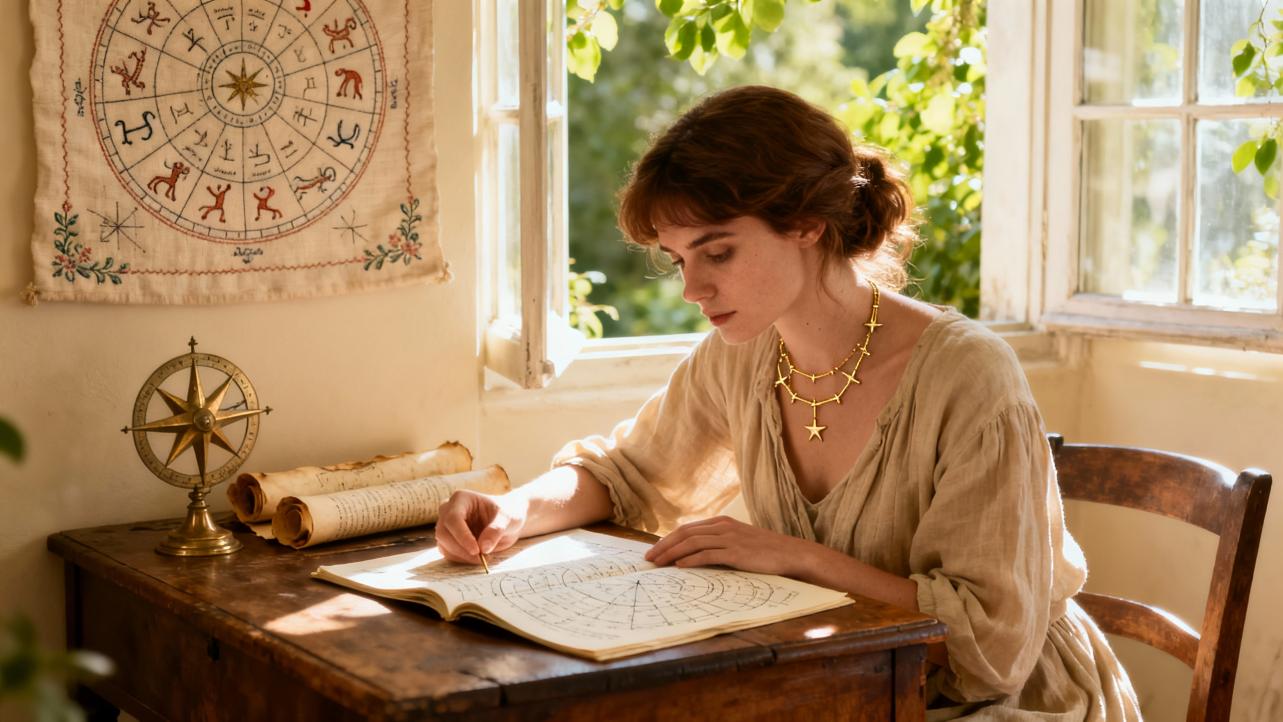
How Astrology Influences Mysterious Patterns and Designs
When someone shares their birth details with me for a custom piece, I do not just see numbers and symbols. I see a secret pattern waiting to be translated into texture, line, and light. As an Artful Gifting Specialist and Sentimental Curator, I have spent years turning birth charts into hand-embroidered constellations, etched brass talismans, and quietly magical keepsakes. Again and again, I am struck by how consistently astrology works as a language of patterns that lends itself beautifully to design.
Astrology, as described by practitioners and educators at places like 12th House, Cafe Astrology, Astrology Hub, and Co-Star, is an ancient practice that reads the positions of the Sun, Moon, and planets at a given moment to understand human tendencies and life themes. A birth chart, or natal chart, is that moment captured: a circular map of the sky at the exact time and place of birth. Inside that circle are mysterious geometries and repeating motifs that are surprisingly natural to express in art.
In this article, I will walk you through how astrologers see these patterns, and how those same patterns can inspire unique, handcrafted designs. Along the way, I will share how I translate charts into jewelry, textiles, and paper goods, as well as the pros and cons of letting the stars guide your creative process.
Astrology as a Map of Invisible Patterns
Astrologers across many sources agree on one thing: your birth chart is a pattern-rich system. Astrology Hub and Astrology Zone both describe a natal chart as a lifelong blueprint or “cosmic thumbprint,” built from three primary components with a crucial fourth layer.
First come the zodiac signs. They are like the stylistic filter on the chart, shaping the tone or style of any energy. Co-Star and other educational sites often explain them as adjectives or adverbs: Aries acts assertively, Taurus reliably and sensually, Gemini curiously and playfully, and so on around the wheel through Cancer, Leo, Virgo, Libra, Scorpio, Sagittarius, Capricorn, Aquarius, and Pisces.
Next come the planets. Writers at Cafe Astrology, Wikipedia’s astrology overview, and magazines like Elle and The Cut consistently treat them as the “actors” or core drives. The Sun symbolizes identity and vitality, the Moon emotions and memory, Mercury thinking and communication, Venus love and aesthetics, Mars action and desire, Jupiter growth, Saturn discipline and limits, Uranus innovation, Neptune dreams, and Pluto deep transformation.
Then there are the houses. As explained by 12th House, Cafe Astrology, and Elle, the chart is divided into twelve houses that correspond to life areas: self and body, money and values, communication, home, creativity and children, work and health, partnership, shared resources and transformation, higher learning and travel, career and public image, friendships and community, and spirituality and the unconscious.
The fourth layer is made of aspects and patterns. Sources like Astrology Hub, Cosmopolitan’s aspects guide, Cafe Astrology, and TimeNomad describe aspects as the angles between planets that create geometric figures: triangles, squares, rectangles, arrows, and more. When three or more planets link in these angles, they form aspect patterns and chart patterns that act like structural “chapters” of the chart.
For a designer, all of this is a goldmine. Signs provide mood, planets give characters, houses provide context, and aspects draw the actual lines. The result is a ready-made pattern language you can quietly encode into a handmade gift.

From Cosmic Code to Visual Design
Zodiac Signs: The Style Language of a Piece
Astrological teachers such as those at Co-Star, The Planet’s Today, and various chart interpretation guides describe the signs in terms of elements and modalities. Fire signs (Aries, Leo, Sagittarius) are active and expressive. Earth signs (Taurus, Virgo, Capricorn) are practical and grounded. Air signs (Gemini, Libra, Aquarius) are mental and social. Water signs (Cancer, Scorpio, Pisces) are emotional and intuitive. On top of that, cardinal signs initiate, fixed signs sustain, and mutable signs adapt.
When I design with someone’s chart in mind, I treat their dominant elements and sign qualities as the “design brief.” If fire dominates their chart, the gift might lean into bold color blocks, sharp diagonals, and dynamic asymmetry. When earth is strong, the work tends to ask for textured surfaces, weighty materials, and patterns that feel like topography or stone. Air-heavy charts often shine in line work, lettering, and airy gradients, while water-dominant charts call for flowing motifs, soft edges, and layered translucency.
Because the signs are the style layer, they also influence typography, color, and rhythm in a piece. Aries and Capricorn placements might inspire angular fonts and assertive layouts; Libra and Pisces placements often call for rounded curves, soft gradients, and gentle symmetry. These correlations are interpretive rather than scientific, but they are grounded in the sign descriptions provided by educational articles from Co-Star, The Cut, and similar sources.
Planets: The Actors Behind Your Patterns
Across sources like Wikipedia’s “Planets in astrology,” Elle’s and Allure’s guides to planetary meanings, and traditional outlines on sites like The Planet’s Today, certain planetary themes appear again and again. I lean on those to choose the emotional tone of a piece, then translate them into visual and material decisions.
Here is a concise way to think about some of the key planets as both symbolic forces and design muses:
Planet |
Symbolic themes mentioned by astrologers |
Design mood ideas for handmade gifts |
Sun |
Ego, purpose, vitality, how you shine |
Radiant focal shapes, warm golds or bright yellows, designs that clearly center the recipient’s name or initials |
Moon |
Emotions, memory, nurturing, home |
Soft curves, pale or iridescent tones, linen, clay, and other comforting textures; designs suited to bedrooms and kitchens |
Mercury |
Communication, learning, movement |
Fine line work, script, maps, envelopes, hidden messages, interactive or modular pieces |
Venus |
Love, beauty, fertility, pleasure |
Delicate ornament, floral forms, balanced symmetry, rose and copper tones, jewelry and decor that feels quietly luxurious |
Mars |
Action, drive, assertion, conflict |
Strong geometry, bold contrast, visible tool marks, designs that feel energetic or protective, such as shields or arrow motifs |
Jupiter |
Expansion, luck, teaching, optimism |
Generous proportions, repeating motifs that “grow” across the surface, uplifting phrases and talismanic symbols |
Saturn |
Structure, responsibility, time, karma |
Clean grids, architectural lines, dark neutrals, heirloom-quality materials meant to last and age with grace |
Uranus |
Innovation, rebellion, sudden change |
Unexpected asymmetry, unusual materials, kinetic or tech-inspired features, playful rule-breaking in the pattern |
Neptune |
Dreams, spirituality, illusion |
Blurred edges, ombre washes, starry skies, symbols of water and mist, subtle iridescence and layered translucency |
Pluto |
Underworld, death and rebirth, depth |
Deep color palettes, hidden details revealed only up close, motifs of roots, caves, or phoenix-like transformation |
Astrologers do not agree on how or why these correlations work. Wikipedia’s overview notes that some attribute them to physical forces such as gravity, while others see planets as mirrors of universal patterns in a “as above, so below” sense. For my work as a maker, I do not need a definitive mechanism. What matters is that these symbolic themes are well documented in contemporary and traditional texts, and clients deeply resonate when they see their story reflected in a thoughtfully chosen motif.
Houses: Where the Gift Will Be Felt
Writers at 12th House, Cafe Astrology, Elle, Astrology Hub, and other educational platforms repeatedly emphasize that houses describe where in life energies are likely to play out. The first house relates to self-image and body, the second to finances and values, the third to communication and siblings, the fourth to home and roots, and so on around the wheel.
When I translate that into gift design, the houses suggest both the object type and the emotional “placement” of the piece. A chart with a strong fourth house might be honored with wall art or a handwoven throw meant for the living room, emphasizing the sense of nest and belonging. A tenth-house emphasis, associated with career and public image, may call for a desk object, a pen, or a piece of jewelry that can be worn to important meetings. Eleventh-house themes of community and friendship may be expressed through matching talismans for a chosen family or creative team.
Astrology teachers regularly remind students that empty houses are not inactive. Cafe Astrology and The Cut both stress that all houses are part of life whether or not planets occupy them. In design, this is a gentle reminder that we do not have to cram every life topic into one object. Instead, we can pick one or two house themes that feel especially sensitive or meaningful to the recipient and let the design breathe around them.

Mysterious Geometries: Aspect and Chart Patterns as Design Templates
Aspects: The Sacred Geometry of Relationship
Aspects are the geometric angles between planets, and many sources agree that they function like conversations or energy flows. Astrology Hub, Cosmopolitan’s aspects guide, and classic explanations on Cafe Astrology all describe the major aspects as follows: conjunctions fuse energies, sextiles offer opportunity and ease, squares create tension and friction that drive growth, trines create a flowing, harmonious circuit, and oppositions set up polarities that demand balance.
TimeNomad and Cafe Astrology go further, describing aspect patterns as clusters of aspects that form geometric figures. A grand trine is a triangle of three trines, a grand cross is a square made of four planets in two oppositions and four squares, a T-square adds a planet squaring both ends of an opposition, and a kite adds an opposition and sextiles onto a grand trine, turning a gentle pattern into something more focused and dynamic. TimeNomad also discusses clusters or stelliums, and a “spike” or arrow-like pattern using tense minor aspects. Evolving Door Astrology describes a Thor’s Hammer or Arrowhead pattern, sometimes called God’s Fist, as a configuration that concentrates energy into a powerful, sharply focused direction.
When I sit down with a chart, these aspect patterns are usually the first thing I sketch. A grand trine may become a triangle pendant with three stones or a triangular embroidery motif spanning a cloth. A T-square often inspires work where three focal points are held in deliberate imbalance, with one becoming the stabilizing anchor of the piece. A kite pattern might become a layered design that leads the eye from a soft, flowing triangle of background imagery to a single, sharp point of emphasis.
Because astrologers agree that trines can be so easy that they encourage complacency, I am careful not to make grand-trine-based designs too smooth. I like to introduce one small textural interruption, echoing the way life insists on movement even through our most comfortable talents.
Overall Chart Shapes: Bowl, Splash, Locomotive and More
Beyond individual aspects, astrologers from Marc Edmund Jones to contemporary writers on Astro.com, Penny Leigh’s teaching articles, and UpAstrology describe a set of overall chart patterns. These patterns are based purely on how the ten planets are distributed around the wheel, and they provide a bird’s-eye view of temperament.
The bundle pattern gathers all planets into about a third of the chart, usually within roughly one hundred twenty degrees. Sources such as Astro.com and Penny Leigh note that this suggests intense focus and persistence in a narrow band of life topics, with both strength and potential narrowness. For a bundle-dominant client, I often design pieces with a tight cluster of symbols or motifs confined to one segment of the object, leaving the rest intentionally sparse. It honors the way their energy gathers and deepens in one arena.
The bowl pattern places all planets within one half of the chart, often framed by two opposing planets that form the “rim.” Writers note that bowl people often feel self-contained yet acutely aware of what they do and do not have, sometimes seeking to fill an inner sense of emptiness. In design, I might use a half-circle composition, with heavy detail in one semicircle and a more open, starry or textured void in the other. The rim planets can be translated into two dominant symbols at the border between fullness and emptiness.
The bucket pattern looks like a bowl with one planet standing alone on the other side of the chart, the handle. Astro.com and Penny Leigh both treat the handle planet as a powerful focal point through which the person channels much of their energy. Creatively, this might become a mostly balanced, symmetrical pattern that culminates in one striking, off-center stone, charm, or motif: the handle that “pours” the rest of the design into the world.
The splash pattern scatters planets across at least seven signs and houses with no heavy stelliums, describing, according to Astro.com and Penny Leigh, broad interests and a tendency to disperse attention. These charts want scattering, dots, or many small motifs across the whole surface of a piece. The art becomes a field of stars rather than a single constellation.
The locomotive pattern fills about two-thirds of the chart, leaving a one hundred twenty degree void. The planet just after that gap functions as the engine, driving the chart forward. Writers describe locomotive people as dynamic self-starters who are often propelled by a sense of something missing. In my studio, locomotive-based designs often become spiral or wheel motifs with one noticeable gap and a prominent symbol at the leading edge, echoing the idea of moving into space that has not yet been filled.
The seesaw pattern splits planets into two clusters on opposite sides of the wheel, separated by empty zones, and the splay pattern scatters them into three or more irregular groups. Both describe lives lived between contrasting pulls or across several distinct talents. In design terms, I like to honor seesaw charts with two strong anchors and a visible bridge between them, while splay charts often want three distinct pattern families that still share one or two unifying details.
None of this is about proving astrology right or wrong. It is about using well-documented astrological structures, described consistently across sources like Astro.com, Penny Leigh, UpAstrology, and Dummies-style guides, as scaffolding for visual storytelling. Over time, I have found that clients recognize themselves instinctively in these structures, even if they have never learned the terminology.
Practical Ways to Weave Astrology into Handmade Gifts
In practice, you do not need to be a professional astrologer to design meaningful, mysterious pieces inspired by the stars. Many modern teachers, including those at Astrology Hub, Cafe Astrology, The Cut, Alice Bell’s chart reading outlines, and introductory sites like Co-Star and Kathryn Hocking’s tutorials, emphasize starting simple.
In my own workflow, I begin with accurate birth data whenever possible. Astrology Zone and The Cut both stress the importance of a precise birth time for calculating houses and the rising sign, and suggest using official birth records rather than memory if you can. If there is no reliable time, I treat the chart as sign-and-planet focused and use houses more symbolically, explaining that to the client.
Next, I focus on the “big three”: Sun, Moon, and rising sign. Multiple sources, from Alice Bell to Cafe Astrology and many mainstream guides, recommend this as the first interpretive step. These three immediately tell me about the recipient’s core identity, inner emotional life, and how they appear to the world. A fiery Sun in a grounded earth rising sign, for example, might turn into a design where bold interior imagery is held inside a calm, neutral frame.
Then I glance at the dominant elements and modalities, using counts similar to those suggested by Dummies-style pattern guides and The Planet’s Today. If fire and cardinal modes dominate, the design leans toward bright colors and decisive forms. If water and mutable energy are strong, I may use watery palettes, softer edges, and more fluid compositions.
Only after that do I look for a clear chart pattern and one or two aspect patterns, following the advice of TimeNomad and Cafe Astrology not to chase every possible configuration. I sketch the geometry of those patterns and experiment with translating them into layouts: triangles for grand trines, squares and crosses for T-squares and grand crosses, elongated arrows for spikes or Thor’s Hammer patterns.
Finally, I choose materials that echo the most important planetary and house themes. Strong Saturn and tenth-house signatures invite structured, durable materials, whereas Venus and Moon emphasis may prefer softer metals, fabrics, and motifs that feel sensual and nurturing. Throughout, I keep returning to the client’s story, because astrology is meant to be a reflective tool. Cafe Astrology, natal overviews, and Wikipedia’s entries all emphasize that it shows tendencies and potentials rather than rigid fate, and my designs honor that flexibility.

Pros and Cons of Designing with Astrology
Using astrology as a design framework is powerful, but it is not without its challenges. On the positive side, drawing on chart patterns makes gifts deeply personal. Educational texts from 12th House, Co-Star, and Astrology Hub consistently note that astrology is now used widely for self-discovery and personal growth. When you craft around someone’s chart, you are not only giving them a beautiful object; you are offering them a mirror.
Astrology also gives you a shared language. Many clients have at least a passing familiarity with their Sun sign, and an increasing number know their Moon and rising. Incorporating these into a piece creates instant recognition and can invite conversations that deepen relationships. Aspect patterns, chart shapes, and even planetary rulerships become quiet in-jokes and symbolic layers.
There are, however, real drawbacks. Several sources, including Cafe Astrology, natal astrology overviews, and Wikipedia’s discussions of planets in astrology, are clear that astrology is an interpretive, qualitative system and does not claim empirical, statistical proof in the way lab sciences do. That means both you and your client must be comfortable treating the chart as symbolic rather than literal.
Accuracy is another challenge. Astrology Zone and The Cut remind us that even small errors in birth time can change the rising sign and house structure. If the time is unknown, any house-based design needs to be framed as an artistic interpretation rather than a precise reading. Misunderstood birth data can lead to designs that do not quite resonate.
There is also a risk of pigeonholing. Dummies-style guides and many ethical astrologers caution against reducing a person to a single placement or pattern. In design, that translates to avoiding stereotypes such as “Leo must always get gold and lions” or “Scorpio must always be dark and mysterious.” The most nourishing gifts are the ones that capture complexity, tension, and growth, not just the easiest stereotype.
Finally, not everyone believes in or enjoys astrology. Some simply find it uninteresting; others might have religious or philosophical concerns. Wikipedia’s article on planets in astrology notes that interpretations differ widely, and modern practitioners themselves debate mechanisms and even basic techniques. As a designer, you need to be ready to pivot to other forms of personalization if astrology does not feel right for the recipient.

Handling Skepticism and Emotion with Care
Because astrology sits at the intersection of belief, psychology, and symbolism, working with it requires emotional sensitivity. Many sources, from Cafe Astrology to Wikipedia’s overview of astrological symbolism, emphasize that planets may function as mirrors for inner dynamics rather than as forces that “cause” events. When I present or ship an astrology-inspired piece, I speak in the language of reflection and possibility, not prediction.
I also pay close attention to heavier placements and patterns. Articles on Saturn by Allure, descriptions of difficult aspect patterns by TimeNomad, and entries on configurations like Thor’s Hammer remind us that charts can highlight pain, pressure, or intense life themes. When those patterns appear, I design with extra gentleness. A chart with strong Saturn or a tense T-square might receive a piece that acknowledges their resilience and structure rather than dramatizing their struggles.
The same care applies when dealing with nodes and shadow points like Lilith, which several beginner-friendly resources describe as touching on life path, comfort zones, and taboo desires. When I incorporate those, I usually keep the symbolism more subtle and always check that the client wants that depth acknowledged.
Above all, I treat astrology-informed gifts as invitations to self-compassion. Astrologers at Cafe Astrology, natal overviews, and many modern teachers frequently underline a key point: the chart shows tendencies and potential patterns, but how we express them is up to us. A handcrafted piece that quietly reflects the chart can become a gentle ally in that ongoing creative act of becoming.
FAQ: Astrology-Inspired Gifts and Design
Q: Do I need to understand my whole birth chart before commissioning an astrology-inspired gift? A: You do not need to be an astrology expert. Following the approach suggested by many teaching astrologers, focusing on your Sun, Moon, rising sign, and one or two standout patterns is more than enough for a meaningful design. If you already have a chart from tools mentioned in educational sources, such as reputable chart apps and websites, sharing that image is usually sufficient.
Q: What if my birth time is unknown or only approximate? A: Several instructional articles explain that an approximate time still allows accurate planetary sign placements, though houses and rising sign become less certain. In that case, I lean more heavily on planets, signs, elements, and aspect patterns, and I frame any house-based references as symbolic. The resulting piece is still personal; it simply focuses more on themes that are reliably known.
Q: Is it respectful to give an astrology-based gift to someone who is skeptical? A: This is where sentiment and consent matter. Since sources like Wikipedia and various natal overviews highlight that astrology remains interpretive and debated, I treat it as a language rather than a doctrine. For recipients who are skeptical but playful, you can present the work as mythic or archetypal symbolism rather than as a belief system. For those firmly uncomfortable with astrology, it is kinder to choose another type of personalization, such as favorite places, colors, or family stories.
In the end, astrology is one of my favorite ways to listen deeply before I make something with my hands. It offers a map of mysterious patterns; art gives those patterns a body. When you place a chart-inspired necklace, print, or heirloom into someone’s palms, you are not just giving them a beautiful object. You are saying, “I see the geometry of who you are, and I made something that remembers it with you.”

References
- https://en.wikipedia.org/wiki/Planets_in_astrology
- https://cafeastrology.com/natalastrology.html
- https://www.theplanetstoday.com/astrology.html
- https://www.allure.com/story/astrology-birth-chart-reading
- https://www.astro.com/astrology/in_jonespatterns_e.htm
- https://www.astrologyzone.com/natal-birth-chart/?srsltid=AfmBOopH1ufJDQtECut80EUXGbiNBAJ6DnR0eigSXEKZ7VqLbOClKboO
- https://www.costarastrology.com/how-does-astrology-work/what-is-a-natal-chart
- https://kathrynhocking.com/the-basics-of-astrology/
- https://nightlightastrology.com/planetary-positions-superior-inferior-aspects-stelliums-more/
- https://pennyleigh.com/astrology-chart-patterns/
