

Understanding the Stringent Aesthetic Standards of French Custom Art
French custom art has a particular aura. Even before you know the artist’s name, you often sense something in the balance of the canvas, the hush of the color palette, or the way a figure seems both idealized and alive. When clients come to me looking for a deeply personal, handcrafted piece inspired by French aesthetics, they often say the same thing in different words: “I want it to feel French… but I can’t quite explain what that means.”
In this article, I want to unpack that mystery with you as an Artful Gifting Specialist and Sentimental Curator who lives in this world of bespoke commissions and heirloom-worthy pieces. We will look at how centuries of French art history, atelier traditions, canvas formats, appraisal practices, and even modern approval workflows quietly shape what “quality” means in French custom art today. Along the way, I will share practical ways to apply these standards when you commission a piece as a gift, so your artwork feels both authentically French and deeply personal.
What Makes French Custom Art Feel So “Stringent”?
To understand why French custom art can feel demanding or exacting, you have to see it as the latest chapter of a very long story. As The Art Story notes, French art is not a short trend but a continuous tradition stretching from medieval Romanesque and Gothic cathedrals through the Renaissance, Rococo, Neoclassicism, Romanticism, Realism, Impressionism, and modern movements like Cubism and Surrealism. Art in Context points out that France repeatedly set standards other cultures then followed, from the cave paintings of Lascaux to the salons of Paris and today’s urban street art.
That kind of history comes with expectations. In the French imagination, art is not decorative filler. It is part of national identity. Gothic masterpieces like Notre-Dame de Paris, with its pioneering flying buttresses and shimmering stained glass, were designed to make people feel they were stepping into another realm. Later, Rococo painters such as Watteau wrapped aristocratic courtship in pastel light and gentle eroticism. Neoclassicists like Jacques-Louis David stripped away frivolity to speak the language of virtue and revolution. Romantic painters like Delacroix turned the chaos of politics into vivid, swirling drama in works such as “Liberty Leading the People.”
By the late 1800s, Impressionists in France shifted the focus again, painting outdoors in loose strokes and luminous color to capture flickers of modern life. As The Art Story recounts, they liberated art from the “stuffy” authority of the academy, yet still cared intensely about composition and perception. Historian E. H. Gombrich even described how viewers had to stand back a few yards for the “puzzling patches” of color to snap into legible scenes, underscoring how carefully these artists planned their effects.
When you commission custom art from a French-trained artist or a French-inspired studio today, you are tapping into this culture of seriousness about aesthetics. The standards can feel stringent because for centuries French artists have been asked to carry not just their own vision, but a legacy.
Inside the French Atelier Mindset
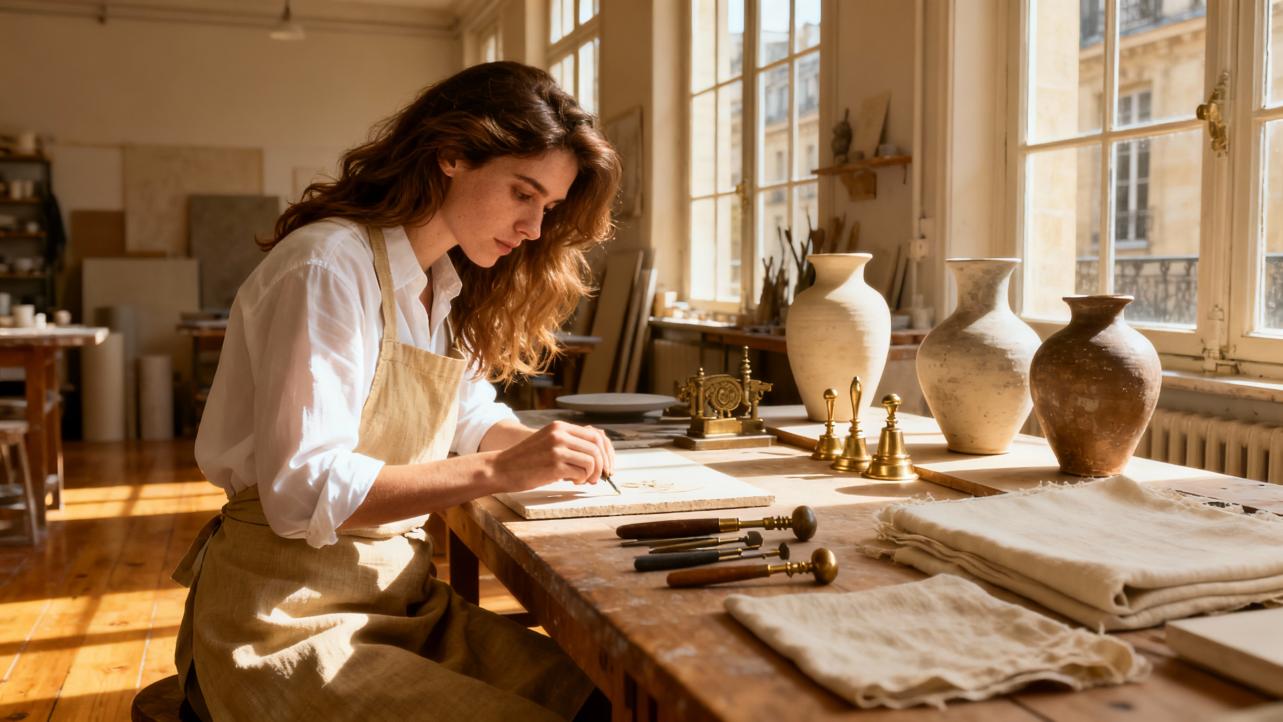
If you want to understand contemporary French custom art, step into the atelier, at least in your imagination. Sotheby’s describes the atelier tradition as the backbone of Western painting: a workshop where a master leads a team of apprentices and assistants, sharing both labor and knowledge. Since the Middle Ages, the French word “atelier” has meant a place where artists live, learn, and work under one roof.
Historically, this was where the magic happened. Students learned by copying the master so precisely that, as recounted in the atelier tradition, early works by Raphael were almost indistinguishable from those of his teacher, Perugino. These spaces were not always gentle; the rivalry between Titian and his former apprentice Tintoretto is legendary. Yet out of these rivalries came monumental works that still shape our sense of “classical” beauty.
In eighteenth and nineteenth century France, ateliers reached their cultural peak. Teachers like Jean-Léon Gérôme and Jules Joseph Lefebvre trained hundreds of artists from around the world, including Mary Cassatt, Thomas Eakins, and Odilon Redon. Their studios were cosmopolitan centers of influence, and photographs of these richly decorated spaces show artworks and sculptures lining the walls, underscoring how work, teaching, and display were intertwined.
Today, the atelier spirit lives on in contemporary artists too. Sotheby’s describes how the Cree artist Kent Monkman, for instance, follows a traditional progression of drawings, color studies, and then large studio-produced paintings inspired by figures like Rubens and Delacroix. He uses this old framework to tell new stories about Indigenous and queer identities, underlining how a stringent method can still serve radically fresh narratives.
When you commission custom art in the French vein, you are often stepping into an atelier mindset, even if the studio is digital or spread across cities. This usually means you can expect several things: rigorous drawing and composition; a stepwise process from sketches to color studies to final work; and a clear hierarchy of decisions, where the artist’s eye holds the final responsibility. It may feel structured, but that structure is what makes the final piece feel so considered and cohesive.

The Invisible Grid: Proportion, Format, And French Canvas Sizes
One of the most quietly “French” aspects of custom painting is something you may not notice at first: the format. France developed a standardized system of canvas sizes for oil painting, designed to make it easier for artists and framers to work together. Grokipedia outlines how these sizes are numbered (0, 1, 2, 3, and so on, up to 120) and how each number comes in three aspect ratios with the same long side but varied short sides.
This might sound dry, but it deeply shapes the feel of a custom piece. A size 0 canvas might have a long side of about 7.1 inches and shorter sides around 3.9 to 5.5 inches, perfect for intimate studies. At the other extreme, size 120 canvases stretch to roughly 76.8 inches on the long side and 38.2 to 51.2 inches on the short side, suitable for statement-making works in a foyer or grand living room. Mid-range sizes, with long sides between about 28.7 and 51.2 inches, appear frequently in galleries because they balance presence with practicality.
For you, as someone commissioning a sentimental piece, the size number becomes a quick way to talk about scale and mood with a French artist or framer. Instead of wrestling with raw dimensions, you can say, in effect, “We are looking for something in the mid-range that feels like a classic easel painting.” They might propose a size 20 or 30 format, knowing it will fit standard stretcher bars and frames.
Here is a simplified glimpse of what that looks like when you translate it into practical terms.
French Size Number |
Approximate Long Side (in) |
Typical Feel in a Home Setting |
Common Use in Custom Gifts |
0 |
About 7.1 |
Jewel-like, intimate, easily tucked on a shelf |
Small portraits, mini landscapes, “secret” love tokens |
20–30 |
About 28.7–36.2 |
Substantial but still cozy, fits above a console or sofa |
Family portraits, wedding scenes, meaningful landscapes |
60 |
About 51.2 |
Bold, room-defining, a clear focal point |
Anniversary statement pieces, large abstract emotions |
120 |
About 76.8 |
Monumental, almost gallery-like |
Corporate or public commissions more than private gifts |
Because these sizes are standardized, the artist can focus on composition instead of reinventing the frame every time. French painting traditions emphasize that composition must “hold together” at a distance and up close. Standardized formats help artists internalize compositional grids and rhythms that make their works feel effortlessly balanced.
When I help clients choose a format for a French-style commission, we talk not only about wall measurements but also about intimacy. A tiny devotional-like portrait on a 0 or 1 canvas feels like a secret kept near the heart. A size 30 family scene becomes the warm anchor over a fireplace. The stringency here is not about rules for rules’ sake; it is about giving the artist a harmonious stage on which your story can unfold.

Beyond Beauty: Value, Provenance, And Condition
French aesthetic standards extend beyond what you see on the surface. They also encompass how an artwork is valued, documented, and cared for over time. If you are commissioning a custom piece as a future heirloom, these deeper layers matter.
Cultural Value Versus Price Tag
Arte Generali, which focuses on collection and insurance guidance, warns that traditional appraisals too often fixate on auction prices. The problem is that auction data represents only a tiny slice of the art world, with less than one percent of contemporary production showing up in significant auction markets. That leaves most artists, including many custom art specialists, outside those metrics.
Sophie Perceval of Wondeur AI, cited by Arte Generali, suggests thinking of art prices as “temporal and plural.” In other words, there is never just one price. There are trajectories that rise or fall over time, and several types of value coexist. AI-based tools now distinguish between intrinsic value (relative to other artists’ careers), liquidity value at auction, and retail value at galleries or dealers. These tools look at exhibition histories, awards, and publications rather than auction headlines alone.
For a custom French artwork given as a gift, the most powerful value is usually neither auction-based nor purely retail. It is the fusion of cultural, historical, and emotional meaning. The fact that your painting arises from a lineage that runs from Gothic cathedrals, through Poussin and Delacroix, to Impressionism and beyond gives it cultural depth. The story you embed in it—the proposal, the anniversary, the memory of a grandparent’s garden—adds emotional weight.
The stringent French standard here is that an artwork should be more than décor. It should carry enough cultural and emotional substance that, if a future appraiser considered it, they would see more than a pretty image. They would see a well-crafted object with documented origins, a clear maker, and a story worth preserving.
Provenance And Documentation For Custom Works
Provenance, as Gallerease explains, is the documented history of an artwork. Strong provenance proves authenticity, reassures buyers, and can legitimately support a higher price. It is built from many possible documents: bills of sale, exhibition records, mentions in books, videos of the artist, and above all, a certificate of authenticity with clear details and verifiable signatures.
Even for a newly commissioned French custom piece, provenance starts the moment the artist’s brush first touches canvas. You may not be thinking of resale, but provenance still matters for insurance, inheritance, or simply peace of mind. A thoughtful French or French-inspired studio will usually provide:
A certificate of authenticity with the artist’s name, title of the work, medium, dimensions, and the date of completion, signed by the artist or by a recognized expert.
High‑quality photographs of the finished piece, sometimes with the artist in the frame, to make its identity harder to dispute later.
Clear documentation of the commission itself: your name as first owner, any dedications, and possibly the story behind the piece.
This is not about bureaucracy; it is a quiet act of care. When you keep this documentation safe, you are protecting not only financial value but also the narrative of your gift.
Condition Reports And Conservation-Level Standards
In France, conservation studios take documentation one step further through detailed condition reports. Atelier du Temps Passé, for example, uses specialized software to record the state of an artwork in a very structured way, including identification data (title, artist, medium, dimensions), high-definition photos, annotations showing cracks or losses, and an expert summary of overall condition.
These reports guide decisions about restoration, insurance, transport, and exhibition. They can also serve as evidence in legal or administrative settings, such as insurance claims. While your custom artwork may not need a condition report on day one, understanding that this level of scrutiny exists in the French ecosystem helps explain the mindset. A “finished” piece is not just judged for beauty. It is judged for structural soundness, materials, and its ability to hold up over decades.
If you are commissioning a piece that will travel far, especially internationally, ask your artist or studio how they document condition before shipping. A few well-lit close‑up photographs and a brief written note about condition can make any future restoration or appraisal much easier. It is a small habit borrowed from museum practice that sets French-style custom art apart.
How French Custom Art Is Actually Produced For Clients
Within this culture of high standards, how does a custom piece actually come to life? The process is surprisingly collaborative, but also carefully staged.
Art Project, a company that offers custom artwork production, describes its process with three simple verbs: discuss, propose, adjust. First, they discuss your needs, context, and any constraints for the artwork. Then they propose artistic concepts or production paths in response to that discussion. Finally, they adjust based on your feedback until the proposal truly matches your expectations and they are ready to produce.
When I work with clients on French-inspired commissions, this is exactly how it feels in practice. The initial discussion is where sentiment comes in. We talk about the story you want to honor, the person receiving the gift, the room where the piece will live, any beloved colors or objects that must appear. This is the emotional blueprint.
From there, the artist proposes. In the French tradition, that might mean small pencil studies for composition, quick color sketches, or digital mockups. Sometimes they experiment with different formats, using standard French sizes, to see which best suits the mood. This is where the atelier discipline shows itself: the artist is working within a system, not improvising randomly.
The adjustment phase is where modern approval workflows help translate stringent standards into a smoother experience. Filestage, a platform designed for artwork approvals, describes a review process where all feedback is centralized on the artwork itself rather than scattered across emails. Reviewers can annotate directly on the image, highlight text, compare versions side by side, and explicitly choose to approve or request changes. Their research suggests that using such centralized tools can significantly reduce review time, freeing artists and clients to focus on creative decisions instead of chasing email threads.
Although you may not see the software behind the scenes, a French-oriented custom art studio will often mirror this logic. They gather your comments in one place, track which notes have been resolved, and pay attention to deadlines so the piece is ready for the birthday, wedding, or holiday you are targeting.
There is a reason this can feel “strict.” You may be asked to approve sketches, then a color study, then a nearly finished version, instead of just seeing the end result. You may be gently pushed to clarify what you mean by “a bit more romantic” or “less formal.” It can feel like being quizzed on your own taste. Yet this structure protects your vision and makes sure the final piece is something both you and the artist can stand behind for years.

Evaluating French Custom Art Like A Curator, Not A Critic
Even with a gifted artist and a clear process, many clients feel nervous at the moment of final approval. How do you know the piece really meets those French‑level standards?
Here, a little self-evaluation framework can be comforting. EmptyEasel proposes a “crit sheet” for artists: a short checklist of questions they ask themselves about every artwork to keep growth focused and consistent. Glitter Meets Glue describes rubrics for student work that break down complex tasks into clear criteria like creativity, craftsmanship, and effort. Both approaches aim to reduce vague subjectivity and replace it with thoughtful, repeatable questions.
You can adapt this mindset as a client without turning your gift into a school assignment. When you look at your commissioned piece, try asking yourself gently:
Does this artwork express the feeling, message, or memory I wanted it to carry, without adding distracting elements?
Do I notice recurring strengths that feel “very us,” such as the way the artist handles light on skin, captures motion, or simplifies the background?
Are there aspects that feel weaker or off, such as a color that jars with your space, or a facial expression that does not quite match the person’s character?
Is there one broad area you might ask the artist to refine, like adjusting values for depth, softening a gesture, or shifting a dominant color slightly?
By keeping the questions consistent and specific, you move from “I just don’t know if I like it” to “I love the overall mood and likeness, but the background color feels too cold for our warm living room.” That is feedback an artist can work with, and it honors both their craft and your sentimental expectations.
Seeing Composition The French Way
Composition is one of the most critical French aesthetic standards, and it is often where you can most clearly feel the difference between a workshop-quality piece and a rushed decorative object. Worthwhile Magazine offers a lovely, simple test for composition when evaluating unsigned work: flip the painting upside down and step back.
When you turn the canvas 180 degrees and the image still feels balanced as an arrangement of abstract shapes, the composition is likely strong. If the whole thing collapses into chaos, it might rely too heavily on recognizable subject matter and not enough on underlying structure. The same article suggests squinting until details blur, which lets you judge the balance of lights and darks, and how forms relate to each other without getting lost in faces or trees.
French academic traditions, going back to artists like Poussin, placed immense importance on this hidden scaffolding. His painting “The Abduction of the Sabine Women” is a good example: behind the dramatic tangle of bodies is a carefully orchestrated arrangement of diagonals, verticals, and architectural anchors that guide your eye.
Try this at home with your custom artwork. Turn it upside down for a moment, or view a photo of it rotated on your screen, and then squint. Ask yourself whether the major shapes still form a coherent whole. Do they frame the central emotion, or do you feel pulled to the edges with no resting point? This kind of looking is not about being harsh; it is about honoring the artist’s work by engaging with it the way French teachers trained their students to see.
When Technology Joins The Atelier
French aesthetic standards are not stuck in the past. They are now interacting with AI, digital tools, and 3D technologies in fascinating ways.
Arte Generali highlights how new companies like Wondeur AI use big data to analyze artists’ exhibition histories and career trajectories, including those who are not yet present at auction. These systems separate intrinsic value from liquidity and dealer-based retail value, offering more nuanced views than a single price. They can help collectors and insurers estimate long‑term prospects, especially in volatile markets.
However, the same article stresses two important cautions. First, the future is fundamentally unpredictable; no model can guarantee that current reputations or prices will endure. Second, appraisers must not blindly trust AI outputs, and they must protect confidential artwork data. Recent guidance for US appraisers, such as the 2024 USPAP updates, emphasizes ethical use and data security.
In the realm of production and preservation, Paris Créations Virtuelles, for example, promotes 3D scanning and modeling as ways to “immortalize, design and preserve” objects in digital form. This technology is offered to individuals, professionals, public services, and galleries. For a precious sculpture or a textured mixed‑media piece, a high-quality 3D scan can be both an archival record and a creative playground for future display or virtual experiences.
If you are commissioning a French custom artwork as a once-in-a-lifetime gift, you might consider asking whether digital documentation is available. A high‑resolution scan or set of photographs becomes another layer of protection and storytelling. It is a modern echo of those atelier oil sketches and preparatory drawings that Sotheby’s describes as the “heart” of studio practice, revealing the artist’s thought process even after the main canvas has left the studio.

Practical Guidance For Commissioning French Custom Art As A Gift
So how do you bring all of this down to earth when you are choosing a heartfelt, handcrafted French-style piece for someone you love?
Begin with the story, not the style label. French art history, from Gothic to Impressionism and beyond, is full of ways to transform personal experience into visual language. Share the memories, objects, or places that matter most, and let the artist translate those into compositional choices, color palettes, and formats that fit the French tradition.
Talk about format and space early. Use approximate French size ranges as a shared vocabulary. If your wall can comfortably hold a long side of about 36 inches, that points the artist toward a mid-range size that will look intentional rather than cramped or overwhelming.
Embrace the atelier steps. When the artist offers sketches, color studies, or digital mockups, treat each as a gentle conversation rather than a test. This is where you refine, not redesign. Offer feedback that connects to your original intent: warmer, more familial, calmer, more dynamic.
Ask for documentation. A certificate of authenticity, a signed note from the artist, and a few well-archived photos turn your gift into a future-proven heirloom. Take inspiration from provenance practices described by Gallerease and the condition-report standards of studios like Atelier du Temps Passé.
Look with both heart and eye at the final piece. Use a simple, personal crit sheet in your head: Does this feel like the person or moment we wanted to honor? Does the composition hold together when I step back, squint, or even flip the image? Do any small refinements still feel necessary before we sign off?
Above all, remember that French stringency is not meant to be intimidating. It is a form of care. It is the belief that an artwork should be crafted, evaluated, and protected with the same seriousness as any cherished relationship.
A Few Gentle Questions, Answered
Is French-inspired custom art only for serious collectors? Not at all. The same standards used by museums and seasoned collectors can serve your family beautifully. What changes is not the level of care but the primary purpose: instead of focusing on investment or resale, you are prioritizing emotional resonance and long‑term meaning in a home setting.
Can I still have input if I am not “art literate”? Absolutely. In fact, your emotional clarity is often more useful than technical language. If you tell the artist, “This needs to feel like a summer evening at my grandmother’s table,” they can translate that into light, color, and composition. The atelier-style process of discuss, propose, and adjust is designed to help you articulate what matters, not to test your knowledge of art history.
Does following stringent standards make the art less personal? In my experience, it does the opposite. Structure and standards handle the craft, so the artist can focus their creativity on the unique parts of your story. When the proportions are thoughtful, the documentation careful, and the approval process responsive, the final artwork feels more like a shared achievement and less like a gamble.
In the end, understanding the stringent aesthetic standards of French custom art is less about memorizing rules and more about recognizing a posture: patience, attentiveness, and respect for both tradition and the story you are trying to tell. When you commission a piece in this spirit, you are not just buying a beautiful object. You are curating a future keepsake—one that can carry a piece of French artistic heritage and your own heart’s history in the very same frame.
References
- https://theartofeducation.edu/2024/12/september-assess-for-growth-and-transform-your-art-classroom/
- https://artincontext.org/french-art/
- http://www.fineartshipping.org/fine-art-procedures/customs-procedures-imports-taxes/
- https://www.sothebys.com/en/articles/the-modern-relevance-of-the-french-atelier-tradition
- https://www.theartstory.org/definition/french-art/
- https://www.tripadvisor.com/ShowTopic-g187147-i14-k2228541-Anyone_have_how_to_spot_fake_art_tips-Paris_Ile_de_France.html
- https://www.artworkarchive.com/blog/the-dos-and-don-ts-of-building-a-successful-visual-art-portfolio
- https://www.atelierdutempspasse.fr/en/condition-report
- https://aura-group.com/arts-culture-in-france/
- https://www.deepspacesparkle.com/evaluating-art-standards/
