

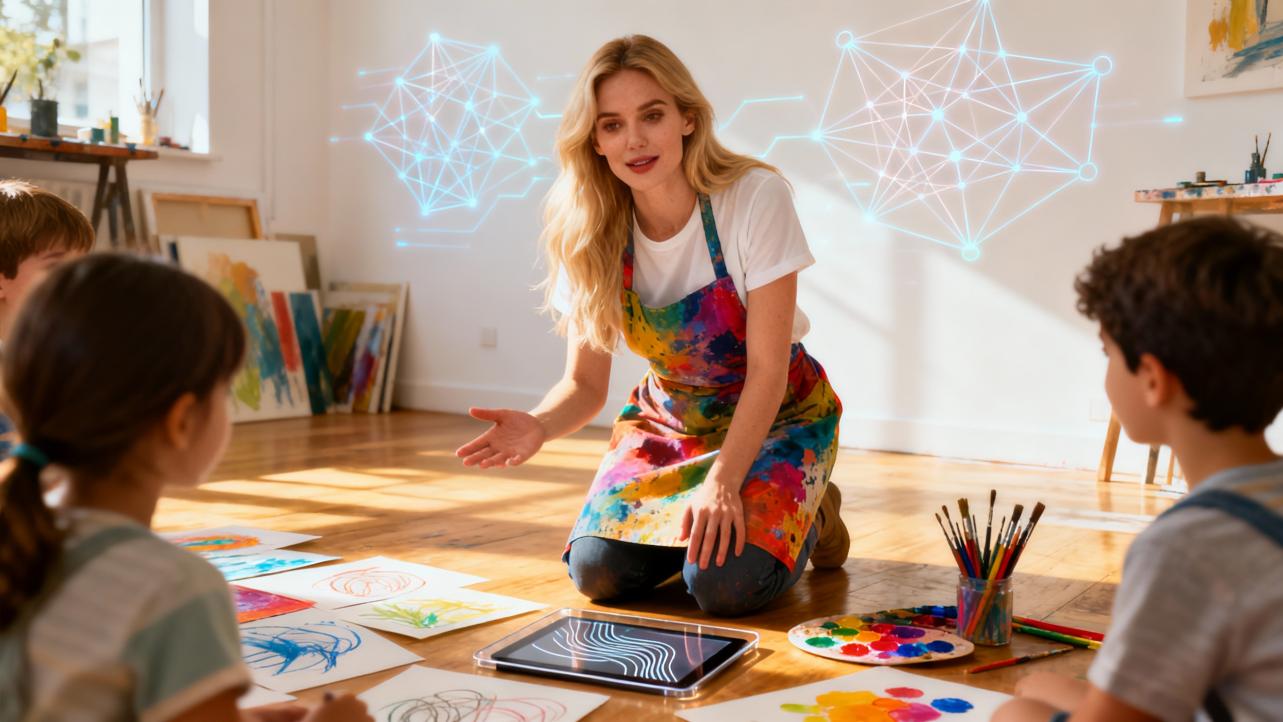
Can Neural Networks Mimic Childlike Art for Gift Design?
When a child hands you a crumpled sheet covered in wobbling lines and wild colors, you are not just receiving a drawing. You are holding a tiny record of their brain wiring itself, their feelings that day, and the story they were brave enough to put on paper. As an artful gifting specialist, I have watched parents tear up over stick figures that would never win a design award, yet mean more than any gallery print could.
Now neural networks can generate adorable “childlike” doodles on demand and even animate real children’s sketches. The tempting question arises: if AI can mimic that style, can it stand in for child art when we design sentimental gifts?
The real answer is more nuanced and, I think, more beautiful than a simple yes or no. To see why, it helps to understand what children’s art actually is, what neural networks are really doing, and how research on AI and kids’ creativity can guide us toward gifts that feel heartfelt rather than hollow.
Why Childlike Art Feels So Precious In Gifts
Child art looks simple, but developmental and education research consistently frame it as serious brain work. Early childhood specialists describe drawing and painting as “good brain food,” because sensory-motor play with art materials strengthens neural networks that support healthy brain activity and self-regulation. When a child drags a brush across paper or presses crayons into waxy layers, they are building fine motor skills, hand–eye coordination, and stress-regulation circuits, not just making a picture.
Process-focused art approaches for preschoolers, described by the National Association for the Education of Young Children, emphasize that the value lies in exploration, choice, and the experience, not in perfectly copying a model. In process art sessions, there are no step-by-step instructions, no single right outcome, and no pressure for every piece to look the same. Children experiment with tools, colors, and textures; they say things like “Look what I made!” and “Can I do another?” rather than “Is this right?” or “Mine doesn’t look like yours.”
Other educators echo this. Montessori-inspired art programs emphasize age-appropriate exploration, noting that toddlers and younger elementary children are not yet geared for complex planning of a final product. They benefit most from discovering lines, colors, and shapes with safe, simple materials rather than being asked to execute polished, adult-like pieces. Research on art and brain development highlights that this kind of hands-on, process-based making helps wire implicit memory, spatial intelligence, and language as children describe what they see and do in their artwork.
In short, childlike art is not just a style. It is a trace of cognitive growth, emotional processing, and self-expression happening in real time. That is why a parent might frame an uneven rainbow or “tadpole person” with arms coming out of a head: it is physical evidence of who their child was at that moment.
When we design sentimental gifts, what we are really bottling is that lived, developmental story. The question is whether a neural network, which learns from patterns in data rather than from scraped knees and bedtime stories, can capture enough of that story to serve as a meaningful stand-in.

How Neural Networks See Children’s Drawings
Neural networks are often described to kids as “computers that learn from patterns.” Articles introducing AI art tools for families explain that if you show an AI system hundreds of photos of dogs, it gradually learns what dogs usually look like and can then create new, imagined dogs or recognize dogs in new pictures. For art, many tools combine that kind of pattern learning with text prompts, allowing people to “paint with words.”
What happens when the input is not a photo but an offbeat child drawing with legs coming out of the head, eyes on the forehead, and a superhero cape that is more scribble than fabric?
A research team at Meta AI tackled exactly that challenge. They built an automatic system that takes children’s hand-drawn human or humanlike figures and animates them so kids can watch their characters dance, skip, or jump. Standard vision models trained on realistic images struggled badly with kids’ drawings, because children often use twisted perspective, irregular symmetry, duplicated or misplaced limbs, and cluttered backgrounds.
To handle this, the Meta AI system fine-tuned an object detection model (Mask R-CNN via Detectron2) using about 1,000 children’s drawings collected from employees’ families. Even then, the raw segmentation masks missed thin limbs or misread background clutter. The researchers combined bounding boxes with classical image processing methods such as adaptive thresholding, morphological operations, and flood fill to carve out a precise mask for each character.
Once the figure is isolated, another neural model, a pose detector retrained on annotated children’s drawings, estimates where key joints such as shoulders, elbows, knees, wrists, and ankles might be in these wildly nonstandard bodies. The system learned to cope with “tadpole people,” where limbs attach directly to the head, and transitional figures where legs sprout from the head and arms from the thighs. Finally, a skeleton and 2D mesh are overlaid on the drawing and animated, with motion choices tuned to how confident the system is about the detected joints.
The fact that this pipeline works at all is striking. From the network’s point of view, childlike art is not noise. It is an alternate but still decipherable representation of the same body concepts it learned from photos. That is the first key insight for gift design: neural networks can learn to see meaning in a child’s drawing in a way that roughly aligns with how we see meaning in it.
Cognitive science perspectives on art support this. Owain Evans, a researcher at the University of Oxford, argues that convolutional neural networks trained only on photographic data can generalize to stylized art without being exposed to art during training. In work on feature visualization and Deep Dream, researchers synthesized images that maximize activations of neurons in object-recognition networks. Surprisingly, these images included abstract geometric patterns and stylized animal-like forms that resemble motifs found in decorative and abstract art. That suggests that once a network has learned to recognize objects, it implicitly encodes a kind of visual style space that can be steered, even without explicit “art lessons.”
So, neural networks can recognize and even create art-like patterns. But can they really mimic the soulfulness of child drawings in a way that feels gift-worthy?

From Recognition To Imitation: Can Nets Mimic Child Style?
Evans contrasts two views of how humans understand stylized art. The “art-specific” view posits specialized skills or even an evolved “art instinct.” The “generalist” view claims that the same visual system that recognizes everyday objects is enough; art simply exploits those general capacities. Neural networks trained only to recognize objects, then tested on paintings and line drawings, offer a kind of controlled experiment that favors the generalist view. Models such as YOLO, trained on photos, can label objects in paintings fairly well, though still below human performance.
When researchers push these networks to generate images via feature visualization, they are not training them to be artists. They are simply asking, “What input would really excite this neuron?” The resulting images often become superstimuli: exaggerated patterns such as grids, zigzags, spots, or simplified animal forms that strongly activate visual features. These are reminiscent of certain abstract paintings or decorative borders. Deep Dream, which maximizes activations across entire layers, transforms ordinary photos into surreal, densely detailed images that feel surprisingly like caricatures or dreamlike illustrations.
From a design standpoint, this means neural networks can absolutely produce visual patterns that read as playful, naive, or childlike. They can imitate markers of “kid art” such as bright color blocks, repeated motifs, or simplified faces. Tools aimed at children, like Quick, Draw! and AutoDraw, go further by turning rough sketches into recognizable icons and guessing what a child meant to draw, offering a kind of auto-correction in a child-friendly style.
However, the intent and process are fundamentally different. In Deep Dream or feature visualization, networks are optimizing activations in their own internal feature space, not telling a personal story. They produce images that are efficient keys for their “locks of perception,” to borrow art historian E. H. Gombrich’s metaphor, but they do not have autobiographical memory attached to those keys.
This distinction becomes important when we move from “Is this visually childlike?” to “Does this carry the same emotional and developmental meaning as a child’s own drawing?” For sentimental gifts, that second question matters at least as much as the first.
What AI Painting With Kids Actually Does, According To Research
A growing body of research looks directly at AI-based painting tools and children’s creativity, and it offers useful guidance for anyone blending AI and child art in gift design.
A PRISMA-guided systematic review of 20 empirical studies on AI-based painting and children’s creative thinking found a consistent pattern: when thoughtfully integrated, AI painting tools generally enhanced children’s creative output compared with traditional paper-only activities. Children generated more varied, unconventional ideas that judges rated as more original and innovative. AI systems acted as cognitive scaffolds by reducing technical barriers, converting narratives into images, or automating low-level tasks, leaving more mental space for idea generation and experimentation.
Another study developed a children’s digital art training system that paired augmented reality smart glasses with an AI engine using a pix2pix conditional GAN. The system captured students’ drawings, recognized outlines, and overlaid expert-like color recommendations and pigment mixing ratios when students requested help. In a quasi-experiment with fourth graders, the group using the AI and AR system showed significantly higher gains in imagination and painting performance than a control group using traditional pigments and tools alone. The authors concluded that integrating AI-assisted coloring into K–12 art learning can effectively boost imagination, color recognition, and overall painting quality.
At the same time, the systematic review warns of risks that are particularly relevant in the context of sentimental gifts. Standardized AI interfaces can lead to cognitive homogenization, where children’s outputs start to look similar because the system gently nudges everyone toward the same kinds of solutions. There is also concern about over-reliance, where children may defer too quickly to AI suggestions instead of wrestling with their own choices.
A separate co-design study with children aged seven to thirteen, conducted through the KidsTeam program at the University of Washington and the Joan Ganz Cooney Center, explored how kids actually experience generative AI tools such as ChatGPT, DALL·E 2, and music generators. The researchers found that children do not automatically perceive AI as a magical creativity booster. They need guidance and reflection to understand what the tools can and cannot do, and how to turn AI outputs into personally meaningful projects. Importantly, the study highlighted “creative self-efficacy”: children’s belief that they can be creative. AI can strengthen this belief by making it easy to try ideas quickly and see them realized, but only if adults frame AI as one tool among many, rather than as the true author.
Children also held nuanced views about authorship and authenticity. For example, they expressed mixed feelings about friends using AI to help with birthday cards. They cared whether the message felt genuine, not just whether it looked polished.
Taken together, these findings suggest a subtle but powerful design principle: AI can expand the playground for child art and make more ambitious, visually striking gifts possible, but it should not be allowed to silently replace the child’s own thinking or mark-making. The most meaningful gifts will keep the child’s authorship visible and emotionally legible, even when neural networks play a role behind the scenes.

Designing Gifts With AI-Infused Child Art
Once we honor those principles, neural networks can become delightful collaborators in sentimental gift design. The key is to start from the child and use AI to amplify, animate, or gently embellish what is already theirs.
Animate The Drawing, Do Not Replace It
The Meta AI work on animating children’s drawings offers a beautiful blueprint. Their system takes a child’s own character, learns where the joints probably are, builds a skeleton and mesh under the original lines, and then makes that figure move. The resulting animation still looks unmistakably like the child’s drawing, quirks and all, but now it can dance or jump.
Translating that idea into gifts, you might begin by photographing or scanning a favorite drawing in soft, even light. An AI-powered animation tool can then turn that static sketch into short loops of motion. Families can turn these sequences into digital greeting cards, animated slideshows for grandparents, or even printed flipbooks where each page is a frame of the child’s character leaping or waving.
From a sentimental perspective, this approach preserves authorship. The shape of the head, the length of the limbs, the uneven smile: all come directly from the child. AI simply breathes motion into the drawing, much the way a music box animates a small figure without altering its design.
“Paint With Words” Together
Text-to-image tools described in family-focused AI art articles invite children to “paint with words.” A child describes a scene, such as “a green dragon playing in a puddle in front of my school,” and the neural network generates an image that tries to match that description.
Used thoughtfully, this can be a wonderful way to design custom gifts that capture a child’s imagination even when their motor skills cannot yet match their mental picture. It also supports language development, because children have to practice describing the styles, textures, and moods they want to see. Articles on AI art for kids note that this prompt iteration naturally teaches concepts such as style and tone as children refine their requests and compare different outputs.
Imagine sitting at a kitchen table with a child, a notebook, and a laptop. Together, you brainstorm a “story picture” for a grandparent’s gift, perhaps involving family in whimsical roles: Grandpa as an astronaut, Grandma as a gardener on Mars, siblings as space explorers. The child supplies the ideas and descriptions while you help type and adjust prompts. Once you have an image that feels right, you print it on archival paper, have it mounted on wood or canvas, or adapt it into a custom jigsaw puzzle.
Here, the neural network is mimicking childlike fantasy more than childlike linework. The emotional core still comes from the child’s words and narrative choices, and gift recipients often feel that immediately when they hear the child explain the scene.
Hybrid Workflows In The Studio
Some of the most beloved keepsakes I have seen in the studio come from hybrid workflows that blend physical mark-making, AI support, and artisan finishing. Research on AI painting platforms describes how digital tools can enrich exploratory, improvisational, and game-based learning by offering diverse materials and environments. A child might begin with a simple drawing in a sketchbook, then photograph it and use an AI coloring assistant modelled after the pix2pix system to explore different color schemes. They compare a glowing sunset palette to a cool twilight version, perhaps learning a bit of color theory along the way.
Once the child chooses their favorite combination, we translate it into a physical medium. That might mean screen-printing the image onto cotton for a throw pillow, etching a simplified version into a metal pendant, or laser engraving it into a wooden keepsake box. The child’s original lines remain the backbone of the design, yet neural networks have expanded the range of achievable finishes, especially for small studios without in-house digital painting expertise.
Benefits And Limitations At A Glance
To ground this conversation, it helps to compare AI-mimicked child art with directly child-made art and with hybrid, cooperative approaches.
Aspect |
Handmade child art in gifts |
AI-mimicked child style |
Hybrid child + AI collaboration |
Visual qualities |
Often uneven, spontaneous, highly individual; shows real motor development |
Can imitate naivety, bright colors, simple forms; stylistic variety depends on training data |
Keeps child’s structure or story while refining color, composition, or motion |
Emotional meaning |
Strong autobiographical trace; families connect it to specific memories and ages |
Emotion depends on recipient’s understanding of how it was made; may feel generic if origin is unclear |
Often reads as both personal and polished when child’s role is visible and explained |
Impact on creativity |
Directly exercises drawing, planning, and motor skills; aligns with process art and drawing-to-learn frameworks |
May encourage idea exploration but can also invite passivity if system drives decisions |
Research suggests boosts in imagination and originality when AI is used as scaffold, not replacement |
Risk of homogenization |
Low; quirks reflect individual child and context |
Higher; interfaces and defaults can subtly push toward similar outputs |
Moderate; mitigated when adults emphasize experimentation and personal choices |
Practical accessibility |
Requires basic art supplies and time; few technical barriers |
Requires devices and tools; can lower technical bar for complex imagery |
Requires some technical setup but can leverage simple capture (photos, scans) plus guided digital steps |
The research reviewed earlier suggests that the hybrid column is where we see the best of both worlds. AI tools used as scaffolds and playmates tend to enhance originality and painting performance, especially when aligned with thoughtful pedagogy. Risks of homogenization and over-reliance rise when AI-generated images simply replace child effort rather than support it.
For gift design, this points to a simple litmus test. If someone looked at the finished piece and asked, “Where is the child in this?” you should be able to answer clearly, whether by pointing to their original lines, their words that shaped the prompt, or their decisions about color, composition, or story.

Practical Guidelines For Heartfelt, AI-Enhanced Gift Design
Begin With The Child’s Hand
Educational research on drawing-to-learn in biology education emphasizes that learner-generated drawings are powerful tools for thinking and communicating. Even simple, boxy sketches or stick figures help students build internal models and make their reasoning visible. Art educators repeatedly note that artistry is not a prerequisite; in many contexts, simple shapes carry the necessary meaning.
For sentimental gifts, it is wise to adopt the same attitude. Invite children to make something by hand first, no matter how rough. This could be a single character, a symbol, or even a pattern of favorite shapes. Photograph or scan that mark-making, then allow neural networks to interpret, color, or animate it. The resulting piece will carry a deeper trace of the child’s development than a purely AI-generated “childlike” image that never passed through their fingers.
Protect Process, Not Just Product
Process-focused art approaches show that when children are allowed to explore materials without strict models, they relax, concentrate, and experience genuine joy in making. Their comments shift from comparison and anxiety (“Mine doesn’t look like yours”) to ownership and curiosity.
When planning AI-assisted gift projects, preserve this spirit. Rather than announcing, “We are going to make a perfect picture for Grandma,” you might say, “Let’s play with some colors and shapes Grandma loves, then see what surprises we can create together, maybe even with some help from the computer.” Encourage the child to start, stop, and revisit the project as they wish. If an AI suggestion does not feel right to them, let that be a moment of creative decision, not a correction they must accept.
Support Creative Confidence, Not Dependence
The KidsTeam research highlights that AI can build children’s creative self-efficacy when they see their ideas quickly realized and when peers’ successes encourage them. Yet it can also undermine confidence if children start to believe that AI is the real artist and they are merely operators.
The PRISMA review of AI painting tools recommends that educators choose age-appropriate systems and integrate them with clear pedagogical and humanistic intentions, using process-oriented assessments that focus on how children generate and refine ideas, not just on the prettiness of final products. Parents and gift designers can borrow this mindset.
As you work on a gift, name the child’s contributions out loud. You might say, “You came up with the idea of Grandpa as a space gardener,” or “You chose this color palette,” or “You decided when the dragon’s pose felt right.” When you discuss the finished piece with the recipient, highlight the child’s role rather than the cleverness of the AI.
Be Transparent About AI’s Role
Children in the KidsTeam study cared about authenticity. They felt differently when a friend wrote a birthday card using their own words versus copying text from an AI. This sensitivity suggests a simple but important practice in gift design: be open about how AI was used.
If a gift is largely based on AI-mimicked child style rather than direct child art, consider including a short note from the child explaining how they worked with “a computer helper” to make it. This frames AI as a tool, not a secret ghostwriter, and invites recipients into the creative process. It also models healthy attitudes about authorship and originality, topics that will only grow more important as children encounter AI tools in school and play.
Keep Screens In Balance With Sensory Play
Articles on art and brain development stress that children need direct sensory experiences—touching clay, dragging brushes, feeling the drag of crayon across paper—to fully develop fine motor control, spatial reasoning, and stress-regulation networks. AI tools, powerful as they are, cannot replace the feel of paint under small fingers.
When designing gifts that involve neural networks, balance screen time with tactile time. You might spend part of the afternoon smearing tempera paint on large paper outdoors, then photograph a favorite section and use AI to explore alternate compositions or colors. The final gift can honor both layers: a digital print that carries an echo of the original texture and a small, unedited section of the physical painting tucked into the frame or inside the gift box.

Brief FAQ
Is it wrong to use only AI-generated childlike art for a gift?
Morally, the answer depends on transparency and intention. If a child did not participate, but the gift is presented as if they made it, that can undermine trust and devalue their real efforts. If you are candid that you used AI to create something in a playful, childlike style as a design choice, recipients can appreciate it as such, but it will not carry the same autobiographical weight as a child’s genuine drawing.
What if my child dislikes drawing but loves telling stories?
Research on AI art for kids shows that “painting with words” can be liberating for children whose ideas outpace their drawing skills. In that case, treat neural networks as an illustration partner. Let the child dictate rich descriptions, choose among AI-generated variations, and then maybe add small hand-drawn details or signatures. The gift will still reflect their imagination, even if the lines were not all theirs.
Do I need advanced tools to do any of this?
Not necessarily. Studies showing benefits from AI-assisted art range from sophisticated AR systems with smart glasses to relatively simple sketch-interpreting tools that run on standard devices. In day-to-day gifting, a phone camera, a few kid-friendly AI art apps, and access to a print service or local maker studio are often enough. The depth of meaning comes from how you center the child’s ideas and gestures, not from how cutting-edge the model is.
In the end, neural networks can mimic many surface features of childlike art and even help children realize ideas that their hands cannot yet render alone. But the heart of a sentimental gift is not the style; it is the story of the small person behind it. When we let AI sit beside that child as a curious assistant rather than stand in for them, we can create gifts that feel both enchantingly modern and deeply, timelessly human.

References
- https://pmc.ncbi.nlm.nih.gov/articles/PMC12572844/
- https://theartofeducation.edu/2024/09/back-to-basics-spilling-the-tea-on-how-to-teach-observational-drawing-with-confidence/
- https://arxiv.org/pdf/2408.01481?
- https://www.lifescied.org/doi/10.1187/cbe.14-08-0128
- https://www.nea.org/nea-today/all-news-articles/express-yourself-arts-integration-classroom
- https://joanganzcooneycenter.org/2024/09/24/can-ai-help-kids-feel-creative/
- https://www.naeyc.org/resources/pubs/tyc/feb2014/process-art-experiences
- https://artcoastdesign.com/blog/neural-networks-the-future-of-design
- https://bycoryshaw.com/ai-art-for-kids-a-new-way-to-encourage-creativity-and-imagination/
- https://www.deepspacesparkle.com/top-eight-tips-for-teaching-art-to-children/
