

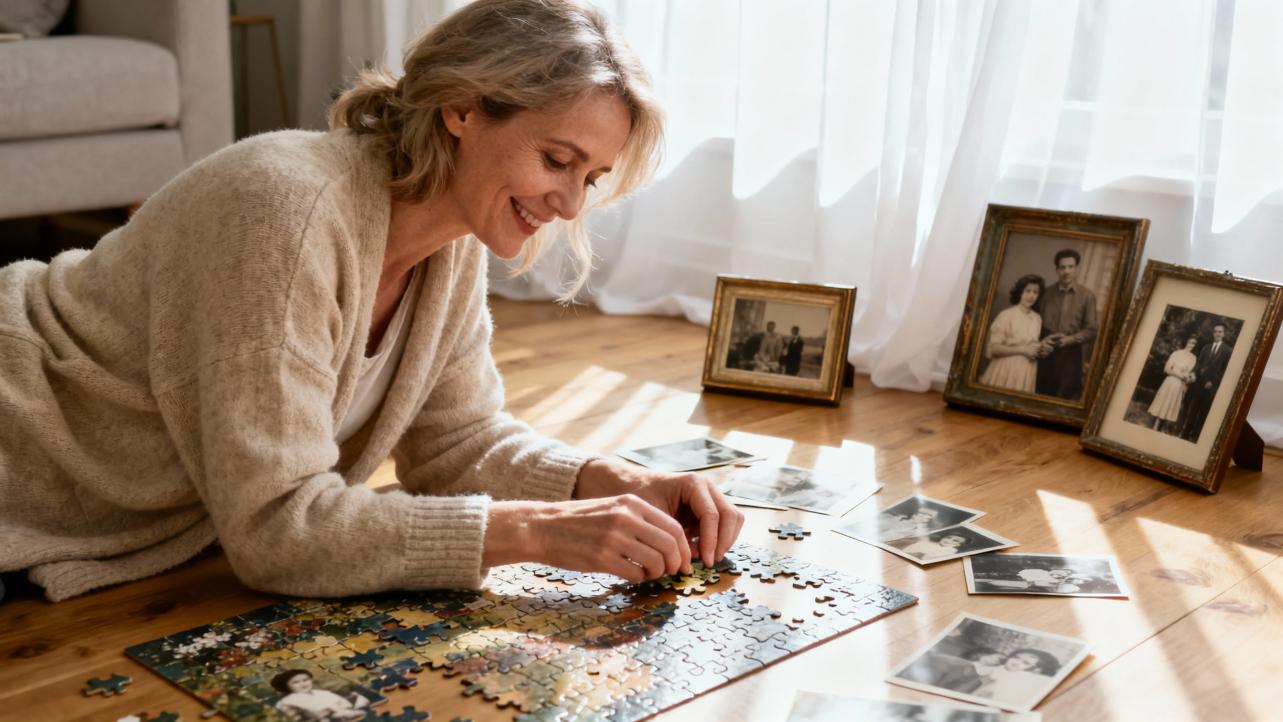
Integrating Multiple Family Photos into Artistic Puzzles Using AI
Family photos are tiny time machines. They hold the look on your child’s face right after blowing out birthday candles, the way your grandparents leaned toward each other at their anniversary dinner, the dog who always ended up in the middle of every scene. As an artful gifting specialist, I love taking those memories and turning them into something you can touch, hold, and gather around together: an artistic puzzle.
Today, AI makes it possible not only to transform a single photo into a jigsaw, but to weave multiple family images into one rich, puzzle-ready artwork. When done thoughtfully, the result is a heartfelt heirloom that feels part gallery piece, part game night tradition.
In this guide, I will walk you through how AI tools can help you blend multiple family photos into puzzles, both physical and digital, while keeping the soul of your memories front and center.
Why Multi‑Photo Family Puzzles Feel So Special
A single-photo puzzle is already sentimental, but integrating several family photos into one design creates a visual story rather than a snapshot. Rather than choosing one favorite moment, you can celebrate a whole chapter: perhaps baby photos evolving into graduation, or holidays that repeat every year, all nested into one scene.
Articles on image-to-puzzle tools from platforms like Vidnoz describe how turning personal photos into puzzles blends creativity with entertainment and gives families a playful way to relive cherished memories. That observation matches what I see in practice. When a puzzle includes several faces and places, each piece becomes a fragment of narrative, not just a patch of color.
Multi-photo puzzles also work beautifully across generations. Older family members enjoy recognizing moments from “their time,” while kids discover relatives and stories they may only have heard about. Solving the puzzle together becomes a gentle excuse to share those stories again.

What AI Photo Puzzles Actually Are
Before we design anything, it helps to understand the main puzzle formats AI can support. Modern tools do much more than slice one image into cardboard pieces.
From Simple Jigsaws to Smart Interactive Games
Many web tools and platforms now convert photos into puzzles with barely any technical skill required. Vidnoz highlights a landscape of picture-puzzle makers that can turn images into jigsaw-style games in minutes, whether you prefer web-based tools or phone apps.
Some tools remain fairly traditional. For example, Picture Puzzle Maker allows you to upload an image and convert it into several puzzle styles, including jigsaw, sliding, reorder, and categorize games. Teachers and parents use it to create learning games like memory matching or label-this-image activities, built around their own photos.
Other platforms focus on play and instant gratification. I’m a Puzzle lets you upload a picture and immediately play it as a browser-based jigsaw, and it also offers a large library of themed puzzles such as animals or holidays. You can adjust difficulty and modes, turning a simple family photo into anything from a relaxed five-minute warmup to a more serious challenge.
Some tools wrap AI around the process. Articles from ReelMind describe how AI-powered systems analyze edges, textures, and color gradients to segment photos into coherent puzzle pieces rather than simply cutting a grid. Generative AI and deep learning help control piece shapes, sizes, and difficulty, and low-code trends mean non-technical creators can use these capabilities without writing a line of code.
Interactive AI photo puzzles also appear in marketing and education. ReelMind notes that personalized puzzles increase time-on-page and engagement, which is one reason interactive content is projected by Grand View Research to reach about $24 billion by 2027, while Statista expects global digital advertising to exceed about $780 billion by 2025. For families, the same dynamics translate into something simpler: these puzzles are sticky, playful, and memorable.
Beyond Jigsaws: Logic Puzzles and Image Mazes
For an even more artisanal feel, you can go beyond classic jigsaws into more unusual puzzle forms, many of which have been explored in research.
One direction is picture-logic puzzles, also known as Nonograms or Japanese puzzles. A paper on automated picture-logic puzzle generation shows how RGB images can be converted into black-and-white or color grid puzzles, where numbers along rows and columns encode runs of filled cells that reveal a picture. The authors describe a pipeline that resizes and filters images, then uses a logic solver to ensure each puzzle has a unique solution. While this is a research system rather than a consumer app, the idea is powerful: a family photo can become a logic puzzle where the final image emerges only after careful deduction.
Another direction is image mazes. Researchers at the University of California, Berkeley describe “image mazes” where maze corridors and walls are arranged so the entire maze resembles a chosen image such as a logo, silhouette, or cartoon character. Their system analyzes the input image, overlays a grid, and builds a maze whose solution path still works as a maze but also preserves key visual features. Translating that to gifting, a family silhouette or initial could become a maze puzzle on a card or print, with the solution path tracing around familiar contours.
These formats require more specialized tools, but the underlying message is encouraging: AI and algorithmic design can reinterpret your family photos as many kinds of puzzles, not just standard jigsaws.

Planning the Story in Your Puzzle
Choosing and Preparing Your Photos
When families come to me with a folder of photos, the first step is not software at all. It is story.
You might choose a single event such as a wedding, then pick photos that show getting ready, the ceremony, the first dance, and the late-night laughter. Or you might choose a “through the years” sequence for a child or couple. The point is to pick images that belong together emotionally, not just visually.
From there, think about variety. Notes from AI puzzle designers emphasize that good puzzle images have clear structure, distinct regions, and varied textures, rather than huge flat areas. In practice, that means mixing close-ups and wider shots, adding a background with architectural lines or foliage rather than a flat wall, and accepting a bit of visual complexity.
Before sending photos through AI tools, it helps to make light edits. Cropping to remove distractions, gently adjusting exposure, and aligning horizons all pay off when the images are fused or turned into puzzles. Since some AI tools impose upload limits, like the AI Jigsaw Puzzle Generator that accepts jpeg, jpg, png, and webp under about 5 MB per image, exporting in a web-friendly format with moderate compression avoids headaches later.
Designing with Fragments, Not Just Full Pictures
One powerful way to integrate multiple family photos is to work with meaningful fragments instead of whole frames. An article on “Complete the Image” puzzles describes a format where only partial corners or close-up details of objects are shown, and players must guess the full object. The author explains how different difficulty levels depend on how much of each object is visible: easy puzzles show more obvious segments, while hard puzzles only show abstract textures.
That same logic works beautifully for family photos. Instead of placing four full pictures in a grid, you might show a child’s sneakers on the beach, a close-up of your grandparents’ hands, the corner of a birthday cake, and a distinctive window frame. The game for the family is to match each fragment to the full scene in their memories.
The same guide recommends choosing objects with distinctive details such as handles, corners, or textures, and cropping to iconic parts rather than bland areas. Applying that insight to family images, you want the details that are unmistakably “you”: the pattern of a favorite blanket, your dog’s collar, the porch railing everyone leans on.
Path One: Collaged Family Portrait → Printed Jigsaw
For many families, the dream gift is a physical jigsaw puzzle in a keepsake box. AI can help you create a unified collage that blends multiple photos into one richly layered image, which can then be turned into a real puzzle.
Creating a Unified Artistic Image with AI
Multi-model platforms described by ReelMind are especially adept at multi-image fusion. They mention a library of more than a hundred AI models, some focused on consistent styles and fine-grained visual control. While their examples center on branded content and cinematic video, the same tools can fuse several photos into a cohesive still image.
A typical workflow looks like this in practice. You gather three to six curated family photos and decide on an overall mood, such as soft watercolor, high-contrast black and white, or a cozy film-like palette. Using an AI art platform that supports image guidance, you upload your chosen photos, describe the setting and style you want, and ask the system to compose an image where these memories coexist naturally. The best results come when your prompt mentions both the emotional tone and key visual anchors, such as “cozy living room gallery wall with framed family memories” or “storybook collage of our travels around a central family portrait.”
Mentions in puzzle-focused research emphasize that puzzle-friendly images benefit from distinct regions and clear edges. When you evaluate AI outputs, look for natural boundaries where puzzle pieces will be easy to distinguish: frames, doorways, trees, clothing edges. Avoid images that dissolve into very flat skies or large areas of nearly solid color, which can make solving frustrating.
Generating the Puzzle Layout
Once you have a collage you love, you need to convert it into a puzzle layout. Some tools, such as the AI Jigsaw Puzzle Generator, will take your finished image and automatically transform it into a jigsaw-style layout after you upload a compatible file under the size limit. The interface is streamlined: you click or drag your image into a central upload area and let the system handle the puzzle generation.
Other tools work more as editors. Pixelcut’s “Edit puzzle with AI” feature, for example, showcases a scenic mountain photo transformed into a wooden jigsaw puzzle look. Although the scraped text is minimal, the example image suggests that some tools stylize the picture with realistic puzzle-piece textures even before it is cut into pieces, giving you a preview of how the final item will feel.
For creators who prefer more control, research notes about AI-created puzzle images recommend aiming for high resolution, often on the order of a few thousand pixels on the long side at about 300 DPI, so that when the art is printed, details remain crisp. Even when a tool does not expose piece counts directly, starting with a high-quality source image gives you flexibility when choosing puzzle sizes.
Printing as a Heirloom Gift
With a puzzle-ready image in hand, printing services turn your design into something you can hold.
Printify describes a workflow where you create a free account, browse puzzle products of different sizes and packaging, choose one, then click “Start designing” to upload your image inside their Product Creator. You can position and scale the art, and if you wish, layer in additional graphics from their library. Although their primary audience includes merchants who connect to online stores, the same system works for a one-off family gift as long as you complete checkout.
OpenPrints presents itself as a provider of high-quality prints for home and business, including puzzles and posters. Their messaging emphasizes quality and fast delivery, taking pride in each print and each customer. Combined with a lovingly designed AI collage, services like this can turn your digital creation into a keepsake that lives on the coffee table rather than in a folder on your computer.
At this stage, it pays to proof your image at full size. Facebook discussions among puzzle lovers about AI-generated art have pointed out typical flaws, such as strange eyebrows, distorted hands, or partial objects that look “off.” The teacher from Artful Ideas Classroom also noticed that free DALL‑E images often contain subtle irregularities and ignored instructions, especially in complex hidden-object scenes. Before you commit to a printed puzzle, zoom in on faces, hands, and small objects to make sure the AI has not added anything unsettling.

Path Two: Interactive Digital Puzzles for Your Family
Not every puzzle has to live in a box. Sometimes the most engaging gifts come as links, apps, or playful experiences that family members can share across states and time zones.
Turning Photos into Clickable Puzzles
Many web-based picture-puzzle platforms allow you to upload your own photos and generate puzzles that run entirely in the browser. Vidnoz’s overview highlights Picture Puzzle Maker, which supports multiple puzzle styles and offers easy sharing or embedding, making it ideal if you want to create a small private “puzzle gallery” page for relatives.
I’m a Puzzle takes an even more casual approach by allowing you to drag in a family photo, generate a puzzle instantly, and then share or replay it. Difficulty sliders let you scale up piece counts as your family becomes more adept.
Articles from The Data Scientist describe AI-powered puzzle games that can take user-uploaded photos and convert them into playable puzzles, often using computer vision to segment images into pieces and adjust difficulty levels. Some systems adapt to how quickly or accurately a player solves prior puzzles, nudging challenge up or down over time and creating personalized experiences.
When using such platforms with family photos, it is worth paying attention to privacy. The Data Scientist notes that photo-based puzzle games may raise questions about how user images are stored and processed. Before you upload cherished family moments, check whether the service explains if photos are retained, how long they are stored, and whether they are used to train models.
Designing Guessing Games and Hidden-Object Hunts
Beyond straightforward jigsaws, AI can help you build playful guessing games powered by your family’s own images.
The “Complete the Image” puzzle format explained by Easy AI Beginner shows how you can generate a 2×2 grid of partial images and have players guess each object. The author suggests clear knobs for difficulty: easy puzzles show obvious segments and main shapes, while harder ones rely on zoomed-in textures and abstract fragments. They also recommend choosing objects with distinctive details and testing the puzzles with real people to see if the difficulty feels right.
You can adapt this model to family content. Imagine a grid of four cropped details from different family photos: the corner of Grandma’s quilt, a segment of a Halloween costume, a bit of a childhood bedroom, a slice of a birthday banner. Using an image-capable AI like ChatGPT with a carefully crafted prompt, you can ask it to generate a “Complete the Memory” puzzle grid that hints at each scene without revealing it outright. Family members then guess which event or year each fragment represents.
Hidden-object puzzles are another lovely format. The Artful Ideas Classroom blog documented a digital art teacher’s attempt to use free DALL‑E via ChatGPT to create a salon-style gallery scene with art tools hidden in the paintings and sculptures. Despite careful prompts, she found that the AI struggled to produce recognizable, consistent hidden objects that matched the answer key. Objects were distorted, the key and scene did not align, and fixing one aspect often broke another.
For family puzzles, this tells us two things. First, complex hidden-object scenes with strict matching requirements can still be challenging for current free AI tools, so plan to review and edit outputs rather than expecting perfection. Second, simpler constraints—such as hiding small framed photos within a larger AI-generated room, or overlaying subtle symbols—are more reliable. You might let AI generate the base room or landscape, then manually place small, clean photo cutouts in a standard image editor so you control their clarity and position.

Path Three: Advanced Artistic Puzzles for Family Photos
If you love unusual puzzle formats, AI-inspired research opens doors to more experimental gifts.
Picture‑Logic Grids Inspired by Nonograms
The paper on automated generation and visualization of picture-logic puzzles explains how arbitrary RGB images can be converted into Nonograms: grids where numbers on rows and columns describe runs of filled cells that encode an image. Their pipeline converts images to grayscale, resizes to puzzle dimensions, optionally smooths noise, and then runs a logic solver to ensure each puzzle has a unique solution. For color versions, they employ color quantization and even a genetic algorithm to reduce the palette while preserving recognizable structure.
While this system is academic rather than consumer-grade, it suggests creative ways to reinterpret family photos. You could start by simplifying a favorite portrait into a high-contrast, almost posterized image and then use or commission a tool inspired by Nonogram generation to map it into a grid puzzle. The result is a puzzle that reveals the family image only piece by piece through logical deduction.
The authors note that the density of black cells and the palette strongly influence difficulty and recognizability. That aligns with gifting considerations: if you are designing for younger solvers or casual puzzle fans, aim for moderate density and clearly defined silhouettes rather than extremely abstract compositions.
Family Silhouettes as Image Mazes
The Berkeley work on interactive image-based maze design offers another poetic option: turning a family symbol into a maze. Their method extracts key shapes and edges from an image, overlays a grid, classifies cells as walls or corridors, and then creates a maze with exactly one solution path. Corridors tend to hug major edges so the original silhouette remains recognizable.
For a sentimental piece, you might use a simplified family portrait, a monogram built from initials, or even the outline of a beloved pet. The maze then becomes both a game and a visual emblem of the family. Printed as a poster, card, or cover page for a family photo book, it invites loved ones to “find their way through” a familiar shape.
The researchers highlight that input images with clear, high-contrast shapes work best, while very detailed or textured images often must be simplified first. In practice, that typically means converting your source to a clean black-and-white silhouette before sending it through any maze-making process.
Pros and Cons of Using AI for Sentimental Puzzles
AI is not magic, and it is not a replacement for artistry or care. It is a collaborator. To decide how much you want to rely on it, it helps to see its strengths and weaknesses side by side.
Aspect |
Where AI Shines |
Where AI Falls Short |
Speed and accessibility |
Platforms like ReelMind and Vidnoz highlight low-code and no-code tools that let non-experts create puzzles in minutes from ordinary photos. |
Free models, as the Artful Ideas Classroom teacher observed, can misinterpret instructions or ignore details, requiring multiple iterations and manual fixes. |
Variety and creativity |
AI art generators support multiple visual styles, from cartoon and Ghibli-inspired filters to cinematic scenes, and can blend multiple photos. |
Complex constraints, such as perfectly matching hidden objects to an answer key, often break down, leading to distorted or inconsistent elements. |
Personalization |
Tools described by The Data Scientist and ReelMind can use user uploads and even adapt difficulty based on behavior, making puzzles feel tailored. |
Over-personalization raises privacy questions, since deeply personal images are uploaded to third-party servers whose storage and usage practices must be understood. |
Technical depth |
Research on picture-logic puzzles and image mazes shows that AI and algorithms can ensure unique solutions and maintain recognizable structure. |
Many of those advanced pipelines remain research prototypes; there is no universal one-click consumer tool that covers every sophisticated puzzle type end-to-end. |
Image quality and realism |
Some AI platforms boast high-quality models and upscaling, producing detailed, puzzle-friendly images with strong edges and textures. |
Puzzle enthusiasts on Facebook and educators note persistent artifacts in AI images, especially in faces, hands, and small details that can look “off” when enlarged. |
Democratization of tools |
A survey cited by ReelMind reports that over seventy percent of creative professionals already use AI to boost productivity and explore new ideas. |
That same democratization can flood the market with generic AI art, so hand-curated prompts, thoughtful editing, and human taste remain vital to stand out. |
The key is to let AI handle repetitive or technical tasks—such as generating multiple composition options, segmenting images into pieces, or stylizing backgrounds—while you remain the curator of meaning. You decide which family photos to include, which style resonates with your story, and when an AI-generated detail feels emotionally off.
FAQ: Making AI Family Puzzles Feel Personal and Safe
How many photos should I include in a single AI puzzle image? There is no strict rule, but research on puzzle imagery emphasizes clarity and varied visual regions. In practice, three to six well-chosen photos often strike a good balance between richness and readability, especially if you let AI blend them into one coherent scene rather than collaging dozens of tiny thumbnails.
Do I need technical skills or coding to create AI-assisted puzzles? The tools discussed in sources like Vidnoz and ReelMind are designed for non-technical users, following low-code and no-code trends that analysts such as Gartner expect to cover a large share of new applications. Most workflows involve uploading images, choosing options from menus, and possibly typing descriptive prompts, rather than writing code.
Is it safe to upload personal family photos to AI puzzle tools? Platforms vary. The Data Scientist notes that any app which processes user-uploaded images must decide how those photos are stored and whether they are reused. Before uploading intimate family images, look for clear explanations about data retention and sharing. If in doubt, you can reserve the most private photos for offline workflows or local software and use online services only for images you are comfortable sharing.
In the end, integrating multiple family photos into an artistic puzzle is not just a design project. It is an act of tender curation. AI can help with the mechanics—stitching images together, cutting them into clever pieces, presenting them as games—but only you can choose which memories matter, and how you want your family to rediscover them. When you bring those two worlds together with intention, the result is a gift that is solved slowly, talked over, and cherished long after the last piece clicks into place.

References
- https://www.academia.edu/10102343/Automated_generation_and_visualization_of_picture_logic_puzzles
- https://digital.wpi.edu/downloads/9593tz483
- https://www.dam.brown.edu/people/agrim/puzzles.pdf
- https://www.umsl.edu/~kangh/Papers/kang_pg08.pdf
- https://webpages.csus.edu/kwan/files/papers/[2016_SIGGRAPH_Asia]_Pyramid_of_Arclength_Descriptor_for_Collage_of_Shapes.pdf
- https://web.cs.umass.edu/publication/docs/2011/UM-CS-2011-028.pdf
- https://people.eecs.berkeley.edu/~sequin/CS285/PAPERS/SIGGRAPH_07/029-xu_ImageMazes.pdf
- https://aijigsawpuzzle.com/
- https://www.openprints.com/CustomPuzzles?srsltid=AfmBOorSJjO8GC-5vZE1_ySAY_Z5TnwdxQxkfq3y9eoLsOl77JwlM_q_
- https://www.artfulideasclassroom.com/blog/adventures-in-ai-image-generation
