

Understanding the Emotional Connection of Gambians to River-Themed Crafts
When you stand on a ferry between Banjul and Barra and feel the brown-green water of the Gambia River sliding beneath you, it becomes obvious why so many Gambian crafts seem to flow with the river itself. As a curator who works with artisans on both coasts and riverbanks, I have seen how a simple carved crocodile or indigo-dyed fabric can hold entire histories of trade, faith, loss, and renewal.
This article is an invitation into that emotional landscape. We will look at how the river shapes Gambian identity, how it appears in motifs and materials, and how you can choose river-themed pieces that are both deeply sentimental and genuinely supportive of the communities that create them.
The River That Shapes A Nation’s Imagination
The Gambia River is not just an impressive stretch of water. It is the spine of an entire country. Geographers writing for Britannica and WorldAtlas describe The Gambia as a slim ribbon of land, only a few dozen miles wide, wrapped around roughly 700 miles of river that run from the highlands of Guinea to the Atlantic Ocean. Administrative regions are literally named for their relationship to the water: Upper River, Central River, Lower River, North Bank, and West Coast divisions.
Historical studies, including research summarized by EBSCO and Atlas Obscura, show that this river has long been a major trade corridor. Mandinka jula traders carried salt, shellfish, iron, cloth, ivory, beeswax, leather, and gold along its course, linking the interior with coastal markets and even routes reaching toward the Niger River. Later, European trading companies fortified river islands and banks. Fort James on Kunta Kinteh Island monitored traffic and levied taxes, turning the river into a controlled gateway for goods and, tragically, for enslaved people.
When a landscape is that central to people’s survival and political destiny, it naturally seeps into art. Children grow up in villages where the word for small creeks, bolongs, is part of everyday speech. Mangroves, oyster-laden roots, ferry horns, and the sound of water against pirogues become part of an unspoken visual vocabulary. So when a carver in Brikama shapes a boat or a crocodile, or a dyer lets indigo flow across cotton in wave-like patterns, they are not “adding a river theme.” They are simply letting the river that is already inside them surface.

From Trade Artery to Memory Keeper
The river’s emotional weight comes not only from livelihood but also from memory. Scholars writing in Études Africaines trace how Alex Haley’s search for his ancestor Kunta Kinte in the village of Juffureh turned a quiet riverside community into a global symbol of African diaspora roots. Kunta Kinteh Island, recognized by UNESCO as a World Heritage Site, sits about 20 miles upriver and still carries ruins of Fort James, a place tied both to the expansion of the transatlantic slave trade and to its suppression after the British Abolition Act.
Heritage specialists from The Gambia’s National Centre for Arts and Culture describe this cluster of riverside sites—Kunta Kinteh Island, Albreda, Juffureh, Fort Bullen—as a serial testimony to centuries of Afro–European encounter. Legal protections, periodic conservation work, and community engagement are all attempts to keep fragile laterite walls and mud-brick structures from disappearing into the sea.
For many visitors of African descent, especially from the United States, river journeys to these sites are not ordinary sightseeing. Research on “roots tourism” in Études Africaines shows that travelers often seek “peak experiences” of symbolic homecoming. They cross the river by boat, stand in ruined fort courtyards, listen to griots retell stories of capture and resistance, and then walk into small craft markets where bracelets, batiks, and carved figures are offered as souvenirs.
In that context, crafts transform into touchable memory-keepers. A simple beadwork bracelet echoes academic work on trade beads along the Gambia River, where imported glass beads once signaled status and power. A hand-carved figure bought in Juffureh may feel like a personal counter-story to an ancestor’s forced departure. When you give such a piece as a gift, you are not just offering something pretty; you are giving someone a portable fragment of a river of history.
The emotional power is double-edged. On the positive side, heritage tourism has helped Juffureh gain electricity, water, and income, according to both Britannica and Études Africaines. On the other hand, the same research warns that if slavery memory is simplified into a marketable story, and if local communities do not shape the narrative, crafts can slide into uncomfortable commodification. As a gift-giver, that tension is worth holding in mind.

Motifs of Water, Creatures, and Journey
If you walk through a coastal bengdula, the small craft markets described by AccessGambia, you quickly notice how often river life appears in wood and textile. Carvings of crocodiles, hippos, and fish stand beside hunters, dancers, and abstract shapes. Some pieces are functional—drums, mortars, seats—and some are purely decorative, but the themes repeat like a familiar song.
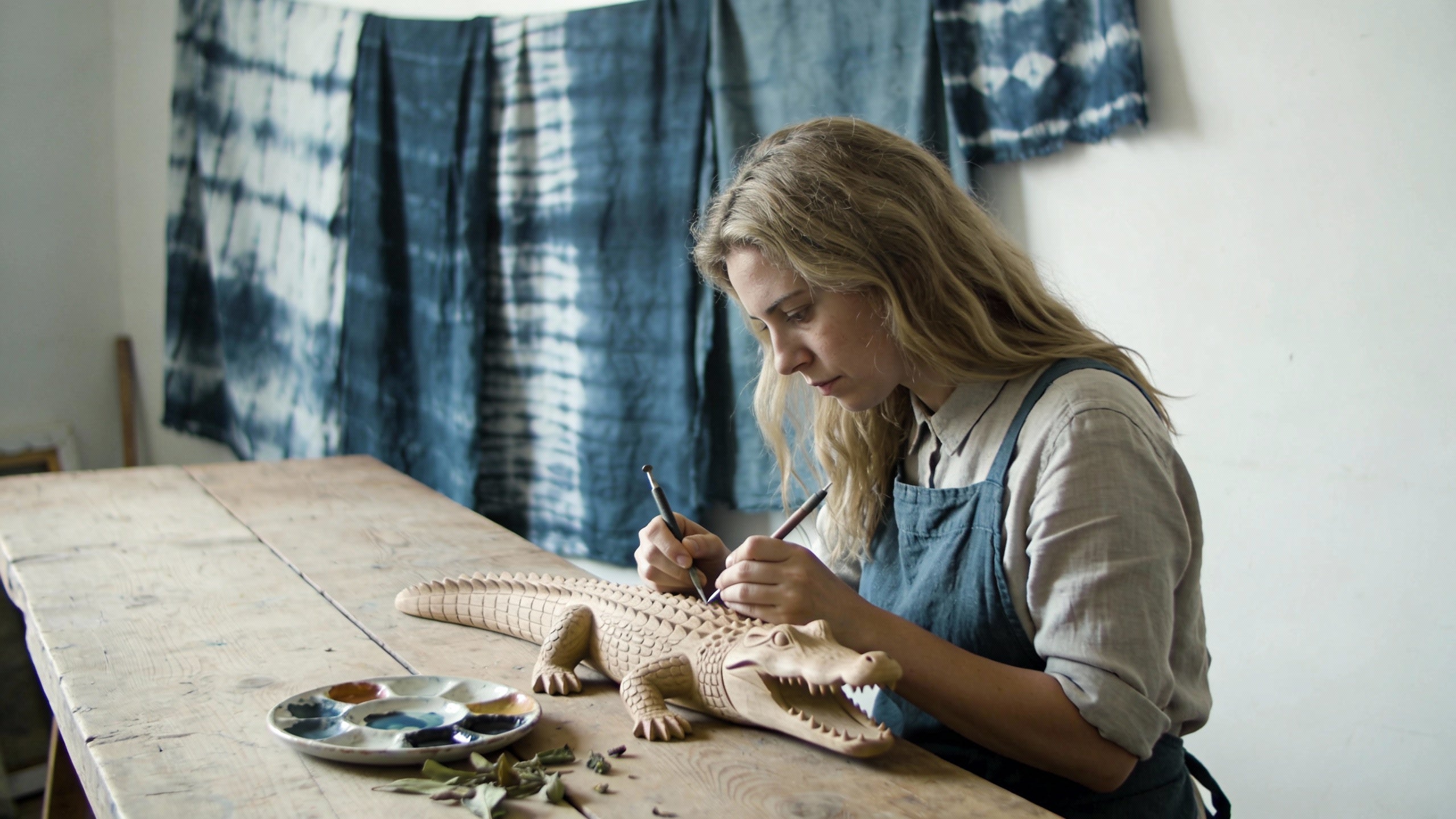
The crocodile is a powerful example. Ecological reports from EBSCO and WorldAtlas note that crocodiles, manatees, hippos, and otters still inhabit the river and its wetlands, though heavy hunting has pushed some close to local extinction. Carving these creatures is not only a nod to local fauna. For many Gambians, they embody strength, danger, protection, and deep-time continuity. A carved crocodile bowl gifted to a new household can be read as a wish for resilience and watchful guardianship.
Another motif weaving through contemporary craft is Ninki Nanka, the mythical dragon said to live in the river’s creeks. The TUI Care Foundation describes how Ninki Nanka stories, songs, and visual images are being documented and reimagined for tourism products along the Ninki Nanka Trail. Artisans design masks, textiles, and toys with winding serpent forms, horned dragon heads, and swirling water patterns that children instantly recognize from bedtime tales.
These motifs carry emotional messages. Ninki Nanka can represent both fear of the unknown and the thrill of adventure, making Ninki Nanka-themed gifts particularly popular with younger travelers or families marking a bold life transition. River boats and pirogues, often painted or carved in miniature, speak to journeys, crossings, and safe arrivals. That is why a small carved canoe can be a quietly perfect present for someone immigrating, graduating, or starting a new business.
The beauty of Gambian design is that even within recurring motifs, each artisan’s hand is visible. AccessGambia notes that many large wood carvings in markets like Brikama are made by Fulani and Bambara carvers, some towering over 4 ft with detailed scarification. No two crocodiles stare back at you with exactly the same expression. That uniqueness is what allows you, as a giver, to match a specific story to a specific person.

Materials Drawn From River Landscapes
The emotional pull of river-themed crafts also comes from the materials themselves. Much of what you hold in your hands once grew along a bolong, lay buried in a riverbank, or floated as a gourd on muddy water.
Pottery is perhaps the most direct expression of river earth becoming art. Archaeological notes compiled in AccessGambia suggest that the Senegambia region has over 6,000 years of pottery history, with Mandinka, Jola, and especially Serahule women in places like Basse and the nearby village of Alohungari renowned for their clay work. They dig a fine kaolin-rich earth, locally called dar, from fields and riverbanks, shape it by hand without a potter’s wheel, and fire it in shallow pits.
These pots become water jars, grain storage containers called buntungo, colanders, cooking pots, and incense burners. When you pour cool water from a terracotta jar into a cup, you are literally tasting how riverine clay, shaped and tempered, can hold and refresh life. That practicality is part of the emotional story: gifts that are both beautiful and useful tend to be cherished longer.
Calabash and gourds form another material bridge between river and home. As AccessGambia explains, larger gourds called leket are soaked until the insides rot, then sun-dried and hardened. The shells become ladles, spoons, and containers, and are even used in making the kora, the 21-string harp-lute played by griots. Here, river water both cures the material and inspires the music. Gifting a carved or pyro-etched calabash bowl is a way of honoring daily rituals of cooking, music, and hospitality.
Baskets woven from dried palm leaves, often by craftspeople from neighboring Senegal, carry the textures of mangrove and wetland landscapes described in environmental briefs from The Gambia’s environment ministry. Wetlands like the Bao Bolon Wetland Reserve, which lies opposite Kiang West National Park, join estuary, mangrove forest, salt marsh, and savannah in one braided system. Communities harvest thatch and fencing materials there, and it is easy to imagine how some of that fiber becomes the hand fans, lampshades, and fruit bowls that line craft market stalls.
Even the presence of protected areas shapes material choices. Official data from The Gambia’s environment authorities note that about 23 protected areas cover roughly 94,700 hectares, or about 235,000 acres, around 8.6 percent of the country’s land. That framework encourages more sustainable harvesting and community-based conservation, so when you choose river-themed crafts made from plant fibers or wood, you can ask how and where they were sourced. The answer often reveals another layer of relationship between makers and the landscapes that sustain them.

River-Themed Textiles and the Feel of Flow
If wood and clay give river crafts their structure, textiles give them movement. The flow of dye into fabric can echo currents and tides as vividly as any painted scene.
Gambian tie-dye and batik, described in both AccessGambia and the story of artisan Musa Jtte, are known for rich color and intricate patterning. Traditionally, local women produce these fabrics at home, using oil drums, hot dye, binding techniques, and wax-resist methods to create abstract waves, fish, plants, and human figures. Cloth is tailored into men’s kaftans (haftans), women’s flowing gowns called warambas or grandmubas, and household textiles like bed sheets and tablecloths.
Musa’s practice, as documented in a recent film project, brings this tradition into sharp focus. He works in Sukuta with natural dyes: orange tones from kola nuts, blues from indigo leaves strengthened with roots and an alkaline ash called say. He ties cloth in tritik patterns that resist dye and stamps wax designs with more than two hundred carved wooden blocks. Each dip in the dye bath and each rinse in water must be timed so the indigo oxidizes evenly, much like waiting for a tide to turn.
For many buyers, the emotional connection lies in this process as much as the finished look. Knowing that the orange of a scarf comes from kola nuts, an important ceremonial gift in West African culture, adds depth to any celebration where you present it. Indigo, with its deep river-like blue, often becomes a symbol of calm, resilience, or spiritual grounding.
There are practical tradeoffs. Natural dyes demand more labor, offer subtler color fastness, and can limit volume. Chemical dyes, which became common from the 1960s as tourism surged, are cheaper and easier, and can produce very bright multi-color effects. Yet artisans like Musa deliberately stick to natural methods because of health concerns and a desire for cultural authenticity. If you value that integrity, asking about the dye process and being willing to pay accordingly becomes part of your gifting ethics.
When you choose a river-themed textile, look at the movement of pattern as if it were water. Does it feel like bolongs threading through mangroves, tide lines on a beach, or the ripples of a ferry wake? Matching that feeling to the person you are gifting—someone adventurous, someone contemplative, someone in transition—turns the cloth into a narrative rather than merely a color choice.

River Crafts, Roots Tourism, and Healing
Many of the most emotionally charged river-themed crafts are bought during journeys of return. Studies of African American tourism to the River Gambia, particularly in Études Africaines, show travelers visiting Juffureh, walking through the slavery museum in Albreda, crossing to Kunta Kinteh Island, and then browsing arts and crafts markets set up with advice from Gambian cultural authorities.
In some cases, visitors participate in more immersive experiences. One documented example involved a group of African American students spending a week in the Jola village of Medina, where they were symbolically adopted by families, dressed in local cloth, and guided through gendered training in cooking, domestic work, and ideals of respect. A final public rite proclaimed them “true” sons and daughters of Africa. While this took place away from the main river, its logic is similar to roots journeys on the Gambia River itself: ritual, storytelling, and crafted objects all work together to stitch a felt bond between people and place.
In Janjan Bureh, a historic town in The Gambia, the Kankurang ceremony described by the Jacob’s Pillow Griot Project shows masked figures in red bark fibers escorting boys through initiation and re-entry into the community. Drums, song, and costume create an aesthetic of protection and transformation. When visitors encounter masks, bark-fiber miniatures, or photographic prints of such rituals, the desire to take home a tangible piece of that experience is understandable.
The upside is clear. Heritage-focused crafts can provide critical income to communities that have endured economic shocks, from the 1994 coup’s impact on tourism to more recent global crises. Études Africaines notes how tourism once brought electricity and piped water to small river villages. Every ethically purchased carving or cloth can still help pay school fees or fund local projects.
The downside is more subtle. Heritage scholars caution that if rituals like Kankurang are staged primarily for tourists, or if slavery memory is simplified into a good-versus-evil script, community meanings can erode even as profits rise. A mask that is sacred in one context may become a mere decorative object in another. As a sentimental gift-giver, you can navigate this by asking craftspeople or guides what a motif means, when it is used, and how they feel about making it for sale. Listening more than speaking, as the Jacob’s Pillow project emphasizes, is a powerful form of respect.
Choosing River-Themed Gifts That Truly Honor The Gambia
With this emotional and historical backdrop, how do you actually choose a river-themed craft, either in The Gambia or from afar, that feels right for the occasion and the people involved?
One helpful way is to think about the relationship between material, river connection, and emotional theme. The following simple table offers a starting lens, based on details from AccessGambia, TUI Care Foundation, and environmental sources:
Craft material or motif |
River connection in The Gambia |
Common emotional themes in gifting |
Wood carvings of crocodiles, hippos, boats |
Drawn from river fauna and everyday transport along the Gambia River and its bolongs |
Protection, courage, safe journeys, resilience |
Calabash and gourds, kora-related pieces |
Grown and processed with water, used for utensils and music tied to river life |
Nourishment, storytelling, continuity of tradition |
Clay pots from riverbank kaolin |
Earth shaped and fired to store water and grains in riverine communities |
Grounding, homebuilding, long-term care |
Indigo and kola tie-dye textiles |
Natural dyes processed with water, patterns echoing waves and currents |
Transformation, healing, calm strength, celebration |
Ninki Nanka and other mythic designs |
Folklore about a river-dwelling dragon used in community tourism projects |
Adventure, facing fears, imaginative play for children |
In practical terms, you can look for three things.
First, authenticity of process and story. Ask how the piece was made, what the materials are, and what the motif means to the maker. My Gambia’s editorial mission, for instance, is to highlight products truly “made in and for The Gambia,” and the Ninki Nanka Trail project invests in training artisans on storytelling and sustainable production. When a craftsperson can tell you exactly where their wood came from or which ancestor taught them a design, you are on solid ground.
Second, community benefit. Tourism provides roughly a sixth to a fifth of The Gambia’s income, according to both TUI Care Foundation and economic explainers, in an economy valued at around $2.9 billion. That means somewhere in the ballpark of 580 million each year depends on visitors. A small slice of that is arts and crafts. Buying directly from river communities, women’s groups, or incubator spaces along the Ninki Nanka Trail keeps more value where the stories originate.
Third, environmental care. The Gambia River remains one of West Africa’s last major undammed rivers, but a large hydropower project upstream, documented in environmental research summarized by EBSCO and WorldAtlas, could alter sediment flows, salinity, and mangroves. At the same time, a scientific expedition by the Tara Oceans Mission Microbiomes team found microplastic pollution in the Gambia River, especially near cities, although at lower levels than in many European rivers. In that context, crafts made from responsibly harvested plant fibers, reclaimed wood, natural dyes, or upcycled materials carry an added layer of meaning. They hint at a future where the river is cherished, not exploited.
There are tradeoffs. Mass-produced souvenirs are cheaper and easier to find but rarely carry deep connections or fair pay. Highly authentic, labor-intensive pieces cost more and may be harder to transport. Shipping a 4 ft carved bust home might mean excess baggage charges, as AccessGambia wryly notes. Being intentional about budget and logistics before you shop helps you choose pieces you can truly honor once you bring them home.
River Crafts and the Future of Belonging
River-themed crafts in The Gambia are not nostalgic relics. They sit in the middle of living debates about development, identity, and belonging.
Government and international partners, including UNEP and UNESCO, frame community-based conservation and underwater heritage protection as part of a broader vision where rivers, mangroves, and submerged wrecks are not only ecological assets but also cultural anchors. National parks, Indigenous Community Conservation Areas, and new underwater archaeology teams all signal that Gambians are asserting stewardship over their watery past and future.
On the cultural side, initiatives like the Ninki Nanka Trail, My Gambia’s storytelling media, and the Roots Homecoming Festival along the river weave together tourism, entrepreneurship, and heritage. Training sessions for craftspeople, particularly women and youth, help them design products, manage microbusinesses, and market their work beyond a single tourist season. If over 150 participants receive around 30 trainings, as the TUI project reports, that is not just capacity building; it is an investment in generational pride.
As an artful gifting specialist, I often see these pieces as invitations. A carved Ninki Nanka mask invites a child to imagine brackish creeks where reality and legend merge. An indigo-and-kola scarf wraps a loved one in colors drawn from soil, leaf, and kola nut offerings. A clay water jar on a modern kitchen counter quietly remembers women who learned to shape riverbank clay without a wheel or kiln thousands of years ago.
When you choose, give, or display a Gambian river-themed craft, you are participating in these unfolding stories. You are helping keep a last undammed river visible in a world of dams and plastic, honoring communities that turned centuries of upheaval into music and pattern, and saying that handcrafted memory still matters.
In a world where so many gifts are forgotten within weeks, a piece that carries the murmur of a river and the handprint of its maker can become a lifelong companion. May the next Gambian river craft you choose do just that—for you, and for the people whose stories it holds.
References
- https://en.wikipedia.org/wiki/Gambia_River
- https://pmc.ncbi.nlm.nih.gov/articles/PMC8847506/
- https://www.journals.uchicago.edu/doi/full/10.1086/710132
- https://www.smcm.edu/gambia/wp-content/uploads/sites/31/2014/11/friendship4.pdf
- https://kids.britannica.com/students/article/The-Gambia/274481
- https://www.gamembank.org/monuments-and-sites/
- https://heritagemanagement.org/the-signifacance-of-kunta-kinteh-island-and-related-sites/
- https://journals.openedition.org/etudesafricaines/18780
- https://www.unesco.org/en/articles/gambia-sets-sail-recognition-its-underwater-cultural-heritage
- https://www.jacobspillow.org/picks/our-favorites/between-tradition-and-modernity-exploring-cultural-landscapes-in-senegal-and-the-gambia/
