

The Boldness of Computer-Generated Pop Art Styles Explained
Computer-generated Pop Art has a way of walking into a room before you do. It shouts in color, hums with nostalgia, and somehow makes an everyday snapshot feel larger than life. For sentimental gift-givers and creative makers, this bold style is not just a visual trend; it is a powerful way to turn ordinary memories into modern heirlooms.
In this guide, we will explore what makes computer-generated Pop Art so striking, how it connects to the 1950s and 1960s Pop Art movement, and what you should know if you want to use it for meaningful, personalized gifts. Along the way, I will draw on art history, digital art research, and current debates around AI-generated images to help you choose or create pieces that are not only stylish, but also thoughtful and ethically grounded.
From Soup Cans to Screens: Why Pop Art Has Always Been Bold
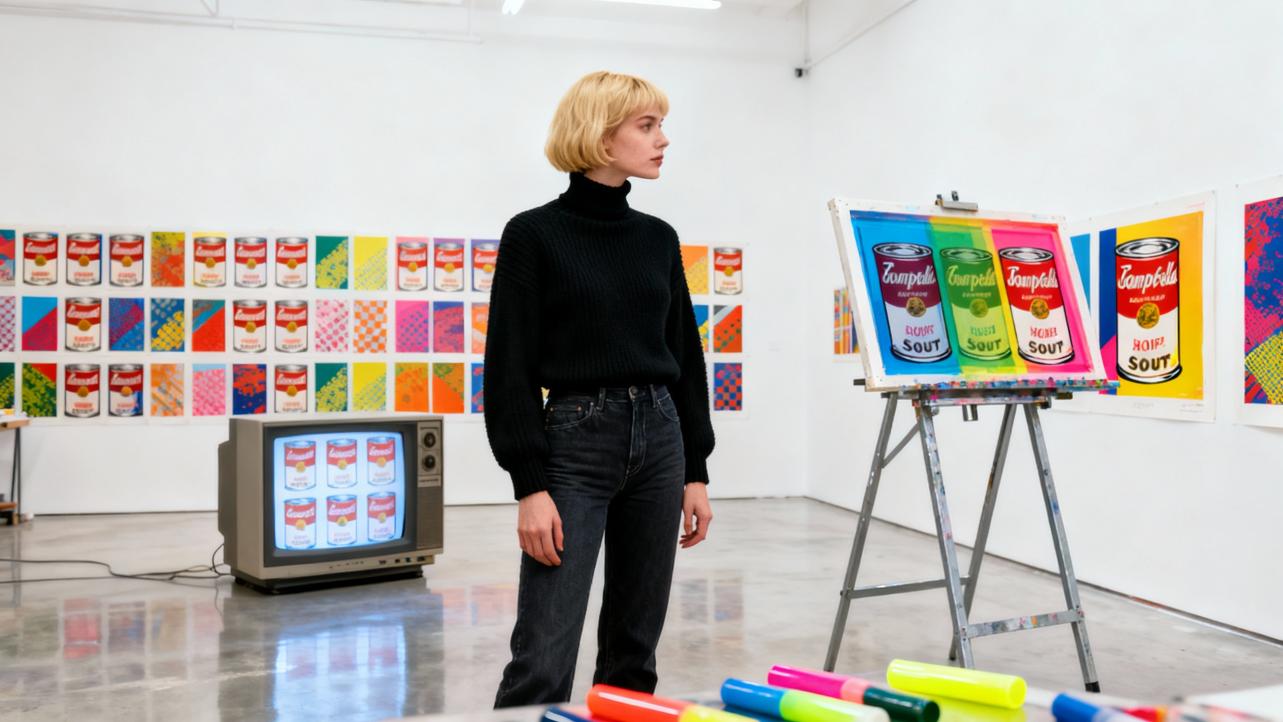
Pop Art began in the mid‑20th century as a radical response to traditional fine art. As histories from Creativity Art Gallery, Naturalist Gallery, and other art writers explain, artists in the 1950s and 1960s in the UK and US started pulling imagery straight from advertising, comics, product packaging, and celebrity photos. Andy Warhol silkscreened Campbell’s Soup Cans and Marilyn Monroe; Roy Lichtenstein painted comic panels with hand-drawn Ben-Day dots; Richard Hamilton collaged magazine cutouts into surreal domestic scenes.
This was bold in at least two ways. Visually, it traded subtle, painterly atmospheres for flat, bright colors and sharp outlines. Conceptually, it insisted that a soup can or a comic strip could be worthy of gallery walls, challenging the boundary between “high” art and everyday life.
Writers at Web Design Degree Center note that Pop Art color choices were deliberately artificial. Instead of chasing realism, artists picked hues that felt like glossy packaging or neon signage. Warhol’s repeated portraits varied mainly in their color schemes, turning celebrity faces into something as standardized as flavors on a shelf. That sense of repetition and mass-production was not an accident; it was the point.
ByKerwin’s analysis of Pop Art’s palette emphasizes how crucial color was to this movement. Pop artists leaned on saturated primary colors like red, blue, and yellow, plus strong black outlines and high-contrast pairings. These choices made images instantly legible and emotionally loud, echoing the look of supermarket packaging and mid-century print advertising. Artists also used complementary pairs, such as blues next to oranges or reds near greens, to create a visual “clash” that mirrored the tensions of consumer culture and individual identity.
The result was a language of color and form that felt fun, democratic, and a little bit confrontational. Pop Art said, “Look closer at what you see every day. Your cereal box and your movie posters are already telling the story of your era.”

What Counts as Computer-Generated Pop Art Today?
To understand today’s bold digital Pop Art gifts, it helps to distinguish a few overlapping practices: digital Pop Art, AI-assisted Pop Art, and fully AI-generated Pop Art.
Digital Pop Art as the New Canvas
Digital art has roots going back to early computer experiments in the 1960s, but the term gained traction in the 1980s. Writers for Artalistic and Eden Art explain that digital art simply means artwork created primarily with digital tools: tablets, styluses, software like Photoshop, Procreate, or Illustrator, 3D modeling apps, and so on. It still depends on core artistic skills such as composition, color theory, and perspective; the difference is the medium.
Applied to Pop Art, digital tools become a new canvas for classic Pop strategies. According to Naturalist Gallery and Home Art Haven, we now live in a kind of “Pop Art 2.0.” Contemporary digital Pop artists still use saturated colors, repetition, and familiar commercial imagery, but they do it through illustration software, animation, and screen-native formats. Some print their work on canvas or posters; others keep it purely digital, showing it on screens or selling it as NFTs.
The benefits of digital art, as outlined by Printumo, Foxylab, Gelato, and Eden Art, include flexible editing, undo buttons, layers, quick color changes, and easy duplication. For someone designing a Pop Art gift, that means you can test five different color schemes for your friend’s portrait without wasting paint, or resize a design for both a wall print and a mug without redrawing it.
AI-Generated and AI-Assisted Pop Art
There is another, newer layer on top of digital tools: generative AI. Models such as Midjourney, DALL·E, and Stable Diffusion, discussed by philosophers on Aesthetics for Birds and researchers in Response Journal, can create images in response to text prompts. They can mimic the look of Pop Art, apply bright comic-book palettes to your photos, or remix brand-like icons into new compositions.
Some creators treat these tools like a camera or paintbrush: a means to an end that still requires human choice and direction. Research from Response Journal describes artists spending months refining prompts, inventing new descriptive phrases, tuning parameters, and even training custom models. AI is the engine, but the human is still steering: choosing themes, deciding which outputs to keep, and possibly hand-editing the final image.
Others lean on more automated photo-to-Pop-Art effects, such as those described by BeFunky. In those tools, you upload a photo, pick a Pop Art filter designed by artists, and adjust sliders until it feels right. The software analyzes the image and applies stylized color blocks and outlines, allowing you to transform a pet portrait or selfie into something that looks like a comic-book panel in seconds.
Researchers at Aesthetics for Birds argue that, philosophically, these AI-driven processes fit into a long tradition of art that recombines existing cultural materials, much like collage, readymades, and Pop Art itself. Think of Duchamp’s Fountain or Warhol’s use of commercial photography: the artist did not invent the urinal or the publicity shot; they reframed it conceptually. In the same way, AI artists work within a sea of prior images, but still make meaningful choices about prompts, selection, and context.

Why Computer-Generated Pop Art Feels So Bold
When you see a computer-generated Pop Art piece, its boldness typically comes from three intertwined layers: visual impact, conceptual friction, and emotional resonance.
Visual Boldness: Color, Contrast, and Clarity
The first hit is purely visual. Pop Art has always embraced color that does not apologize for itself, and digital tools only deepen this. Writers at ByKerwin and Creativity Art Gallery emphasize the use of saturated primaries, flat areas of tone, and sharp, graphic outlines. Add to that the flexibility of digital palettes and the precision of software-based gradients, and you have images that are both retro and razor-clean.
Color theory guidance from Escapemotions helps explain why some computer-generated Pop Art feels especially “poppy.” Boldness is not just about choosing intense hues; it is about contrast in value (dark versus light) and temperature (warm versus cool). High contrast between near-black shadows and bright highlights, plus strategic use of grays as a “bridge” between colors, makes neon accents feel even more electric. Many digital Pop artists or filter designers build this logic into their tools, so a single slider can shift your portrait from quiet to eye-catching.
Repetition adds another layer. As Creativity Art Gallery and Web Design Degree Center point out, Pop Art often repeats logos, faces, or product shapes across a canvas. In digital environments, repetition is trivial to achieve and endlessly modifiable. A row of four identically posed family portraits, each recolored in a different intense palette, immediately references Warhol while still celebrating your specific story.
Conceptual Boldness: Everyday Icons and Machine Collaboration
Pop Art has always been fearless about treating everyday objects as worthy subjects. According to historical accounts summarized on Quora and Penley Art Co, Hamilton, Warhol, and Lichtenstein used vacuum cleaners, soup cans, comic heroes, and movie stars to probe consumerism and mass media. That conceptual move felt daring in the 1950s and 1960s; today, computer-generated Pop Art extends it to smartphones, selfies, streaming icons, and social media memes.
Generative AI adds a provocative twist. Scholars in Response Journal and on Aesthetics for Birds argue that AI art belongs to a broader category of generative art, where an autonomous system follows rules or algorithms to contribute to the final result. Past examples include instruction-based wall drawings, pendulum painting, and chance-based compositions. AI is new in power and scale, but not in principle.
This raises questions that can make an AI Pop Art gift feel bolder than its analog cousins. You are not just giving a portrait; you are giving a small collaboration between a human prompt and a vast, invisible machine trained on countless images. Critics worry, as BBC Future and legal rulings in the United States note, about authorship, effort, originality, and copyright. Supporters see the medium as an extension of collage and remix. Either way, your print carries the energy of an ongoing cultural debate.
Emotional Boldness: Turning Memories into Icons
Despite all the theory, the boldest thing you can do with computer-generated Pop Art is personal: treating your own memories like they belong in a gallery.
Digital art writers at Printumo, Gelato, and Eden Art emphasize how easy it is to duplicate and scale digital files. That means a single Pop Art design can become a wall canvas, a set of coasters, a notebook cover, and a phone case. If you choose a deeply meaningful image—a parent’s favorite car, a couple’s wedding bouquet, a grandparent’s handwriting—the repetition becomes a tender motif rather than mere decoration.
When you use an AI or photo-to-Pop-Art filter on a beloved photo, you implicitly say, “This is iconic to me.” The bold colors help the memory stand up to everyday visual noise: kitchen counters, screens, and shelves. The style transforms a simple snapshot into a sentimental centerpiece, especially when you combine the digital print with handmade touches like customized frames, hand-written notes on the back, or layered mixed media.

Computer-Generated Pop Art vs Traditional Pop Art for Gifts
For sentimental gifts, both traditional handmade Pop Art and computer-generated Pop Art have strengths and challenges. Drawing on comparisons from Foxylab, Printumo, Gelato, Eden Art, and Artalistic, here is a concise way to think about them.
Aspect |
Traditional handmade Pop Art |
Computer-generated Pop Art |
Medium and process |
Paint, collage, silkscreen, mixed media; tactile, slower, often messy, with drying time and physical setup. |
Software, tablets, AI tools, photo filters; fast iterations, clean workflow, easy to edit and undo. |
Uniqueness |
Usually one-of-a-kind; visible brushstrokes, texture, and traces of the artist’s hand; highly prized by collectors. |
Files can be duplicated endlessly; prints can be produced on many surfaces; uniqueness comes from personalization rather than physical singularity. |
Accessibility for creators |
Entry can be low-cost (pencil and paper), but materials add up and need storage space. |
Equipment and software can be costly at first; once set up, experimentation is inexpensive and space-efficient. |
Flexibility and revision |
Mistakes can be hard or impossible to fully correct; changes may leave physical traces. |
Quick revisions with layers and undo; easy to try multiple colorways or compositions before committing. |
Distribution and gifting |
Physical works require framing, shipping, and careful storage; each gift is a single object. |
Digital files can be printed via online services, shared instantly, or adapted to multiple gift formats and sizes. |
Perceived authenticity |
Often seen as more “authentic” due to physical presence and labor-intensive methods. |
Sometimes perceived as less “authentic,” but research stresses that digital and AI art still rely on artistic decisions and can be just as expressive. |
There is no single better choice. Researchers and practitioners across these sources consistently conclude that traditional and digital art are complementary. For sentimental gifting, the sweet spot is often a thoughtful blend: a digitally created or AI-assisted Pop Art image, printed on a beautiful surface, then finished, framed, or gifted with artisanal care.

How to Choose or Design a Computer-Generated Pop Art Gift
If you are considering a computer-generated Pop Art piece for a birthday, anniversary, or housewarming, it helps to move step by step, not just drop a photo into a filter and hope for the best.
Start with the Story, Not the Software
Every meaningful Pop Art gift begins with a story. Before you think about colors, the most helpful question to ask is, “What everyday image feels iconic in this relationship?” Pop Art historically honored the mundane: a soup can, a comic frame, a record cover. Similarly, the best custom pieces often come from humble sources such as a slightly blurry family snapshot, a favorite coffee mug, a beloved apartment building, or a pet’s lopsided grin.
Once you have the story, you can choose a reference image. BeFunky’s guidance for photo-to-Pop-Art tools highlights some useful criteria: clear subjects, good lighting, and minimal background clutter tend to translate best into clean, bold designs. Faces, pets, and simple objects respond especially well to strong outlines and flat color fields.
Decide How Much Control You Want
There is a spectrum of control from fully manual digital illustration to largely automated AI generation.
On one end, you or a commissioned artist can draw in a Pop Art style using tablets and software. Articles from Printumo and Foxylab emphasize that this route still calls for traditional skills in composition, anatomy, and color, even though the medium is digital. The advantage is precision: every dot and line is intentional.
In the middle, you might use photo-to-Pop-Art effects. According to BeFunky, these tools are designed by artists, then automatically analyze your photo and apply stylized filters. You still adjust and fine-tune, but you work within a curated aesthetic. This can be ideal if you want professional-looking results quickly.
On the far end, generative AI systems can create images from purely textual prompts or a mix of text and images. Scholars on Aesthetics for Birds and in Response Journal note that crafting effective prompts is itself a nontrivial skill, sometimes requiring knowledge of art history, photography terms, and generator behavior. If you enjoy wordplay and iteration, this can be a surprisingly creative process. The tradeoff is that AI tools may occasionally produce strange details or inconsistencies, which you may need to correct in other software.
Shape the Palette with Intention
Pop Art color choices are not only about brightness; they are about emotional tone. ByKerwin points out that primaries like red, blue, and yellow can feel energetic and optimistic, while complementary pairs lend drama. Escapemotions adds that contrast in value and temperature is key to making colors “pop.”
Think about the recipient. For a joyful celebration, you might favor high-contrast, saturated schemes with warm accents. For a more reflective gift, you could choose a limited palette with one or two bold notes, letting grays and softer tones carry the rest. Digital tools make it easy to test multiple versions; the art is in choosing the one that best mirrors the mood of the story you want to honor.
Add Handmade and Personal Touches
Even when the image is generated by software, the way you finish and present it can be deeply artisanal.
You might print the piece on textured paper or canvas, then add subtle hand embellishments with paint pens, gold leaf, or ink, echoing the mixed-media traditions described by Robert Lyn Nelson’s gallery. You could mount the print in a frame that references the recipient’s home colors, or insert a handwritten dedication on the back with the date and occasion. You might even pair the Pop Art print with a small physical object from the story it tells, such as a ticket stub, pressed flower, or recipe card, tucked into the frame or wrapped with the artwork.
In a world where digital art can be endlessly duplicated, these small gestures reintroduce tactility and uniqueness. They quietly say, “I did not just click; I cared.”
Ethical and Legal Questions Around AI Pop Art
As you explore AI-generated Pop Art, it is important to be aware of the larger conversations happening in the art world.
Philosophers and critics writing on Aesthetics for Birds observe that objections to AI art often echo earlier debates about photography: accusations that the machine is doing the work, that it makes art too easy, or that it merely copies. However, just as photographic art depends on human choices about framing, timing, and use, AI-generated images depend on prompts, curation, and context.
Definitions of art proposed by thinkers like Jerrold Levinson, Noël Carroll, and Arthur Danto, discussed in those philosophical essays, focus on intentions, art-historical context, and integration into the “artworld” of galleries, critics, and markets. By those standards, AI Pop Art that is created and presented as art, drawn from cultural imagery, and shown in galleries or online exhibitions does count as art.
At the same time, the ethical and legal landscape is complex. The Aesthetics for Birds article and Response Journal highlight concerns including biased training data, cultural appropriation in virtual avatars, and unsettled copyright law. In the United States, for example, some rulings have denied copyright protection to works entirely generated by non-human systems, while a graphic novel creator who used AI images but shaped the overall work did receive copyright for the book as a whole. An Oxford Internet Institute report cited in Response Journal concludes that AI tends to augment rather than fully automate creative labor, but the legal specifics continue to evolve.
For a personal gift, you may not be navigating courts or licensing, but it is still thoughtful to ask a few questions. You might consider whether your chosen tool allows you to control how your images are stored and used, as BeFunky emphasizes in its privacy policies. You might seek AI platforms that are transparent about training data and respect living artists’ rights, especially if the style you are using closely mimics identifiable contemporary painters or illustrators. You might also be open with your recipient about how the image was created, inviting conversation rather than masking the process.
Ultimately, boldness here is not only about color; it is about using new tools with clear eyes and a grounded conscience.
FAQ: Making Sense of Computer-Generated Pop Art Gifts
Is computer-generated Pop Art “real art” for a meaningful gift?
Philosophers and critics writing for Aesthetics for Birds, as well as researchers in Response Journal, argue that AI-assisted and digital works fit comfortably within existing definitions of art, especially when a human creator has clear intentions and makes meaningful decisions. Historically, art movements like collage, readymades, and Pop Art already relied on repurposing existing images or using machines and industrial processes. Generative AI continues that lineage. For a gift, what matters most is the sincerity of your intention and the care you put into choosing or shaping the image, not whether the tool was a brush, a tablet, or an algorithm.
Will a digital or AI Pop Art print feel less special than a hand-painted piece?
Studies of traditional versus digital art from Artalistic, Eden Art, Foxylab, and Gelato show that people often perceive physical, one-of-a-kind works as more “authentic,” partly because of visible brushstrokes, texture, and the knowledge that there is only one. Digital art, however, shines in personalization, flexibility, and reach. If you select a deeply personal subject, guide the style thoughtfully, print it with care, and add even small handmade touches, a computer-generated Pop Art piece can feel every bit as special as a painting. Its magic lies in how precisely it reflects the recipient’s story.
If I use an AI tool, who owns the art?
Legal experts and courts are still working this out, and the research summarized in Aesthetics for Birds and Response Journal underscores that copyright law has not fully caught up with generative AI. Some decisions have denied protection to works produced without human authorship, while others have recognized the human’s creative contribution when AI is just one part of a larger process. For personal gifting, the most practical step is to read your chosen platform’s terms of use so you understand how the images can be stored, shared, or commercialized, and to treat AI as a tool that supports your creativity rather than a replacement for it. If you plan to sell or license the artwork widely, consulting legal guidance is wise.
A Heartfelt Closing
Computer-generated Pop Art sits at a beautiful crossroads: between gallery history and everyday life, between bright spectacle and quiet emotion, between the speed of digital tools and the tenderness of handmade finishing touches. When you choose or create a Pop Art piece for someone you love, you are not just picking a style; you are declaring that their ordinary moments are worthy of bold, joyful celebration.
If you let the story come first, use color with intention, and add your own personal care to the final piece, even the most high-tech Pop Art print can become what every great gift aspires to be: a small, lasting witness to how deeply you see and cherish someone’s world.
References
- https://keboto.org/how-digital-art-influences-pop-culture?srsltid=AfmBOopPSn7oPEIB8MioJSqSRcln6qP5wMSkhSboxy2GGy7-kM5NY6h1
- https://www.creativityartgallery.org/pop-art-guide-techniques-history-artists/
- https://www.webdesigndegreecenter.org/art-influences-design-pop-art/
- https://drpress.org/ojs/index.php/EHSS/article/download/2732/2629/2682
- https://responsejournal.net/issue/2024-06/article/beyond-novelty-unveiling
- https://blog.printumo.com/traditional-art-vs.-digital-art
- https://bykerwin.com/which-colours-are-used-in-pop-art-pop-arts-bright-palette/
- https://www.edenart.com/news/traditional-art-vs-digital-art
- https://www.escapemotions.com/blog/make-your-artwork-pop
- https://foxylabny.com/traditional-vs-digital-art-explained-pros-cons/
