

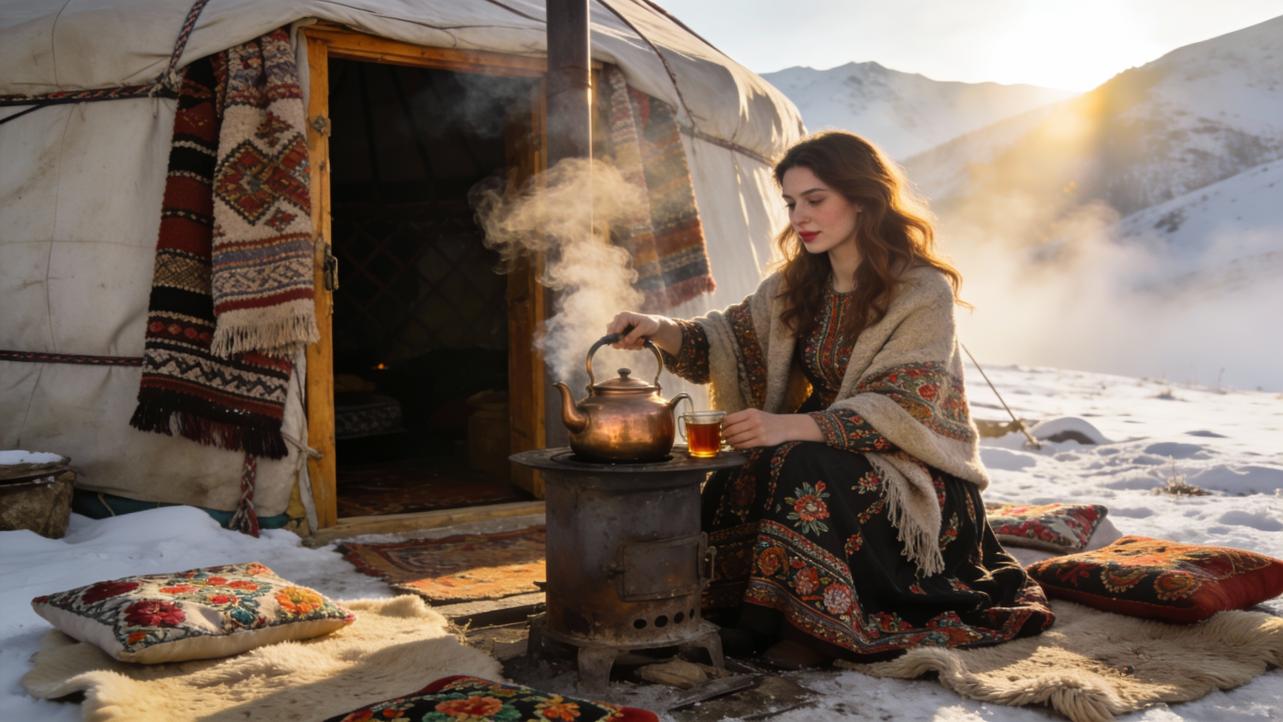
Woven Hearths: The Cultural Significance of Customized Yurt Patterns for Kyrgyz People
Stepping into a Kyrgyz yurt for the first time, you rarely notice just one thing. The air is warm from the central hearth, the light falls through the round opening in the roof, and everywhere your eyes land, there are patterns. Horns curling in felt. Spirals rippling across carpets. Bold borders hugging the lattice walls.
As an artful gifting specialist, I am drawn to these interiors the way some people are drawn to jewelry counters. Every band, carpet, and carved line is a design choice. But in a Kyrgyz yurt, design is never “just décor.” It is memory, protection, prayer, and pride, all stitched into a portable home.
For anyone who loves meaningful handmade gifts or is dreaming up a customized, yurt-inspired piece, understanding these patterns is the key to using them with both beauty and respect.
The Kyrgyz Yurt as a Sacred Canvas
Ethnographers often describe the Kyrgyz yurt, or “boz uy” (literally “gray home”), as a holy dwelling and a microcosm of Kyrgyz culture. Garland Magazine, drawing on the expertise of Kyrgyz craft educator Kulum Shamievna, notes that it has sheltered nomads for thousands of years, keeping them cool in summer and warm in winter. UNESCO recognizes Kyrgyz and Kazakh yurts as part of the Intangible Cultural Heritage of Humanity, not only for their engineering, but for the traditional knowledge and symbolism woven through every component.
A Kyrgyz yurt is a round, collapsible structure made from a wooden lattice wall called kerege, curved roof poles known as uuk, and a circular roof ring, the tunduk. Felt covers made from sheep’s wool wrap the walls and roof. A medium yurt may span roughly 20 to 33 ft in diameter and rise well over 13 ft high, yet it can be assembled in under an hour by an experienced group and dismantled in even less, as language learners in Kyrgyzstan have documented during field builds near Lake Issyk-Kul.
Inside, the space is meticulously organized. The door frames the threshold between outside and inside worlds. Opposite it, on the place of honor called the tor, stand stacked chests, patterned felt carpets, and neatly folded blankets. The right side is traditionally associated with the women’s domain, with cooking tools and textiles. The left belongs to men, with saddles, harnesses, and gear for hunting and herding. The center under the tunduk holds the hearth, the kolomto, where a stove or open fire burns and families share meals.
Now imagine this architecture without its patterns. Structural, yes. But stripped of soul. It is the bands, rugs, carved flourishes, and painted motifs that transform a practical shelter into a living archive of a family’s identity.
Structure Held Together by Pattern
In a Kyrgyz yurt, pattern is not only decorative; it literally holds the house together. Woven straps called boo are looped around the kerege walls and over the roof poles. They act as tension bands that keep the frame stable against high mountain winds. Garland Magazine describes different types of these straps: kanat boo around the wall sections, uzuk boo along the roof covering, tuurduk boo securing the wall felt, and others.
These straps are not plain. Women weave them on a narrow loom called an ormok, using geometric and horn-like motifs in bold color contrasts. UNESCO’s documentation of yurt-making emphasizes that women are responsible for most of the coverings and decorations, and that their ornamented bands are both functional and symbolic.
If you picture a medium yurt with, say, eight wall sections, each section might need a strap that runs nearly 10 ft to wrap and bind it properly. That is about 80 ft of patterned band just along the base, before you even count the horizontal ties and roof straps. Every inch is an opportunity to encode meaning.
In a gifting context, this is a powerful insight. A yurt-inspired wall hanging that borrows the layout of these bands is not simply “striped.” It is echoing the way Kyrgyz families literally bind their homes together with color and pattern.

What Kyrgyz Yurt Patterns Really Say
Across Central Asia, ornament is often described as a visual language. Kalpak Travel notes that there are roughly two hundred basic elements that combine into thousands of patterns, most drawn from nature and early spiritual symbols. For the Kyrgyz, these motifs are not random graphics to “pretty up” a surface. They are shorthand for wishes: for strength, fertility, safe travels, or the protection of children.
Nature in Wool: Horns, Mountains, and Sky
One of the most iconic motifs in Kyrgyz and Kazakh design is the horn pattern, inspired by sheep, goats, and deer. In Kazakh, it is known as “koshkar muyiz,” the ram’s horn, and Kalpak Travel describes it as a symbol of strength, prosperity, and continuity. Kyrgyz sources echo this reading: ichlinks, a Central Asian cultural archive, classifies the ram’s horn as a key prosperity motif that repeats throughout household objects and yurt interiors.
You will see horn-like curls along shyrdak felt rugs, in carved doorframes, and on the bands that circle the yurt walls. West Marin Review, writing about Kyrgyz felt traditions, notes that these spirals and curls frequently stand for animal horns and embody wishes for courage and abundance. In a pastoral society where large-horned animals mean more meat, wool, and hides, it makes sense that the very shape of a horn becomes shorthand for a thriving herd and thriving family.
A real-world example of this meaning appears in wedding dowries. Selvedge, in a deep dive on Kyrgyz shyrdaks and ala-kiyiz rugs, describes how the groom’s family traditionally provides the yurt’s wooden frame, while the bride’s family supplies the “soft” elements: wall hangings, rugs, and cushions. A shyrdak prepared for a young couple may repeat large horn motifs in bold reds and greens, signaling the family’s wish for robust prosperity and strength in the marriage.
When you borrow horn patterns for a customized gift—say, a hand-felted cushion or a framed textile—think of them as more than decorative swirls. They are a Kyrgyz way of saying, “May you be strong, rooted, and provided for.”
Guardians in Geometry: Triangles, Rhombuses, and Protective Belts
Not all meaningful motifs are curving. Many are sharply geometric, especially triangles and rhombuses. World Quilts, in its discussion of Central Asian patchwork known as kurak, notes that black triangles on a white background were especially common in Kyrgyzstan and Tajikistan. These triangles are often called tumorcha or tumar, literally “little amulet.”
The tumar is a general good luck charm and, in many contexts, a symbol of feminine fertility. In textiles, a line of triangles might form a zigzag border, or a diamond may be created by joining several triangles together. World Quilts explains that black and white combinations were considered particularly powerful against the evil eye; some Tajik black and white patterns even carry names that translate as “making evil far away.”
Medium’s overview of Kyrgyz ornaments reinforces this protective reading. Triangles and diamond forms are linked to the idea of the tumar amulet and are deliberately placed on cradles, clothing, and yurt elements to shield the household from harm. Ichlinks further notes that continuous patterns can act as a “protective belt” around objects and spaces, encircling them with symbolic protection.
Imagine a Kyrgyz baby’s cradle cover with a border of repeating triangles. To an untrained eye, it might look simply modern or graphical. To a Kyrgyz grandmother, it reads as a ring of small guardians surrounding the child.
For personalized gifts, this makes geometric yurt patterns especially meaningful for pieces meant to protect or comfort: quilted baby blankets, entrance rugs for a new home, or wall hangings placed near a bed.
Cosmos in the Crown: The Tunduk and Sun Motifs
Look up inside a Kyrgyz yurt and you see the tunduk: the wooden crown that forms the smoke and light opening at the top. It is more than an architectural device. Folkways Today records a Kyzyl-Too yurt master describing the tunduk’s circular form, with four inner squares and twelve radiating beams, as representing the seasons and months and symbolizing friendship, strength, and togetherness.
This crown is so central that it appears on Kyrgyzstan’s national flag. The country’s tourism board explains that the flag shows a golden sun with forty rays, representing the forty tribes that formed the Kyrgyz people, enclosing a stylized tunduk. The sun signifies life, knowledge, and renewal, while the tunduk stands for the shared roof of the nation and the cyclical, interconnected nature of the universe. The red background, used in clothing and accessories as a protective color, evokes bravery, energy, and new beginnings.
West Marin Review adds another layer, describing how the tunduk’s cross pieces align with the “corners of the world,” making it not just a roof ring but a compass of belonging. Inside the yurt, the hearth directly beneath the tunduk marks the heart of the symbolic universe.
A circular wall artwork that echoes the tunduk’s structure—concentric circles with crossing lines—does not simply “look Kyrgyz.” It carries the message: “May your home be a sunlit center, holding family and world together.” For a housewarming or a wedding, that is a deeply resonant theme.
Key Motifs and Their Meanings
To keep the symbolic landscape approachable, it helps to see some of these motifs side by side.
Motif or symbol |
Where it appears around a yurt |
Core meaning in Kyrgyz culture |
Gift mood it supports |
Ram’s horn curls |
Shyrdak rugs, woven straps, carved wood |
Strength, prosperity, continuity of family and herd (Kalpak Travel, ichlinks, West Marin Review) |
Gifts wishing stability, success, and long-term growth |
Triangles and diamonds (tumar) |
Borders of textiles, kurak patchwork, cradle covers |
Protection, especially for women and children; good luck charms against the evil eye (World Quilts, Medium, ichlinks) |
Gifts for babies, travelers, or anyone starting something new |
Circular sun and tunduk forms |
Roof crown, national flag, sometimes center of rugs |
Family unity, shared roof, connection to universe and seasons (Folkways Today, Kyrgyz flag commentary, West Marin Review) |
Housewarming, weddings, “new chapter” life moments |
Spirals and waves |
Felt rugs, wall hangings, tassels |
Cyclical time, life’s motion, link between nature and cosmos (Selvedge, West Marin Review) |
Gifts marking transitions, healing, or creative journeys |
Floral and plant motifs (tulip, almond, branches) |
Carpets, clothing, yurt textiles |
Fertility, renewal, awakening, connection to roots (ichlinks, Kalpak Travel) |
Spring celebrations, new beginnings, reconnecting with heritage |

How Kyrgyz Families Personalize Their Yurts
Yurts across Kyrgyzstan share the same basic ingredients—wood frame, wool felt, woven bands—but no two are quite alike. Personalization happens through pattern choices, color palettes, and the stories families choose to foreground.
In the village of Kyzyl-Too near Lake Issyk-Kul, researchers recording oral histories found that yurt making is both trade and art. In the 1970s only a handful of masters worked there; by 2012, more than a hundred craftspeople in the village specialized in different stages of building and decorating yurts. Fathers often teach sons to shape wood and craft the tunduk, while mothers and daughters focus on felting, weaving, and band-making. That means the patterns inside a finished yurt carry the very literal fingerprints of several generations.
Selvedge describes the process of making shyrdak rugs as deeply communal. Men shear the sheep; women clean, dye, and lay out the wool; neighbors join to roll and stomp it into firm felt while singing and talking. Chinara Seidakhmatova, a scholar of Kyrgyz ornaments, interprets these rugs as “microcosms in felt” that hold family histories and ancestral messages.
Yurts also crystallize personal and family milestones. Folkways Today notes that Kyrgyz families were traditionally born, married, and mourned in yurts. Rich households sometimes maintained several: one for guests, another for a married son, a separate one for newlyweds, and a cooking yurt. In funeral rites, Nomads Life describes how all bright decorations are removed, leaving only plain felt carpets for mourners, and how men and women are laid out on their respective halves of the yurt. Patterns are added, covered, or taken away in rhythm with life.
For a couple starting their life together, customizing the patterns that fill their yurt is like choosing the vocabulary for their shared story. Perhaps the bride’s family emphasizes ram’s horn motifs, signaling a strong pastoral lineage, while the groom’s relatives favor plant motifs that speak of fertile land and gardens. The resulting layout—what hangs where, how high the chests are stacked, which colors dominate the tor—broadcasts both identity and aspiration.
If you are designing a yurt-inspired gift, you can borrow that same logic. Start by asking what chapter of the recipient’s story you are honoring: a new home, a baby, a graduation, a return to their roots. Then choose motifs and placements that echo the way Kyrgyz families quietly “edit” their yurts for each season of life.

From Mountain Pastures to Modern Gifts
Today, relatively few Kyrgyz families live year-round in yurts. Many have houses or apartments in villages and cities, while yurts are used as seasonal homes in the high pastures during summer, or as guest and tourism dwellings near lakes and mountain passes. Advantour notes that yurt camps now serve as important sites of cultural tourism, where visitors sleep under felt roofs and experience Kyrgyz hospitality in situ.
Yet the craft behind yurts and their patterns is anything but obsolete. Kyzyl-Too has become a regional center for yurt and felt making, exporting yurts to neighboring countries and receiving steadily growing flows of foreign visitors each summer. UNESCO’s inscription of Kyrgyz yurts, and of Kyrgyz felt rugs like shyrdaks and ala-kiyiz on its safeguarding lists, underlines how central these forms are to identity and how fragile they can be under pressure from industrial materials and mass tourism.
From a gifting perspective, you essentially face two broad pathways when you bring yurt patterns into your world: traditional textiles and contemporary interpretations.
Traditional Textiles: Depth, Responsibility, and Reward
Commissioning or purchasing a hand-felted Kyrgyz textile is not unlike adopting an heirloom. You are taking home a piece of a living tradition that depends on human hands, local sheep, and extensive apprenticeship. UNESCO and ichlinks both highlight how ornament knowledge is passed within families and community workshops, often from elder women to younger ones, with each motif carrying a name, origin story, and protective purpose.
The benefits of choosing an authentic piece are profound. The colors typically come from natural dyes or carefully selected industrial ones that reproduce the historic palette. The felt has a particular weight and warmth. The pattern language is consistent with local practice; a master craftswoman will not casually place a fertility motif in a position that would be culturally inappropriate. You are also directly supporting the people who keep this symbolic vocabulary alive.
There are tradeoffs. Genuine shyrdaks or yurt bands can be more expensive and slow to produce than printed textiles. They require thoughtful care: gentle beating rather than vigorous vacuuming, rotation away from direct sunlight, and protection from moths. If you imagine a generous wall hanging perhaps 6 ft long and a few feet wide, that is a considerable amount of hand-felted wool and weeks of work. But the emotional return—a gift that can realistically span generations—is equally considerable.
Contemporary Interpretations: Playful and Accessible, but Handle With Care
On the other side, modern designers across Central Asia and beyond are reimagining yurt patterns in new materials: printed cottons, laser-cut wood, graphic posters, jewelry, and digital design. Kalpak Travel notes that national ornaments have spread into logos and corporate design, becoming proud symbols in branding. This opens playful, more affordable possibilities: phone cases with tunduk motifs, notebooks with horn patterns, or throw pillows with stylized kurak triangles.
Medium’s analysis of Kyrgyz ornaments, however, offers a gentle warning. As motifs leave their original ritual context and enter worldwide markets, there is a risk that they become generic “ethnic decoration,” stripped of nuance. Protective symbols may end up casually mirrored or mixed in ways that clash with their traditional logic. Ichlinks emphasizes that for Kyrgyz people, patterns are treated as living beings that carry energy and information; without that understanding, it is easy to unintentionally trivialize what others hold sacred.
For gift-givers, the sweet spot is collaboration. Look for contemporary brands that work directly with Kyrgyz artisans or designers, credit traditional sources, and show awareness of motif meanings. A modern poster of a tunduk, designed by an artist from Bishkek and printed sustainably, bridges worlds much more gracefully than an anonymous factory item labeled simply “tribal design.”
A small practical calculation can help illustrate the difference. If a cushion cover is priced only a little higher than a mass-market item yet claims to be “hand-felted and embroidered in Kyrgyzstan,” ask yourself whether the labor, shipping, and materials could realistically fit that margin. Often, prices that feel almost too low are telling you the design is merely inspired by Kyrgyz motifs, not produced within the tradition.

Practical Guidance for Designing or Choosing Yurt-Inspired Gifts
Once you fall in love with Kyrgyz yurt patterns, it is tempting to sprinkle them everywhere. To keep your choices as thoughtful as they are beautiful, it helps to move slowly and intentionally.
Start with the Story You Want to Honor
Every meaningful gift begins with a moment. Is this a new home, a baby, a wedding, a recovery after a hard year, or a quiet thank-you? In Kyrgyz culture, major life events—from births and weddings to funerals—have long been held in yurts, as UNESCO and Folkways Today document. The yurt itself is a stage for transitions.
If you are marking a new home, for example, you might lean toward sun, tunduk, and horn motifs that speak of shared roof and resilience. For a new baby, protective triangles and gentle floral motifs may be more fitting, echoing traditional cradle covers. For a retirement gift, spirals and mountain-like shapes can evoke a life’s journey and the steady presence of nature.
Once you know the story, it is easier to decide which motifs belong in the design and which are best left for another occasion.
Match Motifs to Meaning, Not Just Aesthetics
Horn patterns naturally suit gifts for people taking on responsibility: a new parent, a small-business owner, or someone stepping into leadership. Their association with strength and prosperity gives them a grounded, supportive character.
Triangles, diamonds, and continuous zigzag “belts” are ideal for anything tied to protection and safe passage. A travel journal with a subtle tumar border, or a door mat that quietly repeats these shapes, borrows from age-old amulet logic.
Floral motifs, particularly tulips and other stylized blossoms described in ichlinks and Kalpak Travel, feel right for springtime, weddings, or any renewal moment. They hint at rebirth and the return of color after winter, much as tulips bloom on Kyrgyz high pastures when snow recedes.
Spirals and wave-like motifs, central to the interpretations shared in Selvedge, speak of cycles, healing, and the connection between earthly life and the broader cosmos. For someone undergoing change—moving countries, changing careers, or recovering after illness—these patterns can carry a quiet message: your path is part of a larger, meaningful flow.
Choose Colors with Care
Color in Kyrgyz and broader Central Asian ornament is never neutral. Kalpak Travel notes that the dominant palette in Kyrgyzstan’s high pastures often combines greens, reds, and blues, echoing grasslands dotted with red flowers under a wide sky. World Quilts adds that black and white combinations were historically treated as powerful protectors against the evil eye. Ichlinks associates red with vital force and protection, and yellow with wealth, ancestral spirits, and even specific healing properties.
If you are customizing a yurt-inspired design, think beyond “which colors match the sofa.” A predominance of red can signal energy, courage, and new beginnings; it is no coincidence that red backgrounds carry such weight on the Kyrgyz flag and in clothing meant for protection and good luck. Yellow or gold accents can gently call in well-being and gratitude for those who came before. Black and white contrasts can be used sparingly as a symbolic boundary or shield.
For a baby, you might choose a warm cream field accented with a few red and gold protective motifs rather than heavy black borders. For a bold, entrepreneurial friend, stronger reds and deep blues with horn motifs could echo the ambition of a highland sky and sturdy herd.
Partner with Kyrgyz Artisans Whenever Possible
Because yurt patterns are part of a living heritage, the most meaningful way to work with them is side by side with those who carry that heritage. Folkways Today’s account of Kyzyl-Too shows how targeted support for craftspeople and thoughtful tourism policies can transform yurt making into a sustainable rural industry. UNESCO likewise stresses how community-based groups, often led by women, keep weaving, felting, and embroidery skills alive.
When commissioning or purchasing a customized piece, look for signs of authentic connection. That may mean buying directly from a craft cooperative in Kyrgyzstan, choosing a gallery or online shop that names specific artisans and villages, or working with a designer who can explain the origins of their motifs. Respectful collaboration does more than avoid cultural appropriation; it helps ensure that Kyrgyz children and grandchildren have reasons to keep learning these designs.
Caring for Yurt-Inspired Pieces
Traditional Kyrgyz yurts are designed to endure harsh climates, with multiple layers of felt providing insulation against both heat and cold, as National Geographic and Advantour emphasize. That durability rests on natural fibers and patient maintenance, not on indestructible materials.
Treat felt and wool pieces gently. Shake or beat rugs outdoors rather than scrubbing them, rotate wall hangings occasionally to prevent uneven fading, and store off-season textiles in breathable bags with natural moth deterrents. For wooden items bearing yurt motifs—such as carved boxes or frames—avoid prolonged direct sunlight and extreme humidity swings.
Think of these pieces the way Kyrgyz families think of their yurts: portable hearths that reward attentive care with decades of companionship.

Respecting a Living Tradition
There is a delicate line between appreciation and appropriation, especially when working with sacred patterns. Medium’s commentary on Kyrgyz ornaments notes that modern commercialization can flatten complex symbols into generic visuals. Ichlinks warns that for Kyrgyz people, many motifs still have protective or ritual functions, even if some meanings have faded.
A simple way to stay on the right side of respect is to keep asking two quiet questions as you design or shop. First, “Do I understand, at least in broad strokes, what this motif traditionally means?” Second, “Who benefits from my use of it?” If the answer to the first is “no” and the answer to the second is “mainly a distant factory,” it may be wise to choose a different pattern or supplier.
By contrast, when you choose a piece whose maker can tell you, “These triangles are tumar amulets for your children,” or “These spirals carry our grandparents’ story of the river,” you are not merely decorating. You are participating in a conversation that spans centuries and landscapes.
Short FAQ
Can I meaningfully use Kyrgyz yurt patterns if I am not Kyrgyz?
Yes, as long as you approach them as someone entering another family’s home: with curiosity, humility, and care. Rely on sources like UNESCO, ichlinks, and Kyrgyz scholars to understand basic meanings, and whenever possible, source your pieces through Kyrgyz artisans or designers who wish to share this heritage with the world.
Is it okay to change traditional colors when I customize a design?
Soft adaptation is usually fine, especially in contemporary work, but try to keep the emotional logic of the palette. If a pattern is strongly associated with protection and uses striking black and white, diluting it to pastel gray might undermine its character. When in doubt, follow the guidance of the artisan you are working with; they know which elements are flexible and which feel essential.
How can I tell if a yurt-patterned gift is authentic or mass-produced?
Authentic pieces tend to come with stories: the name of the craftswoman, the region, the type of felt or wool, sometimes even the names of motifs. Mass-produced items often lack such detail and rely on vague labels like “tribal” or “ethnic.” If a seller can clearly explain the motifs and acknowledges Kyrgyz culture specifically, that is a good sign you are engaging with the tradition rather than just its surface.
In the end, customized yurt patterns are less about owning a slice of someone else’s culture and more about entering a relationship with it. When you choose a horn curl, a sun ring, or a little row of tumar triangles for a gift, you are weaving your own story into threads that long predate any of us. May the pieces you collect and commission carry that awareness, becoming small, portable hearths that warm the lives they touch.
References
- https://folklife.si.edu/magazine/women-artisans-central-asia-kyrgyzstan
- https://digitalcommons.unl.edu/cgi/viewcontent.cgi?article=1015&context=tsaconf
- https://www.academia.edu/figures/44446855/figure-6-drawing-of-the-kyrgyz-and-kazakh-yurt-several-long
- https://sites.nd.edu/sla2018/tag/traditional/
- https://education.nationalgeographic.org/resource/yurt/
- https://worldquilts.quiltstudy.org/centralasianstory/design/pattern
- https://www.selvedge.org/blogs/selvedge/microcosms-in-felt?srsltid=AfmBOopaA4MZUTW4x8F58Vu6kMgjMGtVexN6fb6NyuPTcTyfCoCH-4S4
- https://ich.unesco.org/en/RL/traditional-knowledge-and-skills-in-making-kyrgyz-and-kazakh-yurts-turkic-nomadic-dwellings-00998
- https://westmarinreview.org/volume-9/kyrgyzstan-yurts/
- https://www.pomoly.com/Exploring-the-Rich-History-and-Cultural-Significance-of-Yurts-Across-the-Globe-a712726.html?srsltid=AfmBOopfcdQTXtGonc1lBFvlUJWhnfamVPtM1jhjW8_jA_KiGUORqdGz
